Tradition / Region: Irish mythology
Alternative names: Clídna, Clionadh, Clíodna, Clíona, Cleena
Category: Deity, Ghost
The Myth
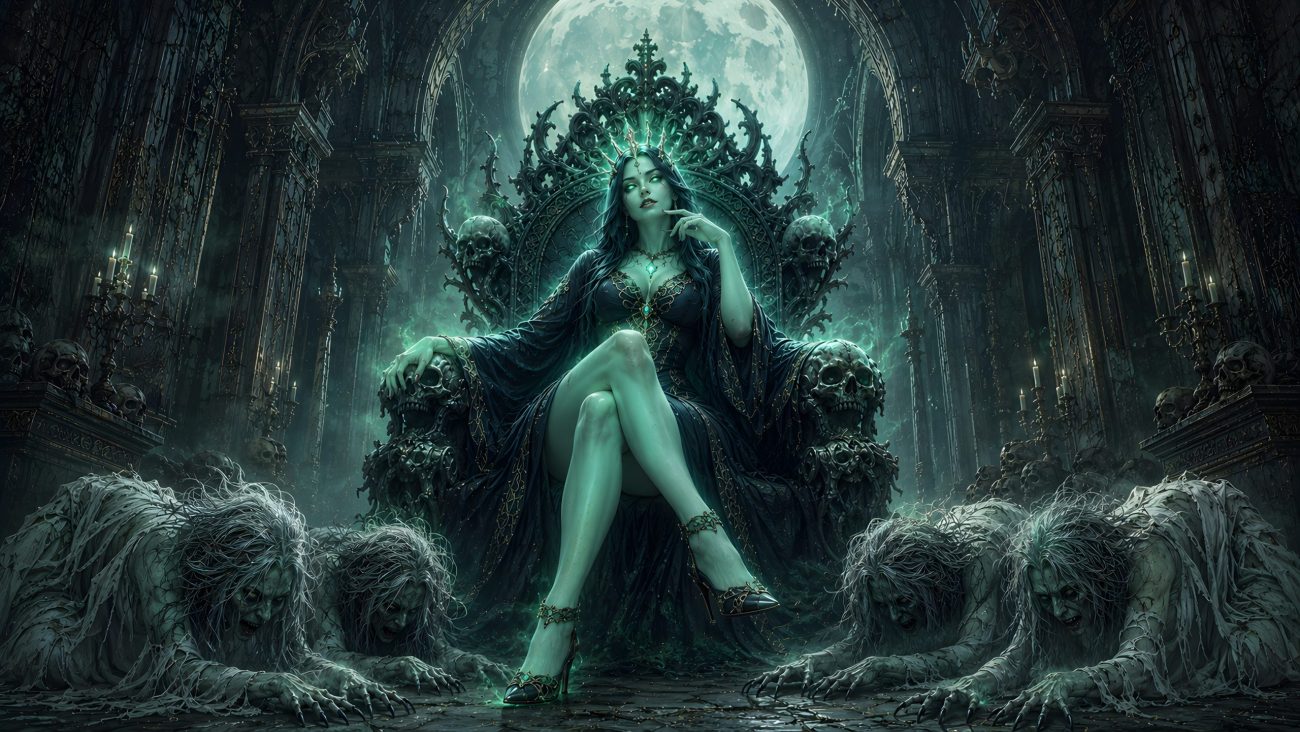
Clíodhna is one of the greatest fairy queens of Irish mythology and the legendary Queen of the Banshees. Counted among the Tuatha Dé Danann, she is celebrated as a goddess of love, beauty, and the Otherworld, while also serving as the powerful ruler of the sídhe (fairies) of South Munster. Her hidden palace lies beneath the rocky hill of Carrigcleena in County Cork, where Irish tradition says she continues to reign over her fairy court.
Among Clíodhna’s greatest wonders are her three brilliantly colored magical birds. Feeding upon apples from a sacred tree in the Otherworld, their sweet songs possess extraordinary healing powers, curing sickness, soothing sorrow, and lulling listeners into a deep enchanted sleep. Their music was said to be unlike anything heard in the mortal world.
One of her oldest legends tells of her love for the mortal prince Ciabhan, whom she met in the Otherworldly kingdom ruled by Manannán mac Lir. The two fled together to Ireland, hoping to live among humans. As Ciabhan went ashore to hunt, Clíodhna remained sleeping in their boat. The servants of Manannán pursued the lovers and enchanted Clíodhna into a magical sleep with supernatural music. A gigantic wave then swept her out to sea before she could escape. Ever afterward that wave became known as Tonn Chlíodhna (“Clíodhna’s Wave”), one of Ireland’s most famous mythological landmarks. Whether she drowned or simply returned to the Otherworld varies between traditions.
In another medieval tale, The Voyage of Teigue, Son of Cian, Clíodhna appears as a noble lady dwelling on the mysterious island of Inis Derglocha. There she aids the hero by giving him three magical birds to guide and comfort his companions with their music, along with an emerald cup capable of turning water into wine. She warns him never to lose the cup, for doing so would bring about his death. Thanks to her gifts, Teigue rescues his captured people and safely returns to Ireland.
Many later Irish legends portray Clíodhna not only as a fairy queen but also as a passionate and deeply emotional supernatural being. One famous story tells of the prince Caiov O’Keeffe and the two daughters of the last great druid, Clíodhna and Aoivil. Both sisters fell in love with the young prince, but his heart belonged to Aoivil. Consumed by jealousy, Clíodhna secretly cursed her own sister, imprisoned her within a hidden cave, and eventually transformed her into a beautiful white cat doomed to guard vast treasures of gold and silver. Though Clíodhna later regretted her actions, she had lost the magical wand needed to undo the spell. According to legend, the enchantment will only be broken by someone who loves Aoivil more than the riches she guards.
Clíodhna also appears in romantic tales involving the Fitzgerald family. In one legend she abducts the handsome chieftain Fitz-Gerald, carrying him away to her fairy palace beneath Carrigcleena because she desired him for herself. His beloved Ellen O’Brien journeyed to the fairy queen’s dwelling and pleaded so movingly for his release that Clíodhna, touched by her devotion, returned him to the mortal world, allowing the lovers to marry.
Another tradition links Clíodhna to the famous Blarney Stone. Before appearing in court, Cormac MacCarthy, lord of Blarney Castle, sought the fairy queen’s help. Clíodhna instructed him to kiss the first stone he encountered that morning. After following her advice, he spoke with such irresistible charm and eloquence that he won his legal dispute. The stone was later built into the walls of Blarney Castle, where it became renowned for granting the legendary “gift of the gab” to those who kiss it.
For centuries Clíodhna was regarded as the supernatural protector of many noble families of Munster, especially the MacCarthys, O’Keeffes, O’Donovans, and FitzGeralds, who believed she watched over their fortunes and occasionally intervened in their affairs. Local folklore describes fairy gatherings at Carrigcleena, where, under the light of the moon, Clíodhna leads her fairy court in magnificent dances among the ancient rocks before disappearing once more into her hidden palace beneath the earth.
Thus Clíodhna is remembered not merely as a fairy queen, but as one of Ireland’s most beloved mythological figures—a goddess of beauty and love, a healer through the songs of her magical birds, a passionate lover, a patron of kings and noble families, and the eternal sovereign of the fairies of Munster.
Sources
Wikipedia contributors. (n.d.). Clíodhna. In Wikipedia. Retrieved June 27, 2026, from https://en.wikipedia.org/wiki/Cl%C3%ADodhna