Tradition: Iranian Mythology, Persian Mythology
Alternative Names: Agnus Scythicus, Planta Tartarica Barometz, Borometz, Borametz, Boranetz, Agnus Vegetabilis, Agnus Tartaricus
Category: Sheep, Plant
The Myth
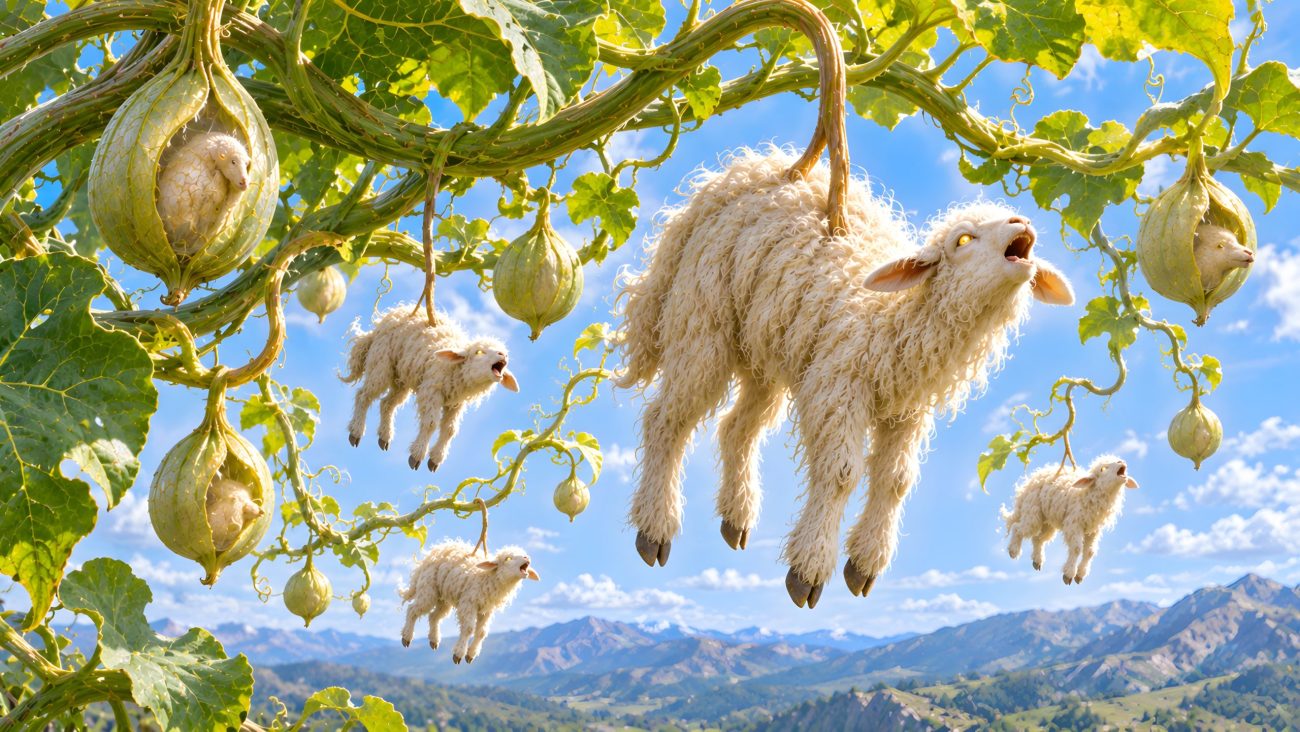
The Vegetable Lamb of Tartary was a legendary creature believed to grow from the earth like a plant while taking the form of a living sheep. Its body was connected to the ground by a long stem resembling an umbilical cord, which allowed it to bend down and graze on the grass and vegetation within its reach. Once all the plants around it had been consumed, the lamb and the plant itself would die.
Descriptions of the creature varied. Some accounts described it as a lamb-shaped fruit growing from melon-like seeds, while others imagined a living sheep attached to a plant. Its flesh, blood and bones were said to resemble those of an ordinary lamb. Some claimed that its blood tasted sweet like honey, while its wool could be harvested by local inhabitants and used to make clothing and head coverings. Wolves were reportedly among the few animals, besides humans, attracted to the strange creature.
The legend became particularly well known in Europe through the fourteenth-century Travels of Sir John Mandeville. It described a strange fruit growing in Tartary, resembling a gourd that could be opened to reveal a lamb-like creature inside. The animal possessed flesh and blood but had no wool. Similar stories told of lambs growing from plants in lands near Persia and the Caspian Sea.
During the Renaissance, scholars became fascinated by the possibility of a plant producing an animal. The Vegetable Lamb was compared with other legendary plant-creatures, including the Jewish Yeduah and the Chinese watersheep. Its existence became the subject of considerable debate among those attempting to understand the natural world.
Several explanations were eventually proposed for the origin of the legend. One possibility was that descriptions of cotton plants had been misunderstood, since their soft white fibres resembled sheep’s wool. In 1698, the physician and naturalist Hans Sloane suggested a more specific explanation: the woolly rhizome of the Chinese tree fern Cibotium barometz. When removed and turned upside down, the fern’s furry surface and the bases of its cut stems can create a striking resemblance to the body and limbs of a lamb.
The German scholar Engelbert Kaempfer also investigated the legend during his travels in Persia in the seventeenth century. Despite searching for the extraordinary creature, he found no physical evidence of its existence. He concluded that the Vegetable Lamb was a legend and suggested that reports of wool harvested from unborn lambs might have helped inspire the strange story.
Sources
Wikipedia contributors. (n.d.). Vegetable Lamb of Tartary. Wikipedia. https://en.wikipedia.org/wiki/Vegetable_Lamb_of_Tartary