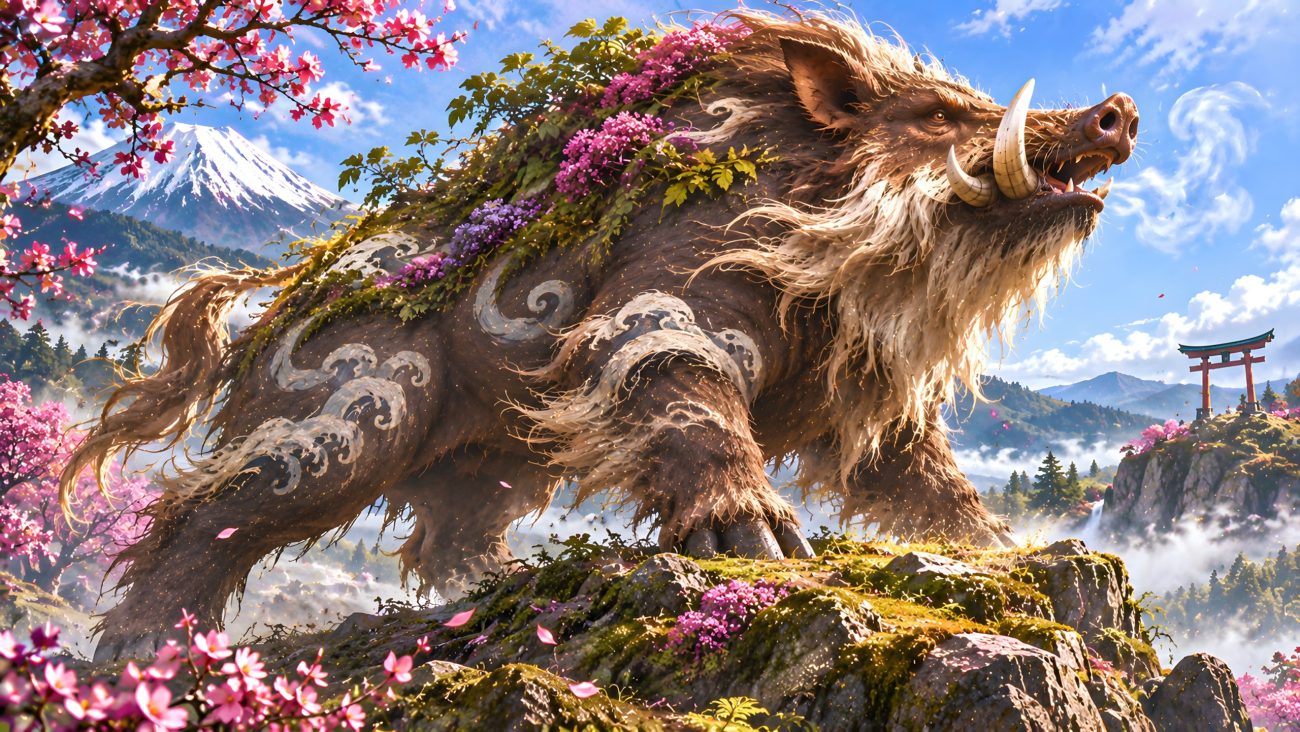
Tradition: Japanese Mythology
Alternative Names: 山鯨, Mountain Whale
Category: Pig
The Myth
Yama Kujira, meaning “Mountain Whale,” was a euphemism for wild boar meat during the Edo period, when cultural and religious taboos against eating the flesh of land animals remained influential. Establishments known as momonjiya, which sold or served wild game, used the term to disguise the sale of boar meat. The name likely referred to the resemblance between boar and whale meat, while also providing the convenient fiction that the meat came from a fish rather than a land animal.
In 1799, the writer Kyokutei Bakin playfully exploited this expression in the illustrated satirical book Kujira Sakuhin Kawabaori, which introduced the “mountain whale” as a humorous variety of whale. The creature was depicted resting among bush clover in an auspicious composition, with its eyes open despite supposedly sleeping. It had a long snout and sharp tusks, and was said to inhabit the “sea of the sleeping boar’s bed.” Its alleged length of sixteen ken was a wordplay on shishi, a Japanese term for boar or wild game, interpreted through the multiplication of four by four. The account also incorporated famous hunting and theatrical stories involving wild boars, including Nitta Tadatsune’s slaying of a giant boar during the Fuji hunt and Hayano Kanpei’s mistaken shooting of a boar in Kanadehon Chūshingura.
Other Japanese traditions feature a literal mountain whale, describing a time when whales lived on land before moving into the sea. In a different tradition from Inawashiro, Fukushima Prefecture, the 1888 eruption of Mount Bandai and its accompanying disturbances were attributed figuratively to a raging mountain whale, imagined as a gigantic wild boar. To appease the mountain deity, villagers constructed a float shaped like a great boar and prayed for relief. When conditions became peaceful again, the community came to venerate the mountain boar as a sacred animal and held an annual festival to thank the mountain deity and pray for a good harvest.
Sources
“Yamakujira.” 新版TYZ 妖怪図鑑 (New TYZ Yokai Encyclopedia). https://tyz-yokai.blog.jp/archives/1073492280.html