Tradition: Japanese mythology
Alternative Names: Seiryū, Seiryō, Shōryū, Sōryū, Azure Dragon
Category: Dragon
The Myth
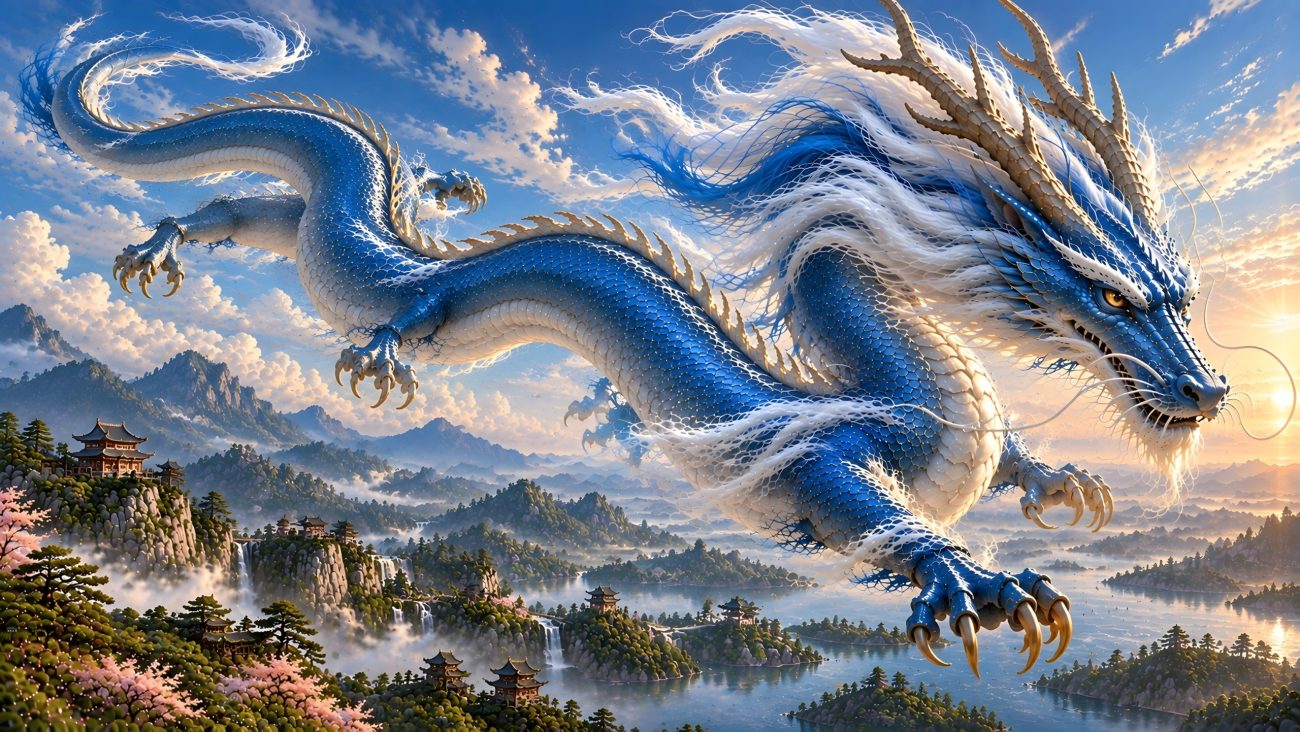
Seiryū, the Azure Dragon, is a great blue dragon who guards the eastern direction of the heavens. He is one of the Four Symbols, four mythical beasts associated with the four directions and the cosmic order. Seiryū represents the east and is connected with the element of wood, spring, and the planet Jupiter.
The tradition of the Four Symbols originated and became established in China during the Han dynasty through ideas concerning Yin and Yang and the Five Elements. Each direction was associated with a particular celestial beast, and these beings became important not only in cosmology but also in ritual practices and the planning of cities.
The Azure Dragon appears alongside the Vermilion Bird, Black Tortoise, and White Tiger as part of this cosmic arrangement. The Book of Rites describes military banners bearing the Four Symbols: the Vermilion Bird was placed at the front, the Black Tortoise at the rear, the Azure Dragon on the left, and the White Tiger on the right. These sacred beasts therefore accompanied armies as symbols representing the ordered directions of the heavens.
The Huainanzi further associates the east with wood, Taihao and Jumang with the governance of spring, Jupiter with the corresponding celestial body, and the Azure Dragon with the beast of the eastern direction.
The image of Seiryū later became deeply established in Japan. One of the most important surviving representations can be found in the murals of the Takamatsuzuka and Kitora Tumuli in Asuka, Nara Prefecture. The tombs were constructed around the seventh and eighth centuries, and their chambers contain representations of the Four Symbols. The artistic tradition was transmitted from the continent through China and Korea, with comparable representations appearing in Chinese tombs from the Han through the Six Dynasties and in the tombs of Goguryeo, Baekje, and Goryeo.
The Four Symbols also became part of Japanese court ritual. The Shoku Nihongi records that during the New Year’s ceremony held in the Daigokuden in 701, seven banners decorated with the Four Symbols together with crows, the sun, and the moon were erected and displayed. This ceremonial arrangement was modeled on the culture of Tang China.
Thus Seiryū is not simply a dragon of the eastern sky, but one of the four great beings through which the heavens, directions, seasons, elements, and earthly ritual were understood as part of a single cosmic order.
Sources
Takahashi, Toshihiro. “青竜 [せいりゅう] (Seiryū).” 新版TYZ 妖怪図鑑 (New TYZ Yokai Encyclopedia). October 21, 2024. https://tyz-yokai.blog.jp/archives/1082920496.html