Tradition / Region: Luxembourgish Mythology
Alternative names: —
Category: Cow
The Myth
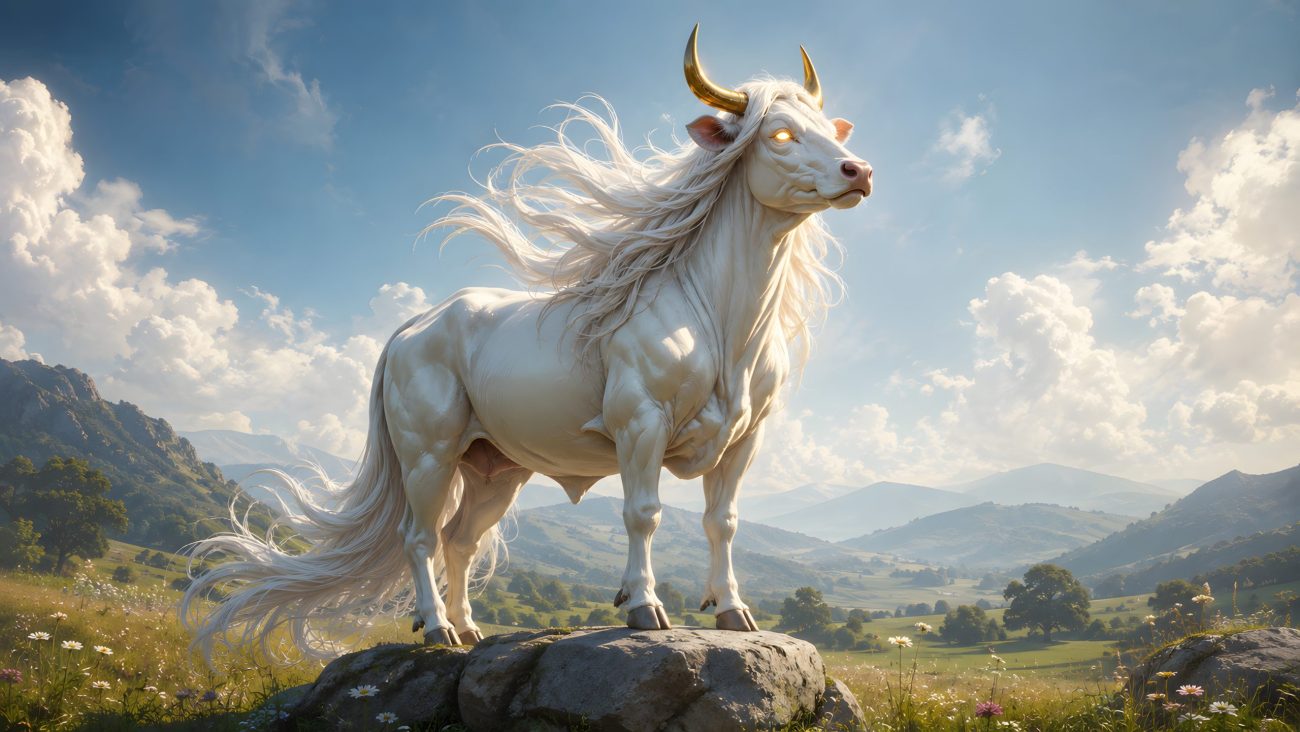
The White Cow of Bollendorf is a supernatural white cow with golden horns that emerges from the forest and joins the village cattle. She appears when the villagers neglect their meadows and allow their cattle to graze for too little time.
According to the legend, the cow would quietly enter the pasture and graze among the village herd. Her presence caused the other cattle to remain in the meadow and feed properly. When the herdsman tried to bring them home in the evening, the white cow refused to move, and none of the other cattle would leave without her.
No shouting or attempts to drive her away could make her yield. The herdsman was forced to remain in the meadow until the mysterious cow decided that it was time to return to the forest.
The white cow continued to appear day after day, always arriving and leaving according to her own will. She never harmed the cattle, but her presence ensured that the herd remained in the meadow long enough to feed properly.
One evening, the herdsman followed her as she returned toward the forest. The cow eventually disappeared into a cleft in the rocks. Inside the grotto he discovered a strange dwarf who guarded the hidden place.
The herdsman demanded payment for the time he had spent watching the cow. The dwarf told him that the cow had not come for his benefit and had never required his care. She had appeared of her own accord and remained only as long as necessary.
Nevertheless, the dwarf opened a chest filled with gold and silver and took out a single worthless coin. This was the payment he gave the herdsman for his service.
After that night, the white cow with golden horns never returned to Bollendorf. The herdsman thereafter took greater care of the meadow, rising earlier and keeping the cattle there longer.
Sources
Gredt, Nikolaus. “Das Wichtlein zu Bollendorf und die Kuh mit goldenen Hörnern.” In Sagenschatz des Luxemburger Landes. Luxembourg, 1883. Reproduced by SAGEN.at. Accessed August 15, 2026. SAGEN.at source