Tradition: Japanese Mythology
Alternative Names: Unikoru, Unkouru
Category: Sheep
The Myth
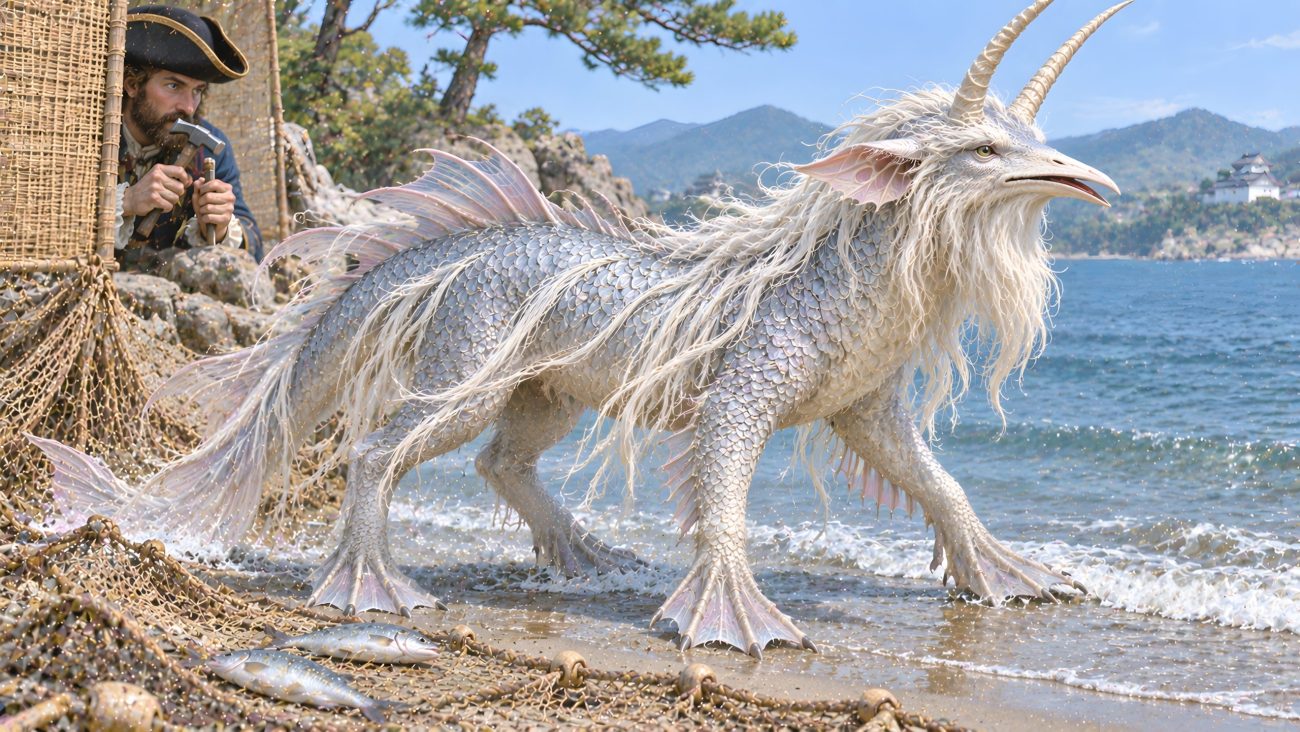
The Unikouru is a strange sea creature resembling the unicorns of European legend. It has four legs, a scaled body, webbed feet, and a slender, bird-like mouth. A beard extends from beneath its ears to its chin, while several long strands of hair hang from the sides of its body. Unlike the familiar unicorn, however, the Unikouru possesses two horns growing from its head.
During Japan’s Edo period, unicorns became known through contact with the Dutch. Their horns were highly prized for their supposed medicinal properties, as they were believed to neutralise poison and reduce fever. Narwhal tusks were frequently traded as unicorn horns and valued as powerful remedies. Some were even presented as tribute when Dutch trading-post chiefs travelled to Edo.
One illustrated tale tells how hunters captured a Unikouru along the shore. They placed iron nets near the water and used fish as bait. When the creature spotted the fish beneath the surface, it came ashore to catch them and entered the trap. The hunters quickly closed the entrance, capturing the creature alive.
Once it was trapped, the hunters used a hammer and chisel to remove its two horns. These were believed to possess extraordinary powers. According to the tale, simply stroking a fish with one of the horns could bring it back to life instantly. The horns were therefore prized as miraculous medicines, supposedly powerful enough to restore even the dead.
The creature’s capture is depicted with a foreign-looking man hiding behind a perforated screen on the shore, waiting with his hammer and chisel to remove the horns.
Sources
Tyz-Yokai. (n.d.). Unikor. https://tyz-yokai.blog.jp/archives/1070421565.html