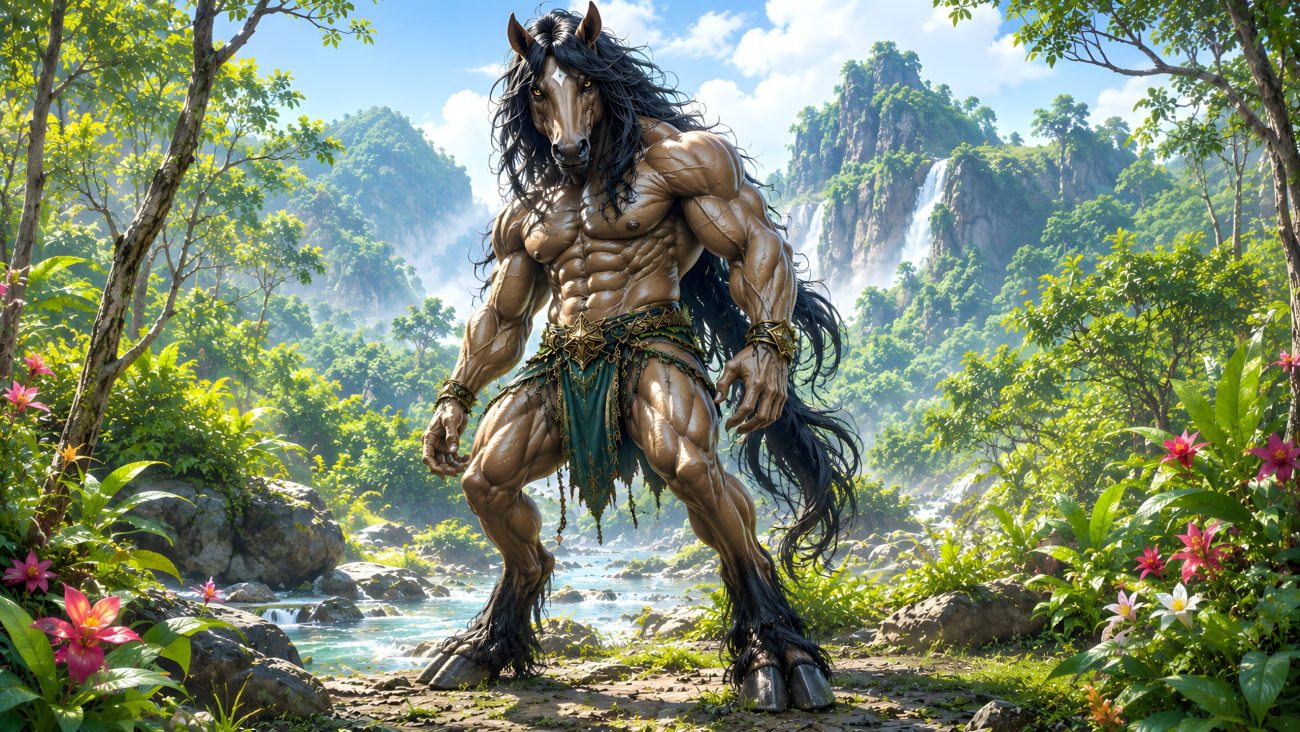
Tradition / Region: Philippine Folklore
Alternative names: Tigbalang, Tigbalan, Tikbalan, Tigbolan, Werehorse, Unglo (Visayan)
Category: Horse
The Myth
The Tikbalang is a supernatural creature of Philippine folklore that dwells in the mountains and rainforests. It is usually described as a tall, gaunt being with the head and hooves of a horse and the body of a human. Its limbs are unnaturally long, and when it squats, its knees rise above its head. Some traditions say it is the transformed spirit of an aborted fetus sent to earth from limbo.
Early Spanish accounts did not describe the Tikbalang as horse-like. Instead, it was regarded as a ghost or forest spirit that haunted wild places and could assume many frightening forms. Later, after horses became familiar in the Philippines during the Spanish colonial period, the creature came to be consistently portrayed as a half-human, half-horse being.
The Tikbalang is closely associated with forests and large sacred trees, particularly balete and kalumpang trees. It is believed to guard these places and is often encountered beneath bridges, in bamboo thickets, banana groves, or beneath ancient trees.
The creature is notorious for misleading travelers. It causes people to lose their way, making them unknowingly walk in circles and repeatedly return to the same place. According to tradition, this enchantment can be broken by turning one’s shirt inside out or by politely asking permission before passing through the forest.
Many legends also describe the Tikbalang as a shapeshifter capable of becoming invisible or taking human form. During sunshowers, Filipinos commonly say that a Tikbalang is getting married.
According to one tradition, the Tikbalang possesses a mane filled with sharp spines, among which three golden hairs hold magical power. A person brave enough to leap onto the creature, restrain it with a specially prepared cord, and remain mounted while it struggles through the air can pluck these three hairs. Once subdued, the Tikbalang becomes the person’s loyal servant, and the hairs may be kept as a powerful talisman.
Sources
Wikipedia contributors. (n.d.). Tikbalang. In Wikipedia. Retrieved June 29, 2026, from https://en.wikipedia.org/wiki/Tikbalang