Shiro (Shirodawashi)

Tradition / Region: Japanese Mythology
Alternate Names: Shirodashi, Shirodawashi (White Scrubber)
Category: Yōkai / Mountain Dweller / Cave Dweller


The Myth

Shiro, also called Shirodawashi, was a yōkai known for his beast-like face, hooves, and a kimono patterned with scrubbing brushes. He lived in a cave near a remote mountain settlement and first appeared as a friendly and helpful figure.

A pair of monsters, Mōryō and his wife Ochiyobon, fled from Ushū to the mountains beyond Hakone and settled in a ruined house. Shiro assisted them in establishing their new home, but his friendliness soon revealed another nature. He was a heavy drinker and a troublemaker who repeatedly visited their house, demanding food, drink, and money.

Shiro became infatuated with Ochiyobon and schemed to take her for himself. One day, he borrowed a padded robe from Mōryō and never returned it. When Ochiyobon came to demand its return, Shiro claimed he had pawned it and left to retrieve it. Instead, he went to Mōryō’s shack armed with a blade and declared that Ochiyobon was now his wife. Intimidated and afraid, Mōryō surrendered, giving Shiro all his possessions, including clothing, bedding, and cosmetics.

When Ochiyobon learned what had happened, she was devastated. Shiro responded brutally, declaring that since she was now his wife, she must submit. Other monsters gathered, and even Momojii, the master of the cave dwellings, appeared. Momojii attempted to restore Ochiyobon to her husband, but Mōryō, fearing public shame, refused reconciliation and announced plans to remarry.

Abandoned, Ochiyobon grew close to Momojii, who treated her with kindness. Enraged, Shiro attacked Momojii with an oak log, but Momojii overpowered him with a massive axe and drove him away. To settle the conflict, Momojii arranged for Shiro to marry a beautiful female ghost.

Despite her beauty, the ghost suffered under Shiro’s relentless desire. Unable to endure him, she abandoned her lingering grudge against the living and wished to return to the underworld. When demons arrived to claim her, Shiro fought them fiercely. During the chaos, the ghost passed on peacefully, leaving the demons with no soul to seize. They attempted to drag Shiro to hell instead, but along the way a mysterious boy appeared and gave Shiro demon-slaying sake. The boy revealed himself to be the tanuki Kakubei, who slew the demons.

Grateful, Kakubei asked Shiro to help abduct the daughter of a fox whose marriage proposal had been rejected. Shiro eagerly agreed and joined the tanuki in attacking the wedding procession, successfully capturing the bride’s palanquin. However, he soon encountered Mikoshi Nyūdō, who defeated him and took him prisoner. Impressed by Shiro’s boldness, Mikoshi Nyūdō eventually released him, predicting he might serve a greater purpose someday.

Later, tanuki thieves stole the White Fox Jewel and entrusted it to Shiro. When monsters and foxes came to retrieve it, they heard a woman’s voice from within Shiro’s cave. Ochiyobon emerged, holding a bloodstained knife and the jewel. Having been disgraced and betrayed, she took revenge by killing Shiro and returning the treasure to its rightful owners.

Thus ended Shirodawashi, remembered as a violent, cunning, and lust-driven yōkai whose ambition and cruelty ultimately led to his downfall.


Interpretive Lenses

Religious Readings
Philosophical Readings
  • Nietzschean Deep Dive
Psychological Readings
  • Jungian Deep Dive
Esoteric Deep Dive
  • Hermetic Deep Dive
Political / Social Readings
  • Marxist Deep Dive
Other
  • How to Invite The Spirit

Zarazarazattara

Tradition / Region: Japanese Folklore (Haibara County, Shizuoka Prefecture)
Alternate Names:
Category: Yōkai / Mountain Dweller


The Myth

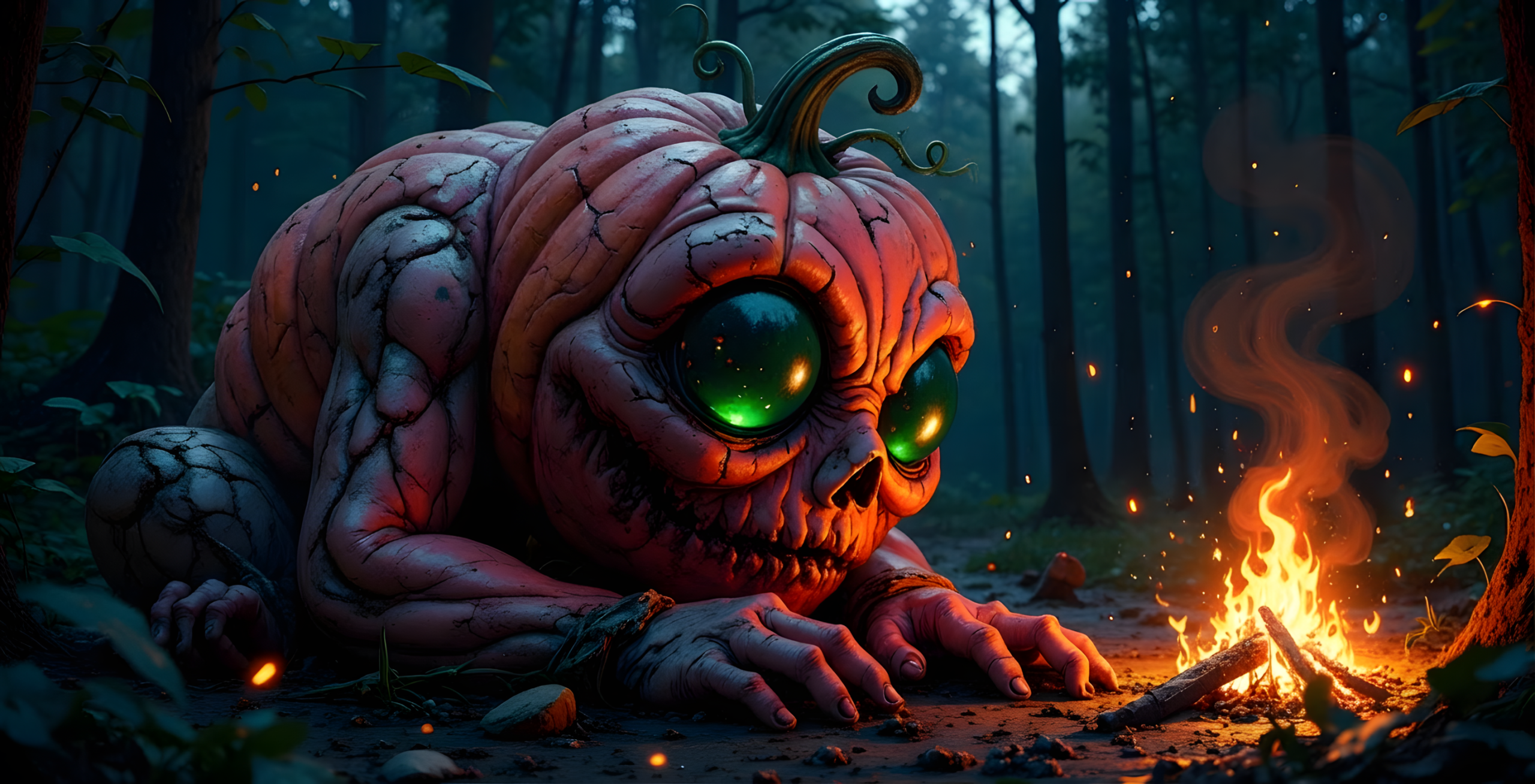
In Haibara County, it is told that a man once spent the night alone in a mountain hut, sitting by the hearth to keep warm. As the fire burned low, the hut lay silent except for the crackle of embers.

At one point, the man lifted the straw mat that covered the entrance. Suddenly, a round object—shaped much like a pumpkin—rolled inside the hut and came to rest beside the hearth. Startled, the man stared at it, thinking how unsettling the thing looked.

Before he could act, the round object spoke, saying, “It’s nothing. I am Zarazarazattara.”

The man felt an even deeper unease and thought to himself that he wished he had left the hut earlier. Immediately, the creature replied, “Never mind. I’ll be right there.” Realizing that the being responded to his very thoughts, the man became terrified, knowing that even thinking in silence was no protection.

Trying to act without revealing his thoughts, the man decided to tend the fire. He picked up a piece of firewood and snapped it to add fuel to the hearth. By chance, a fragment of the broken wood flew off and struck the creature where its face seemed to be.

At this, Zarazarazattara cried out, “I never thought of that,” and fled the hut at once, disappearing back into the night.

Afterward, the man was left alone by the fire, shaken but unharmed, and the strange yōkai was never seen there again.


Interpretive Lenses

Religious Readings
Philosophical Readings
  • Nietzschean Deep Dive
Psychological Readings
  • Jungian Deep Dive
Esoteric Deep Dive
  • Hermetic Deep Dive
Political / Social Readings
  • Marxist Deep Dive
Other

Oshoné

Tradition / Region: Japanese Folklore (Yatsuka-chō, Matsue City, Shimane Prefecture)
Alternate Names: Osshine (variant pronunciation)
Category: Yōkai / Water Spirit


The Myth

On a bitterly cold day in Yatsuka-chō, a fisherman waited alone in his boat at sea, watching his nets and enduring the freezing wind. As the cold deepened, he began striking a bell-like instrument to keep himself awake. Suddenly, he noticed what appeared to be a large mountain directly in front of him, looming where open water should have been.

Believing the mountain to be some illusion or object washed into the sea, the fisherman rowed toward his shore shack and pulled on the anchor rope to steady himself. Finding nothing amiss, he returned to his work. Though uneasy, he closed his eyes and continued fishing.

After some time, he opened his eyes and saw three children gathered around a bonfire burning on bamboo. The children had no hands and no feet, yet they moved about the fire as if untroubled. Realizing what he was seeing, the fisherman thought of an old tale he had heard and understood that these beings were Oshoné, a strange yōkai known from local stories.

Acting quickly, the fisherman threw shushumi leaves into the fire. As the leaves crackled and snapped loudly, Oshoné was startled. In confusion and fear, the creature scattered, fleeing with a lantern and vanishing into the pine trees of the nearby mountain.

After that night, the fisherman never saw Oshoné again, but the story remained along the waters of Yatsuka-chō, told as a strange encounter with a yōkai that appeared by the sea, took the form of limbless children, and vanished when frightened by sudden noise and flame.


Interpretive Lenses

Religious Readings
Philosophical Readings
  • Nietzschean Deep Dive
Psychological Readings
  • Jungian Deep Dive
Esoteric Deep Dive
  • Hermetic Deep Dive
Political / Social Readings
  • Marxist Deep Dive
Other