Tradition: Welsh Mythology
Alternative Names: Hen Wen, Old White
Category: Pig
The Myth
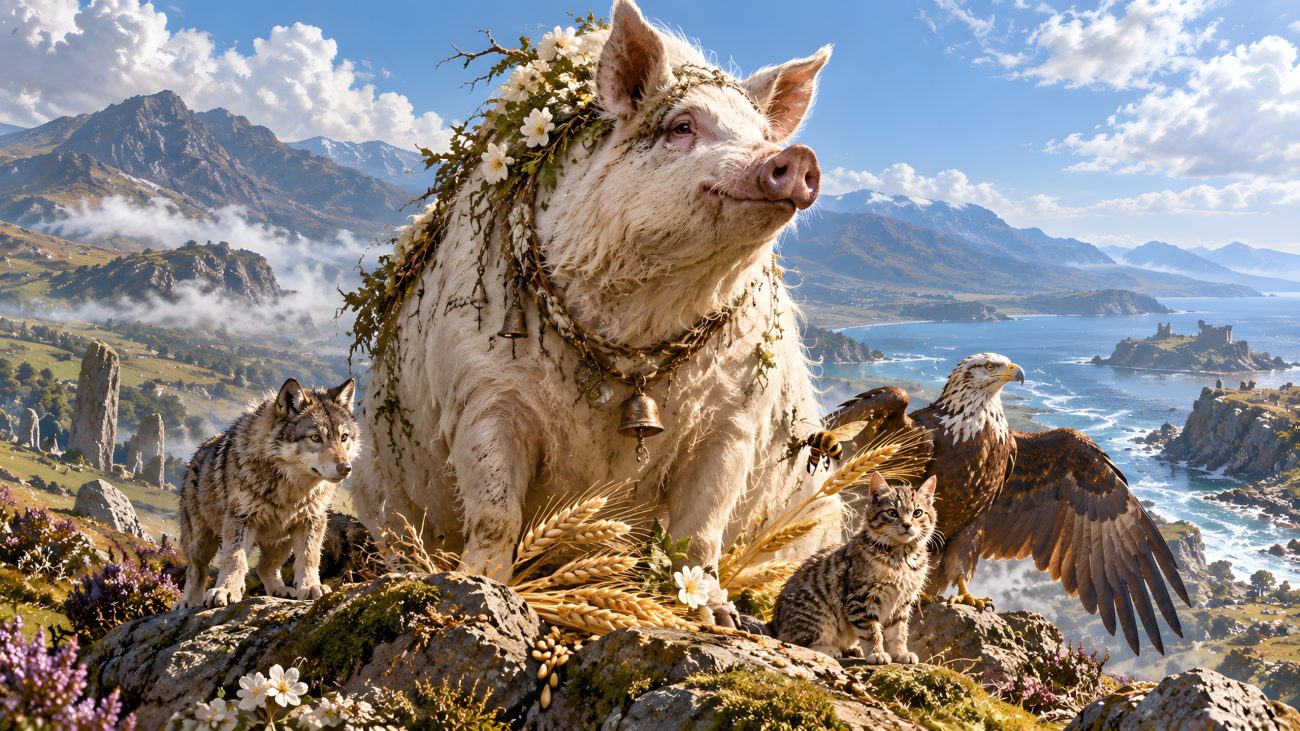
Henwen, whose name means “Old White,” was a sow in Welsh mythology whose offspring included both beneficial and dangerous creatures. According to the Welsh Triads, she was kept by Coll son of Collfrewy, a swineherd serving Dallwyr Dallben. When Henwen was about to give birth, a prophecy warned that her offspring would bring misfortune to Britain. She was therefore pursued until she plunged into the sea at Penrhyn Awstin in Cornwall, eventually emerging at Aber Tarogi in Gwent Is-coed.
As she travelled across Wales, Henwen gave birth to a remarkable variety of offspring. At Maes Gwenith in Gwent, she produced a grain of wheat and a bee. At Llonion in Pembroke, the accounts differ over whether she gave birth to barley, wheat, or a piglet, while another tradition records a grain of rye at Lleyn in Arfon. On the hill of Cyferthwch in Snowdonia, she produced a wolf cub and an eaglet, and beneath the Black Rock at Llanfair in Arfon, she gave birth to a kitten. Her offspring thus included creatures associated with agricultural abundance as well as animals regarded as potentially dangerous.
The wolf cub and eaglet were adopted by prominent men, but both supposedly brought trouble to their keepers. The swineherd took the kitten and threw it into the Menai Strait. On the island of Anglesey, known in Welsh as Ynys Môn, the sons of Palug raised the kitten until it became Cath Palug, a monstrous cat. This creature later appeared in Arthurian tradition as an opponent of either Cai, also known as Sir Kay, or King Arthur himself. Henwen’s legend connects a mysterious animal’s journey across Wales with the origins of both prosperity and monstrous threats.
Sources
“Henwen.” Wikipedia: The Free Encyclopedia. Wikimedia Foundation. Accessed October 27, 2026.