Ghost Cart

Tradition: Swiss Mythology
Alternative Names: The Phantom Cart of the Sihl Ravine
Category: Ghost


The Myth

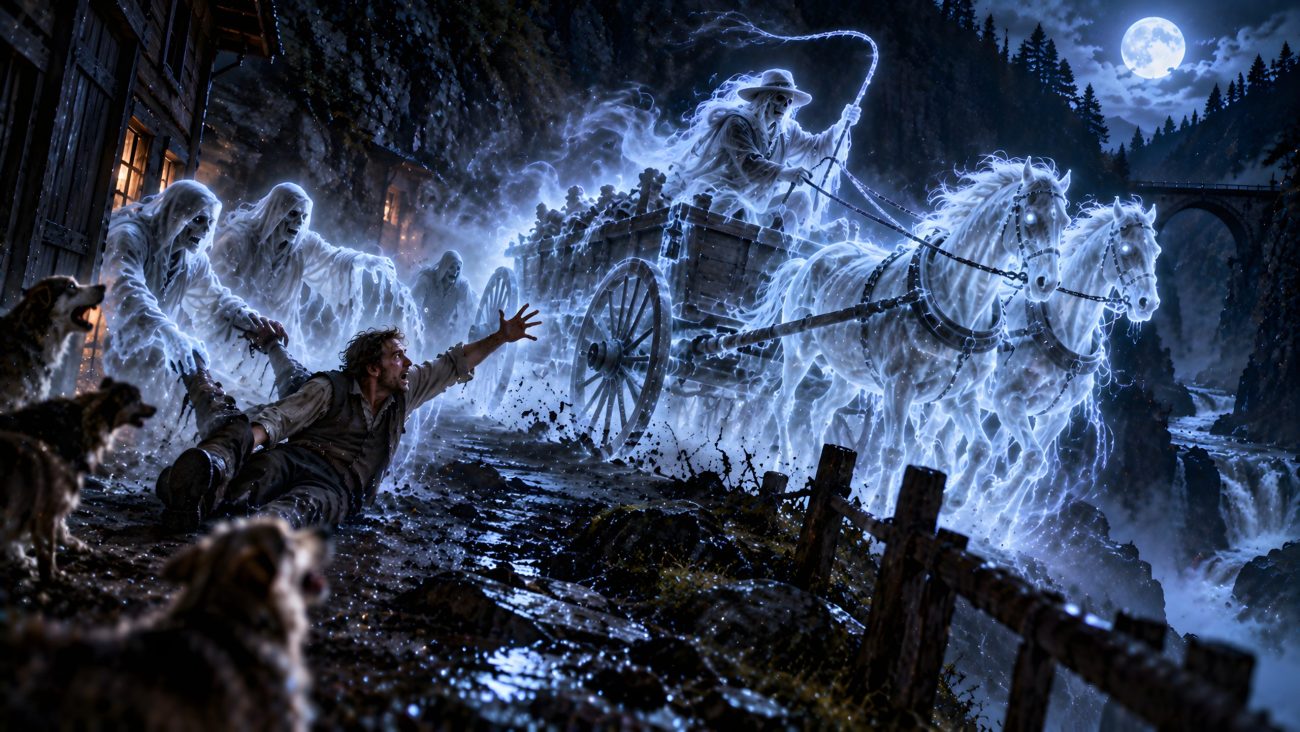
In the old house of Friedli Menzinger, a man who was later beheaded, there once lived a poor widow with a large family of hungry children. Not far from the house lay an enchanted ravine carved by the Sihl River, whose waters often raged fiercely. On certain nights, the quiet of the surrounding countryside was disturbed by a strange and unsettling sound coming from the narrow path through the ravine.

The noise resembled a heavily laden cart struggling to make its way uphill, its wheels and load apparently laboring along the steep, confined track. The sound was so frightening that the widow never dared to look through her window or peer through the narrow cracks in her shutters. Whenever the ghostly cart approached, an even more terrible commotion erupted around the house: dogs and cats howled wildly and seemed to rage around the property.

The mysterious vehicle became known as the ghost car from the Sihl ravine. Its exact nature and origin remained unexplained, but its nocturnal passage brought terror to the widow and her children. The legend preserves the image of a phantom cart whose unseen journey could be heard in the darkness, accompanied by the furious howling of animals around the old house.


Sources

“Der Geisterwagen.” SAGEN.at – Traditionelle Sagen aus der Schweiz (Zug). Reproduced by SAGEN.at. https://www.sagen.at/texte/sagen/schweiz/zug/geisterwagen.html


Walchwil Ghost

Tradition: Swiss Mythology
Alternative Names: The Ghost of the Walchwil Vineyards
Category: Ghost


The Myth

Many years ago, the picturesque hills of Walchwil in Switzerland were famous for producing an exceptionally fine wine said to possess mysterious powers. The wine was celebrated far beyond the village, and wondrous tales circulated about its strength. Yet the vineyards were also haunted by an evil ghost that tormented and terrified people of all ages, appearing both in daylight and under the cover of darkness. The pious winegrowers and fishermen of Walchwil struggled for a long time to find a way to rid themselves of the troublesome spirit.

Their hopes rose when a small monastery of Capuchin friars was established in nearby Arth. Desperate for help, the inhabitants sent a messenger to the neighboring village, asking the monks to drive away the ghost. A Capuchin friar answered their plea and came to Walchwil. Before attempting the exorcism, however, he demanded half a liter of the village’s fiery wine.

The ghost was terrified by the friar’s plan and immediately fled, declaring that if the priest drank even half a liter of Walchwil wine, it would be completely defeated. From that moment onward, the evil spirit was never seen in the vineyards again. The legend celebrates the extraordinary strength of Walchwil wine, whose reputation proved powerful enough to overcome even a terrifying supernatural enemy.


Sources

“Der Wein.” SAGEN.at – Traditionelle Sagen aus der Schweiz (Zug). Reproduced by SAGEN.at. https://www.sagen.at/texte/sagen/schweiz/zug/wein.html


Stockhüper

Tradition: Swiss Mythology
Alternative Names: Stock Jumper, Hopen
Category: Ghost


The Myth

Along the road from Sattel to Ägeri, in the Swiss canton of Zug, lies the Schornen, an area known for its Letziturm tower and the remains of ancient defensive earthworks built by the people of Schwyz. According to local tradition, this disputed stretch of land once belonged to the estate of Ägeri but eventually passed into the possession of the municipality of Sattel through the sacrilegious perjury of an unscrupulous man. For his false oath, the man was condemned to a supernatural punishment, forever haunting the boundary of the land whose ownership he had helped determine dishonestly.

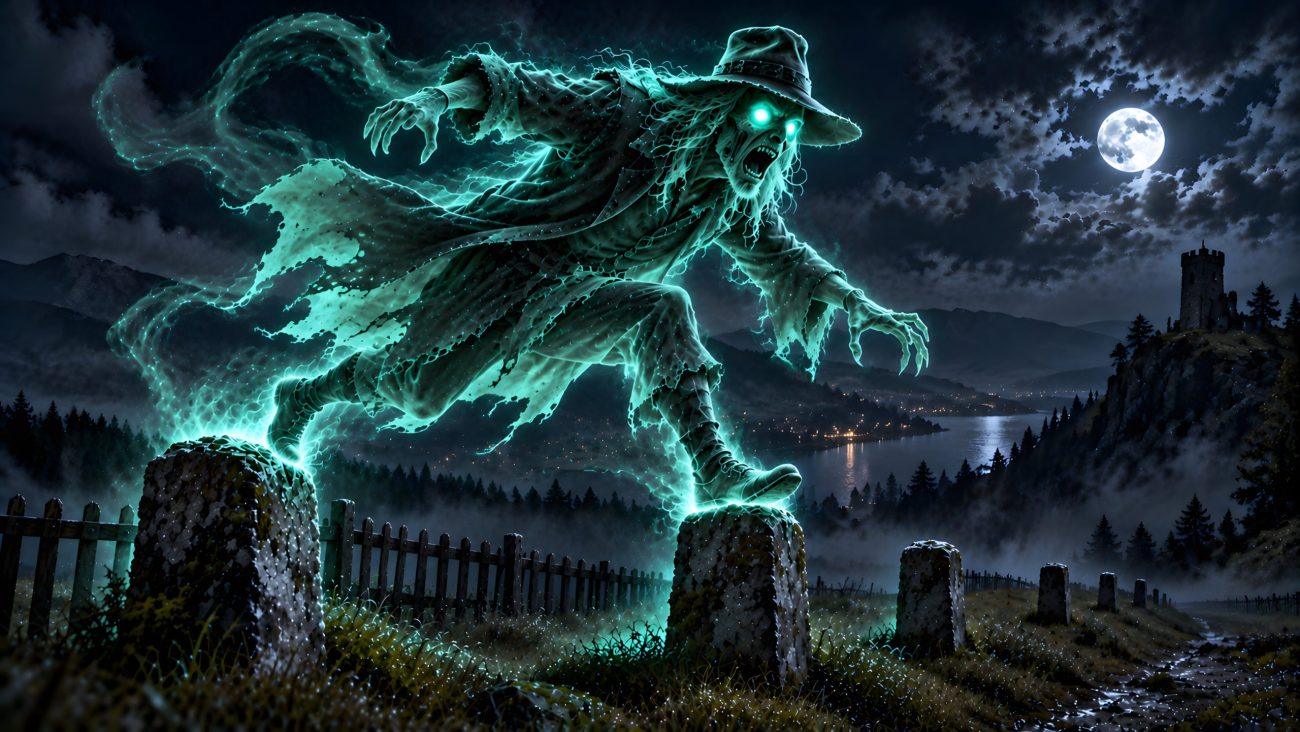
The perjurer appears as a mysterious black figure wearing a long coat and a broad-brimmed hat that hangs low over his head and reaches toward his broad shoulders. He is sometimes seen sitting atop the wooden picket fence that once marked the disputed boundary. More often, he leaps wildly from one boundary stone to another, racing along the border in a frantic, unnatural chase. During these nocturnal journeys, he emits a piercing, bone-chilling cry known locally as the Hopen. He particularly favors a small hill called the Stock, which gave rise to his name, Stockhüper, meaning “Stock Jumper.”

For many years, the Stockhüper was a familiar figure in local legend, condemned to roam the boundary as punishment for his dishonest testimony. However, the ghost has not been seen for a very long time. According to the tradition, a parish priest eventually banished him for eternity, bringing an end to his eerie nocturnal leaps and terrifying cries.


Sources

“Der Stockhüper.” SAGEN.at – Traditionelle Sagen aus der Schweiz (Zug). Reproduced by SAGEN.at. https://www.sagen.at/texte/sagen/schweiz/zug/stockhueper.html


Ghosts of Ramswag Castle

Tradition: Swiss Mythology
Alternative Names: The Ramswag, The Golden Skittles of Ramswag
Category: Ghost


The Myth

Knight Heinrich Walther von Ramswag distinguished himself in 1278 when he marched with King Rudolf of Habsburg against King Ottokar of Bohemia and saved his sovereign’s life at the Battle of Marchfeld. As a reward for his service, he received 500 marks of silver, the estate of Kriessern with Blatten Castle, the estates of Bernhardzell and Sitterdorf, and the imperial bailiwick in Thurgau. The family’s sudden prosperity, however, made the Ramswags arrogant. During the period of celebration that followed, a magnificent feast was reportedly held at Ramswag Castle, attended by the king himself. In the castle courtyard, guests amused themselves by playing skittles with golden balls and pins.

During the Appenzell Wars, Knight Rudolf met a tragic death at Ramswag Castle, and the family’s estate eventually passed into other hands. Yet the castle’s past revelry is said to endure beyond the destruction of its walls. On nights of heavy, eerie weather, Rudolf’s ghost wanders through the deep cellars of the castle ruins, accompanied by other spectral figures. During these mysterious gatherings, the golden skittles are brought out once more, as though the ghosts are recreating the festivities of their former lives.

Those who pass near the ruins on such nights may hear the unmistakable sounds of the phantom game: balls rolling across the ground and pins tumbling down. These noises are interrupted by the groans and moans of the castle’s ghostly inhabitants. The spectral game continues in the darkness, preserving the memory of Ramswag’s former wealth and splendor long after the family and its castle have fallen into decline.


Sources

“Ramswag.” SAGEN.at – Traditionelle Sagen aus der Schweiz (St. Gallen). Reproduced by SAGEN.at. https://www.sagen.at/texte/sagen/schweiz/st_gallen/ramswaghtm.html


Musical Ghost

Tradition: Swiss Mythology
Alternative Names: The Piano-Playing Ghost of Neuheim
Category: Ghost


The Myth

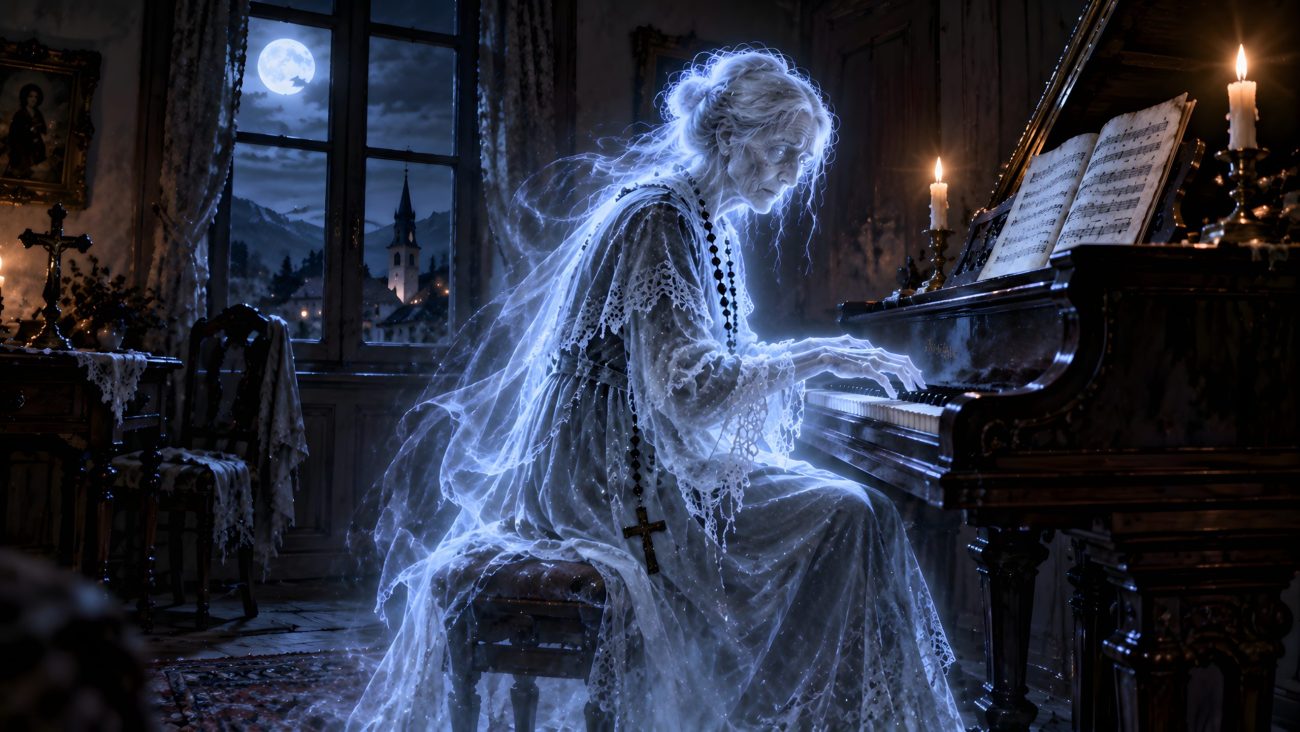
A farmer’s wife from the mountain village of Menzingen once travelled on a pilgrimage to the Marian shrine of Einsiedeln, accompanied by her twelve-year-old daughter. During the journey, the girl suddenly pulled a sugar heart from beneath her clothes and ate it, although she had no idea who had given her the mysterious gift. After the family returned home, the child began seeing a strange apparition: an old, wrinkled woman carrying a walking stick and a large rosary, approaching from the neighboring house. The girl alone could see the woman, but the haunting soon began to affect the entire household.

During the night, the inhabitants heard someone pacing up and down the wooden stairs, closing doors, and playing a musical instrument. The unexplained noises caused considerable fear and annoyance, but the farmer could find no source for them. Suspecting that a ghost had entered his home, he summoned the dean and several other priests to bless the house and perform exorcisms. They searched the entire building and kept a strict watch over the yard, hoping to discover the cause of the disturbances. After a prolonged period, the musical ghost reportedly disappeared, but the farmer was said to have spent 500 guilders dealing with the haunting.

A similar apparition was associated with the old chaplain’s house in Neuheim, where a ghost reportedly wandered through the building at night and played the piano. Its music disturbed the sleep of the household, turning an ordinary home into a place of nocturnal unrest. Together, these accounts describe spirits whose presence was revealed not only through strange visions but also through unexplained sounds and music that disturbed the living.


Sources

“Das Gespenst.” SAGEN.at – Traditionelle Sagen aus der Schweiz (Zug). Reproduced by SAGEN.at. https://www.sagen.at/texte/sagen/schweiz/zug/gespenst.html


Bleichi-Mueterli

Tradition: Swiss Mythology
Alternative Names: Bleichi-Mueterli, The Spirit of the Bleaching Field
Category: Ghost


The Myth

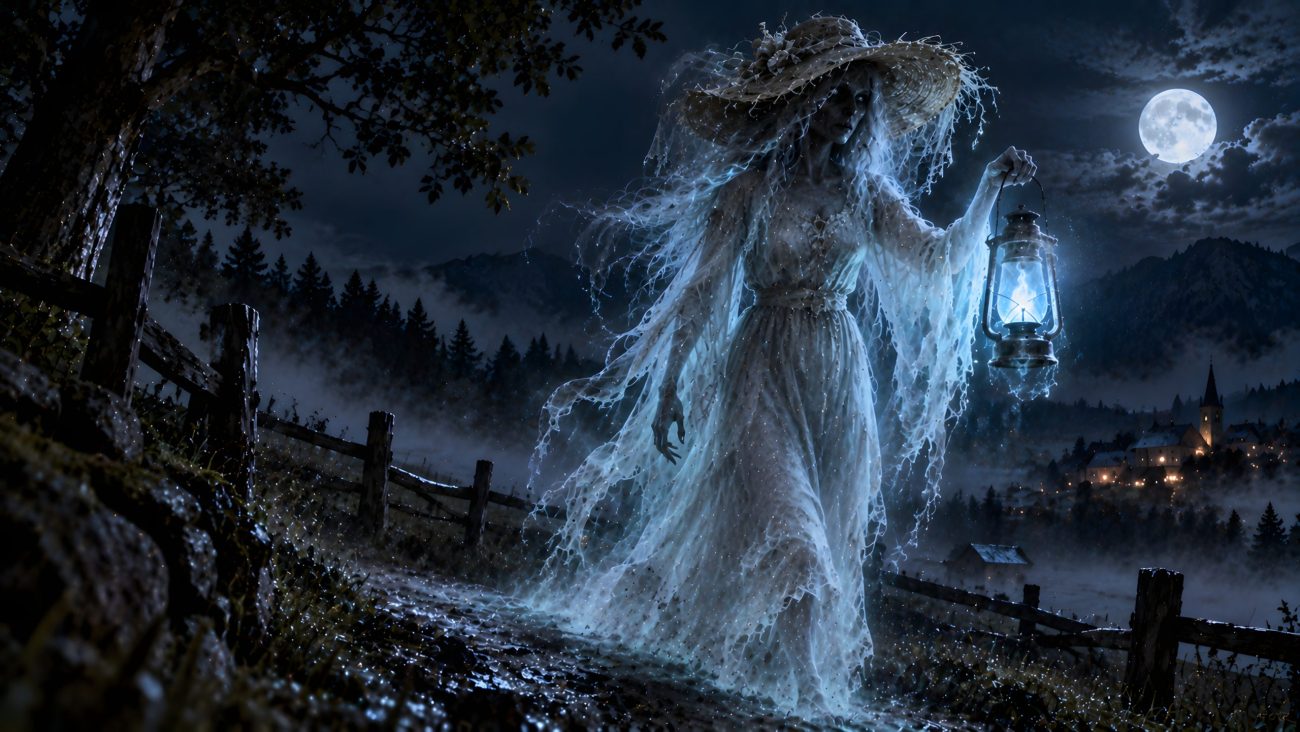
Above Schönbrunn, along the road toward Hinterburg between Bethlehem and a place known as the Loch, lies a stretch of land called the Bleichi. The area was once haunted by a mysterious female apparition known as the Bleichi-Mueterli. She was described as a dark-faced figure wearing a white gown and a straw hat, often emerging from the Wösch, a forest between Bethlehem and Edlibach. She carried a light as she wandered through the area, and her strange appearance frightened those who encountered her.

Even in the nineteenth century, the apparition was remembered as a source of terror. A young boy from Schönbrunn was so frightened by seeing the Bleichi-Mueterli that he remained ill for some time afterward. In another account, a boy from Menzingen was walking past the Bleichi with his father when he saw the ghost carrying a small blue light. Terrified, he stayed close to his father, who could perceive nothing of the apparition.

The name of the Bleichi-Mueterli also became associated with a more earthly figure. A cheeky fruit thief reportedly disguised himself as the bleaching-field spirit and made his rounds among the heavily laden fruit trees, using the ghost’s frightening reputation to carry out his thefts. His long fingers helped him pluck the fruit, but the farmers eventually became watchful and put an end to his schemes. The legend thus preserves both the memory of a feared nocturnal apparition and the tale of a thief who exploited local superstition.


Sources

“Der Bleichi.” SAGEN.at – Traditionelle Sagen aus der Schweiz (Zug). Reproduced by SAGEN.at. https://www.sagen.at/texte/sagen/schweiz/zug/bleichi.html


Schönbrunn Pious Recluse

Tradition: Swiss Mythology
Alternative Names: The Treasure-Guarding Hermit of Schönbrunn
Category: Ghost


The Myth

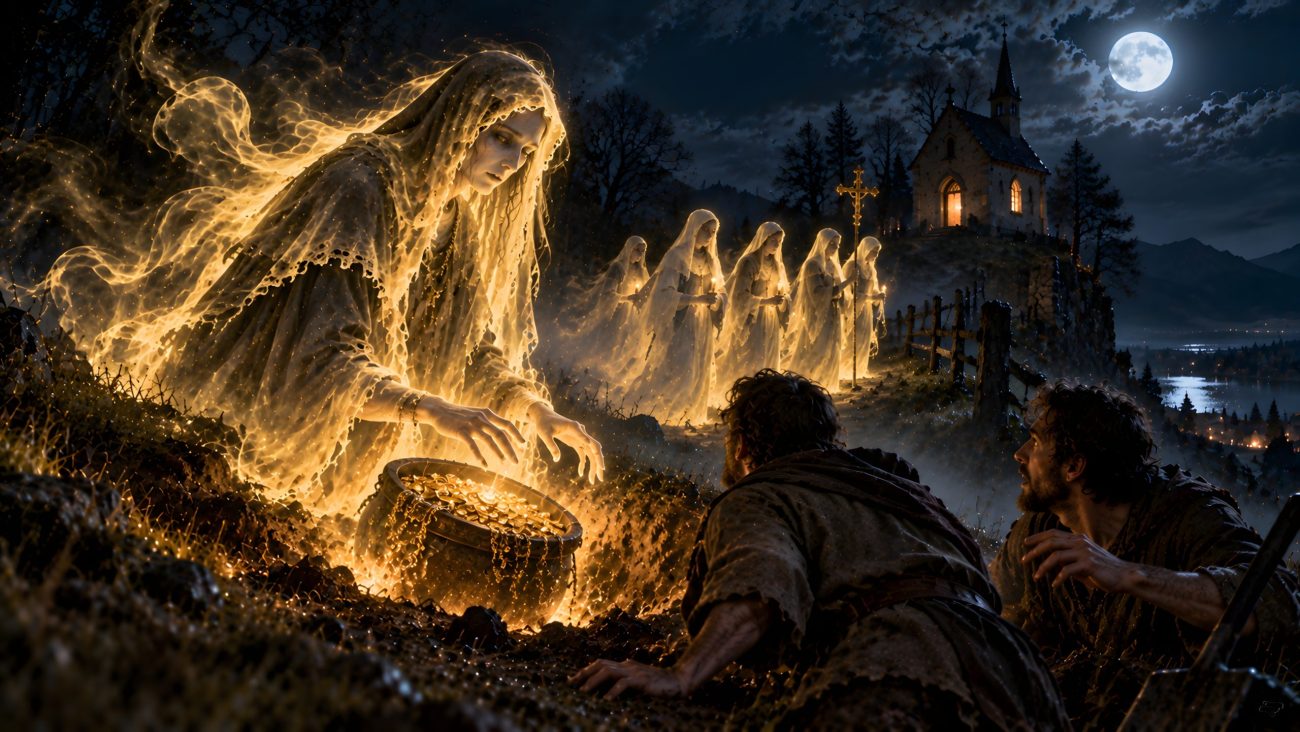
Around the turn of the twelfth and thirteenth centuries, pious women lived as recluses on the hill above Schönbrunn in the Swiss canton of Zug. According to local tradition, one of their houses stood at a place called Chilebode, below the site of the present-day chapel. One legend tells of a great treasure hidden deep beneath the earth in an earthen vessel. The treasure was guarded by a devout woman who watched over it as the centuries passed. Every hundred years, the treasure rose gradually toward the surface until it finally emerged into daylight, allowing it to be unearthed by anyone who knew how to retrieve it.

When the appointed time arrived, two local men set out to recover the treasure. They began their work, knowing that they had to remain completely silent if they wished to claim the riches. As they labored, one of the men suddenly noticed a procession of pious nuns approaching from the direction of the chapel. Surprised by the sight, he nudged his companion and exclaimed, “Look there!” The moment he spoke, the treasure sank back into the earth, disappearing beyond their reach.

The treasure-guarding recluse sighed in distress, for she had nearly been freed from her endless duty. Had the two men remained silent throughout their work, the treasure could have been recovered and her long watch would finally have ended. Instead, she was condemned to guard it for another hundred years, awaiting someone who could retrieve it in complete secrecy. As the treasure vanished, the procession of praying women disappeared along with the hermit, leaving the two disappointed treasure hunters with nothing.


Sources

“Die Klausnerin von Schönbrunn.” SAGEN.at – Traditionelle Sagen aus der Schweiz (Zug). Reproduced by SAGEN.at. https://www.sagen.at/texte/sagen/schweiz/zug/klausnerin_schoenbrunn.html


Menzingen Ghost

Tradition: Swiss Mythology
Alternative Names: The Sunken Monastery of Menzingen
Category: Ghost


The Myth

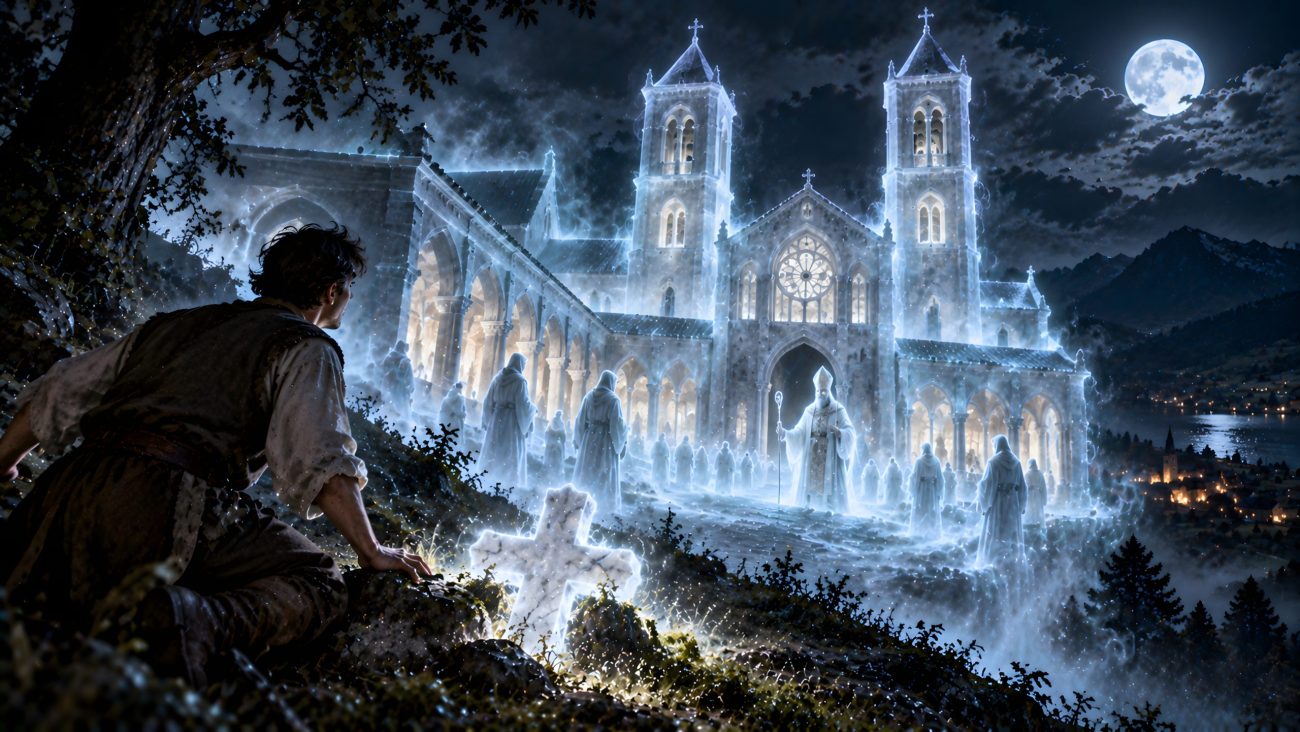
Near Menzingen in the Swiss canton of Zug, a monastery once stood before suddenly disappearing into the earth without leaving a trace. Yet its presence was not entirely forgotten. From time to time, the faint ringing of its hour bell could still be heard, calling the faithful to prayer as though the vanished religious community continued its devotions beneath the ground. The mysterious sound eventually drew the attention of a simple farmhand from Menzingen, who heard the bell and climbed the hill to investigate.

There, the farmhand discovered a brightly shining, square marble cross lying on the ground. When he reverently touched it, a magnificent monastery suddenly appeared before him, complete with two imposing bell towers. A pale monk emerged through a narrow gate and beckoned him inside. The farmhand followed him through a broad colonnade into a tall, dimly lit church, where a black curtain concealed the chancel. When the monk touched its hem, the curtain slowly rose, revealing richly decorated choir stalls occupied by sleeping monks. On a raised seat sat the abbot, wearing a gleaming mitre. The monk led the bewildered farmhand toward him.

The elderly abbot opened his eyes and asked in a dark, melancholy voice, “What time is it outside?” Thinking that he was expected to answer, the farmhand quickly replied that it was half past four. Immediately, a wild storm swept through the church. The monastery vanished, and the farmhand found himself sitting in a daze upon a large stone. According to the legend, had he remained silent instead of answering the abbot’s question, he would have become a rich man. The mysterious encounter thus offered a fleeting glimpse of the vanished monastery and the fortune that might have been his.


Sources

“Das verschwundene Kloster.” SAGEN.at – Traditionelle Sagen aus der Schweiz (Zug). Reproduced by SAGEN.at. https://www.sagen.at/texte/sagen/schweiz/zug/kloster_verschwunden.html


Hüper

Tradition: Swiss Mythology
Alternative Names: The Egelsee Hooter
Category: Ghost


The Myth

The Hüper is a mysterious haunting spirit associated with Lake Egelsee in the Swiss canton of Zug. Its legend dates back to the defeat of the Zurichers at Gubel in 1531, when a young horseman fled wildly from the battlefield. Reaching Lake Egelsee, he attempted to escape into the woods on the opposite shore. In the midst of his desperate flight, he found himself in grave danger and made a solemn vow to God in his heart, promising devotion if he were spared a sudden death.

When the horse finally carried him onto dry ground, the rider abandoned his pious intentions and began laughing and mocking the vow he had made. Suddenly, his horse turned around and leaped back toward the lake. The terrified rider struggled to control the animal, striking it and digging in his spurs while shouting, “Hup, hup!” But nothing could stop the horse. It plunged into the dark waters with its master, and the rider drowned miserably.

For many years afterward, a terrible cry could be heard around midnight near Lake Egelsee: “Hoo, hoo!” The sound was attributed to the restless spirit of the drowned horseman, known as the Egelsee Hooter or Hüper. Its mournful call served as a reminder of the rider’s broken vow and dreadful fate. According to the legend, however, the eerie cries ceased after the French came to the region, and the Hüper was never heard again.


Sources

“Der Hüper.” SAGEN.at – Traditionelle Sagen aus der Schweiz (Zug). Reproduced by SAGEN.at. https://www.sagen.at/texte/sagen/schweiz/zug/hueper.html


Wildenburg Castle Ghosts

Tradition: Swiss Mythology
Alternative Names: The Battle of Egelsee
Category: Ghost


The Myth

The lord of Wildenburg Castle was a quarrelsome knight who once became embroiled in a fierce dispute with the neighboring Baron of Wädenswil. Seeking to confront his rival, the knight led his men into the Winzwilerholz forest, where they established a camp. However, the cunning baron had discovered their position and maneuvered around them, bypassing the Wildenburg forces and threatening their castle. Realizing that they had been outwitted, the knight and his men hurried home to defend their stronghold.

Their retreat led to a vicious battle beside a stream near Egelsee. The Wildenburg warriors were fiercely attacked, and many were thrown into the nearby lake. So much blood flowed into the stream that its waters turned red, earning it the name of the Red Stream. The battle ended in terrible slaughter, leaving many of the Wildenburg knight’s men dead in the surrounding wilderness.

Afterward, the area around Egelsee became haunted by strange and frightening sounds heard during the night. Ghostly warriors mounted on wild horses were seen riding through the air, accompanied by the dreadful noise of cowbells. These spectral riders were believed to be the fallen men of Wildenburg, returning as restless spirits to reenact their violent fate. Their phantom battle preserved the memory of the bloody conflict, haunting the lake and its surroundings long after the warriors had perished.


Sources

“Die Geisterschlacht.” SAGEN.at – Traditionelle Sagen aus der Schweiz (Zug). Reproduced by SAGEN.at. https://www.sagen.at/texte/sagen/schweiz/zug/geisterschlacht.html