Blümelisalp

Tradition: Swiss Mythology
Alternative Names: The Flowering Alpine Pasture, The Cursed Alpine Meadow
Category: Ghost


The Myth

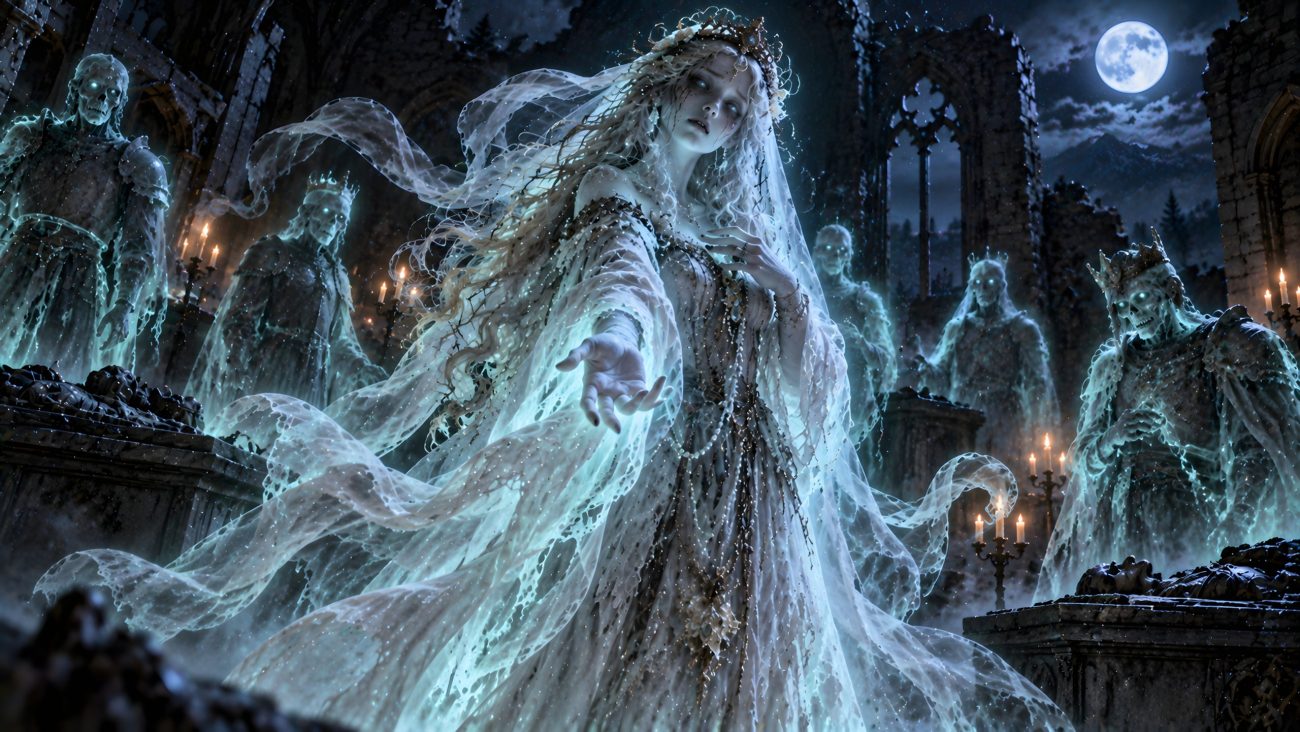
Blümelisalp is a legendary alpine pasture in Switzerland that was once extraordinarily fertile and covered in flowers, but was transformed into a desolate landscape of ice and rock debris. The legend explains its destruction as divine punishment for the arrogance and impiety of a wealthy herdsman who abused the abundance of the mountain and mocked the traditional customs of the land. Similar stories are told in several Swiss regions, including the Bernese Oberland and the Klariden mountain range. In the days before the catastrophe, the pasture was so rich that cattle thrived beyond measure. Each cow was milked three times a day and produced two large buckets of milk at every milking.

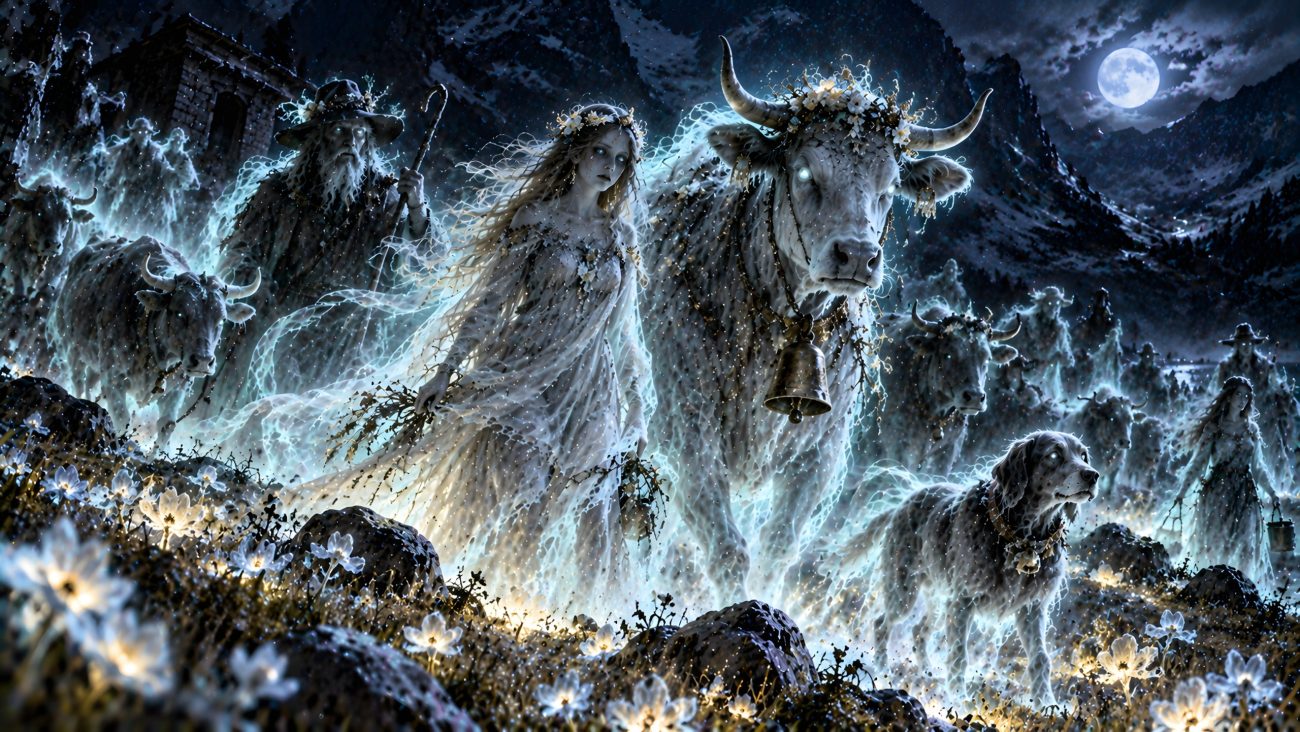
The prosperous herdsman grew proud of his wealth and began to scorn the simple customs of earlier generations. He furnished his mountain dwelling lavishly and pursued a beautiful maiden named Kathrine. His arrogance culminated in an act of sacrilege: he built a staircase into his house using his own cheeses, spread butter over them, and washed the steps with milk. His sweetheart Kathrine, his cow Brändel, and his dog Rhyn all used this extravagant staircase. His pious mother, unaware of her son’s behavior, visited the alpine pasture one summer Sunday. Exhausted by the journey, she asked for a drink. The herdsman filled a pail with sour milk, sprinkled sand over it, and offered it to her. Shocked by this deliberate insult, his mother descended the mountain and, once she reached the bottom, turned back and called upon God to punish her impious son.

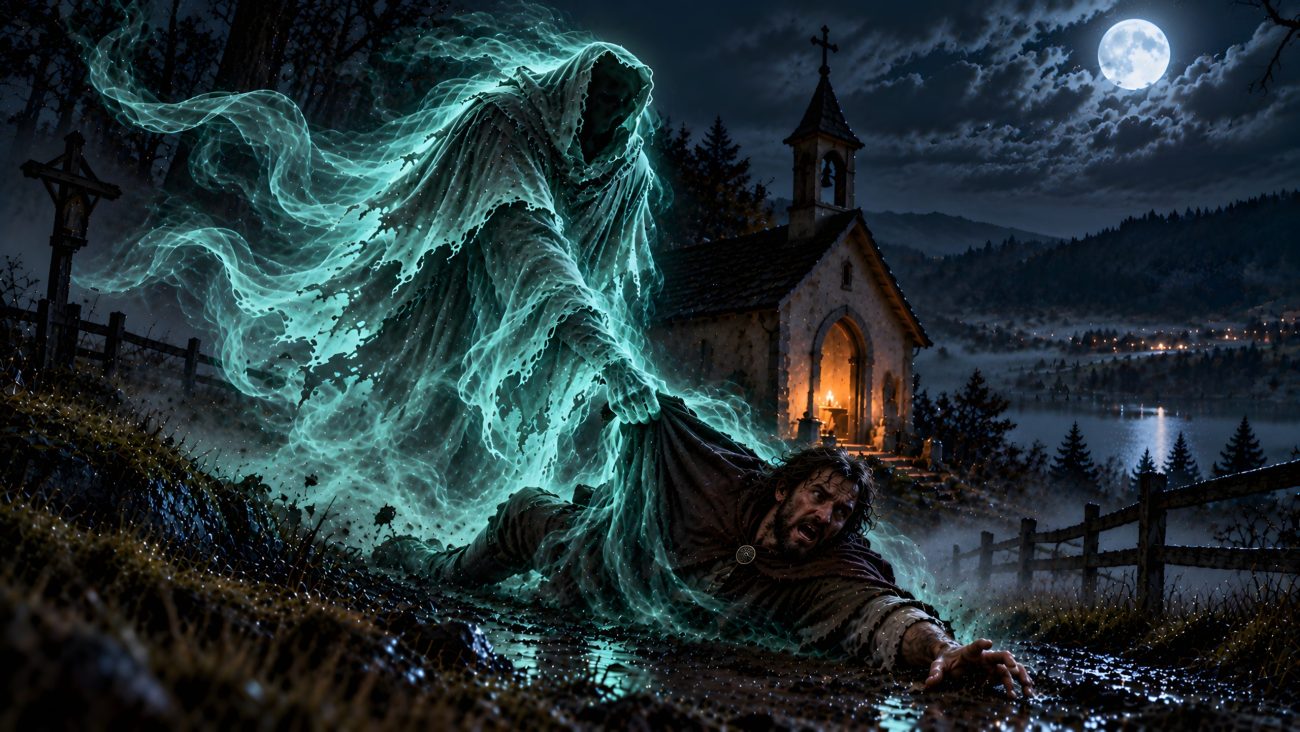
A violent storm suddenly swept across the mountain, devastating the once-blessed pasture. The herdsman’s dwelling and household were buried, and both people and animals perished beneath the destruction. The herdsman’s ghost and his household were condemned to wander the mountains until they could be redeemed. His lament declares that his dog Rhyn, his cow Brändli, and his beloved Kathry must remain on Mount Klaride forever. Redemption depends on a herdsman successfully milking Brändli in silence on Good Friday, despite the thorns surrounding her udder that make the cow restless and difficult to milk. One man once managed to fill half a bucket before another person suddenly tapped him on the shoulder and asked whether the milk was foaming nicely. The milker instinctively answered, breaking the required silence. At once, the attempt failed, and Brändlein vanished from his sight. The legend leaves the alpine household trapped under its curse, awaiting someone who can complete the difficult task without speaking.


Sources

“Der Hirte auf der Blümelisalp.” SAGEN.at – Schweizer Sagen. Reproduced by SAGEN.at. https://www.sagen.at/texte/sagen/grimm/bluemelisalp.html
Gauliweibchen

Tradition: Swiss Mythology
Alternative Names: The Gauliweibchen, Gauliwibli, The Curse of Blümlisalp
Category: Ghost


The Myth

The Downfall of a Midshead, His Kathrin and His Little Dog is a Swiss alpine legend explaining the destruction of once-fertile mountain pastures beneath the glaciers of the Bernese Oberland and Valais. The stories tell of wealthy herdsmen and dairymaids whose prosperity and abundance were destroyed by divine punishment for their wickedness. Their pastures, once covered in flowers and rich grass, were swallowed by advancing ice, burying dwellings, cattle, and people beneath glaciers and rock debris. The legends also describe restless spirits that continue to haunt these desolate mountain landscapes, accompanied by the sounds of invisible cattle bells and mournful voices.

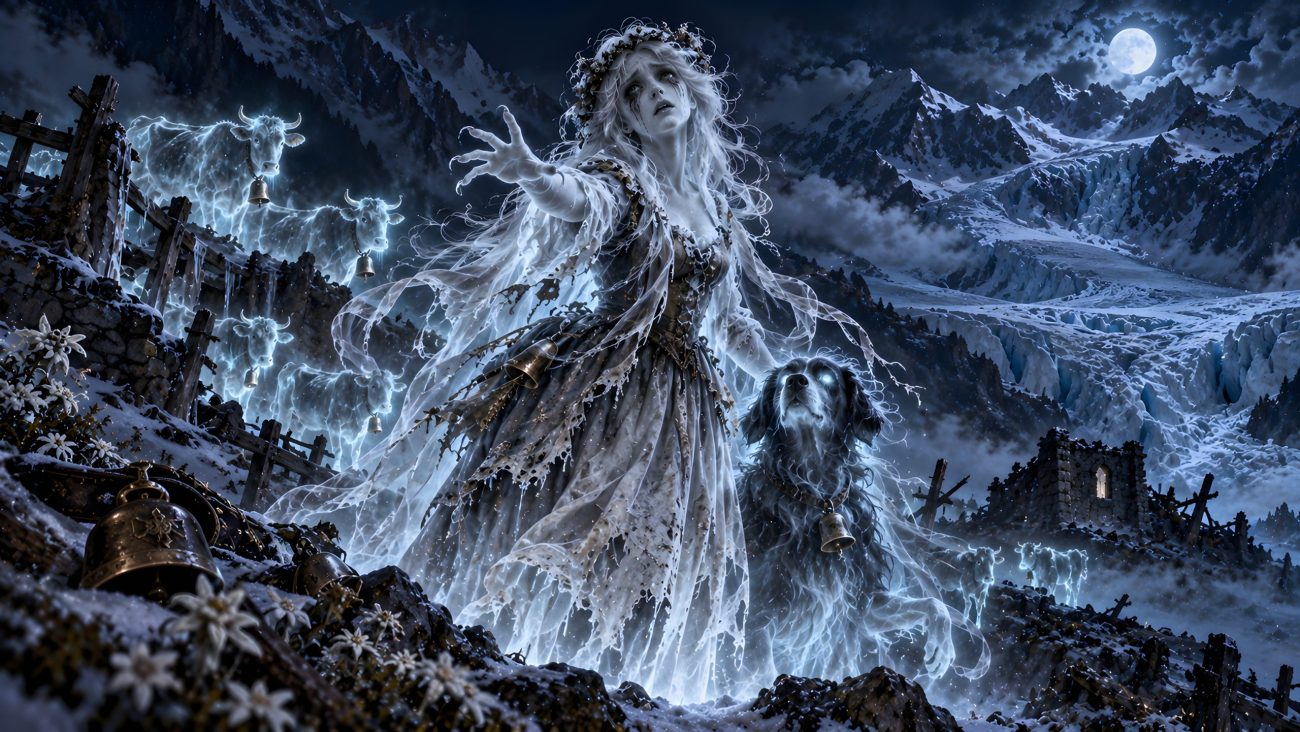
One version concerns the beautiful Blümlisalp, which once occupied the valley now covered by the Gauligletscher. The pasture belonged to a wealthy dairymaid whose wicked deeds brought heavenly punishment upon her household. The alpine meadow was cursed and buried beneath the glacier, killing the dairymaid, her little dog, a stranger, and her entire herd. The dairymaid’s ghost became known as the Gauliweibchen or Gauliwibli. She and her dog are said to appear occasionally to shepherds in the Gauli region. During one encounter, a man heard her lament that she, Kathrin, her cow Brün, and her dog Rhin must remain forever on Blümlisalp. Shepherds also sometimes hear the bells of cattle that cannot be seen. In the nearby Aaralp, another haunting is attributed to a headless woman from Valais, who has reportedly approached shepherds while they were milking goats.

A related version comes from the Turtmann Glacier in Valais. Before the glacier covered the valley, a magnificent alpine pasture called Blümlisalp flourished there. Its herdsman lived a dissolute life with a young woman named Kathrin and kept a black dog, while treating his elderly, blind father cruelly. One night, during a terrible thunderstorm, the son ordered his father to bring in cattle grazing at a distance. Afraid to disobey, the blind man ventured into the storm. Strangely compelled to continue onward, he wandered farther from the pasture, followed by the entire herd. At that moment, the glacier broke loose from the heights and swept over the pasture, burying the dwelling and its inhabitants beneath an immense mass of ice and rubble. The herdsman, Kathrin, and the little dog perished, and their former home could never again be seen. Before devastating floods, valley dwellers are sometimes said to glimpse the little black dog and hear a voice lamenting that Kathrin and the speaker must remain forever beneath the ice.

Another similar tale concerns the Oberplegi Alp on Mount Glärnisch. A herdsman who lived there had sinned with a young woman named Kathrin, built a staircase out of cheese, and served dung to his elderly mother. One day, he and Kathrin plunged into a crevasse. The herdsman is occasionally said to appear engulfed in flames, crying that he, Kathrin, and his dog Pari must remain forever beneath the ice. A comparable legend is also associated with the Clariden mountains. Across these stories, the destruction of fertile alpine pastures becomes a punishment for cruelty, arrogance, sexual misconduct, and the violation of obligations toward one’s parents. The surviving apparitions preserve the memory of the lost households, condemned to remain in the mountains that buried them.


Sources

“Der Untergang.” SAGEN.at – Sagen aus Vernaleken. Reproduced by SAGEN.at. https://www.sagen.at/texte/sagen/vernaleken/untergang.html


Homburg Castle Music

Tradition: Swiss Mythology
Alternative Names: Ghost Music of Homburg Castle
Category: Ghost


The Myth

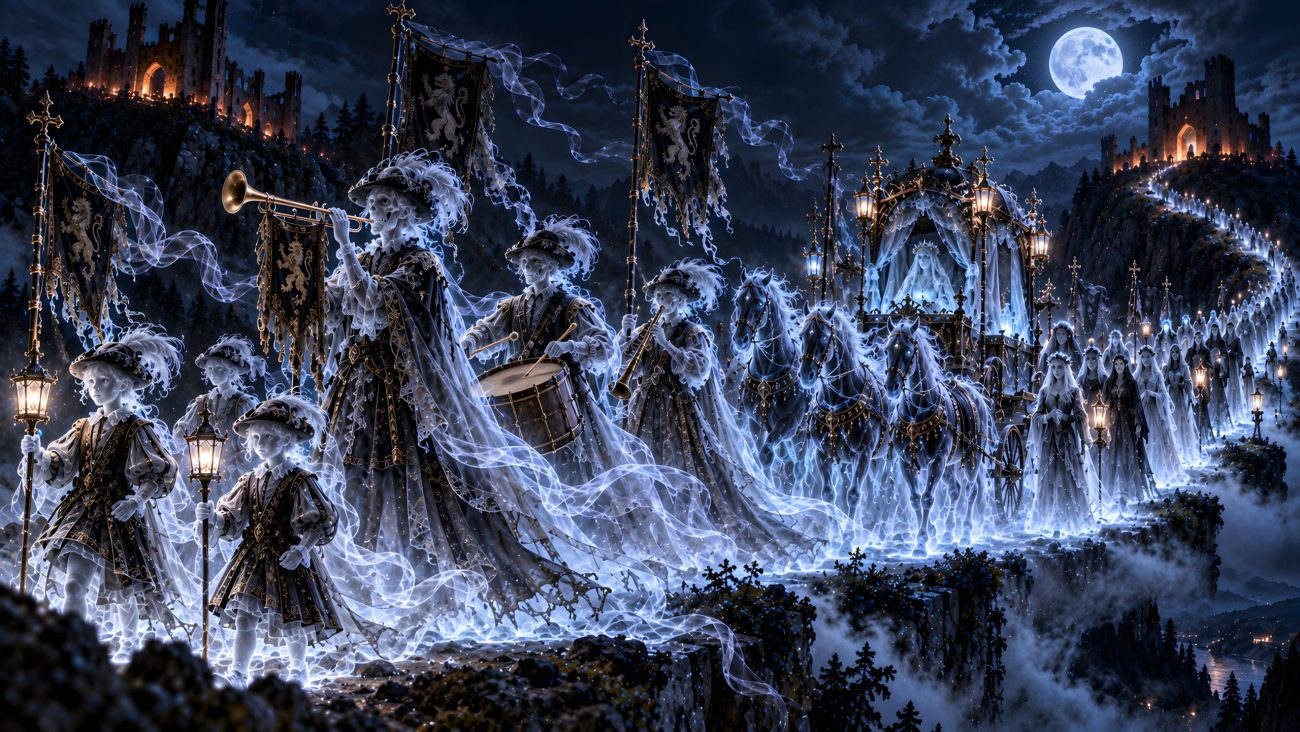
The Homburg Castle Music is a mysterious supernatural procession associated with the ruins of Homburg and Rechberg castles, which stand on opposite wooded summits of the Homberg ridge between Basel-Landschaft and the Fricktal region of Aargau, Switzerland. On moonlit nights, strange music can accompany an extraordinary procession traveling along a road suspended in the air between the two castles. The music is played by an otherworldly band of horn players, trombonists, and trumpeters, and the procession moves with uncanny grace and silence. The phenomenon is also regarded as a portent of severe summer thunderstorms, whose approaching fury can be heralded by the distant sound of the mysterious music.

One night, a traveler named Joseph Hochreuter from Wittnau was crossing the Homberg after returning from Basel-Land. As he descended the mountain, he discovered that the plain before him was blocked by a double hedge of living greenery, with a broad, perfectly straight highway running between the hedges. While he stood wondering at the sight, the night wind carried the sound of distant music toward him. Soon a magnificent procession appeared. At its head marched pairs of boys dressed like pages in identical black-and-white coats, arranged from the smallest to the largest. Behind them came men dressed entirely in black, followed by a band whose musicians played loudly as they advanced. A fine gentleman’s carriage drawn by six jet-black horses followed at a distance, with several ladies and gentlemen visible inside. Behind the carriage walked pairs of maidens in snow-white dresses, ranging from tiny children to fully grown women, while women in black cloaks brought up the rear.

The procession passed in remarkable order and elegance, raising no dust and making no sound beyond its music. Hochreuter soon realized that the highway did not follow the mountain’s slopes but ran straight through the air from Homburg Castle to Rechberg Castle. Eager to discover where the procession was going, he hurried toward the ridge to obtain a better view. Suddenly, the moon disappeared, plunging everything into darkness. The green hedges, the elevated highway, and the entire procession vanished, and the music gave way to thunder roaring in every direction. A violent storm broke over the mountain, and Hochreuter struggled to find his way down to the valley. According to the legend, the music of Homburg Castle can still be heard for hours across the surrounding countryside when a severe summer thunderstorm approaches.


Sources

“Die Homburger Schlossmusik.” SAGEN.at – Schweizer Sagen. Reproduced by SAGEN.at. https://www.sagen.at/texte/sagen/schweiz/allgemein/homburger_schlossmusik.html


Vanished Duke

Tradition: Swiss Mythology
Alternative Names: The Ghost of Charles the Bold, Charles of Burgundy
Category: Ghost


The Myth

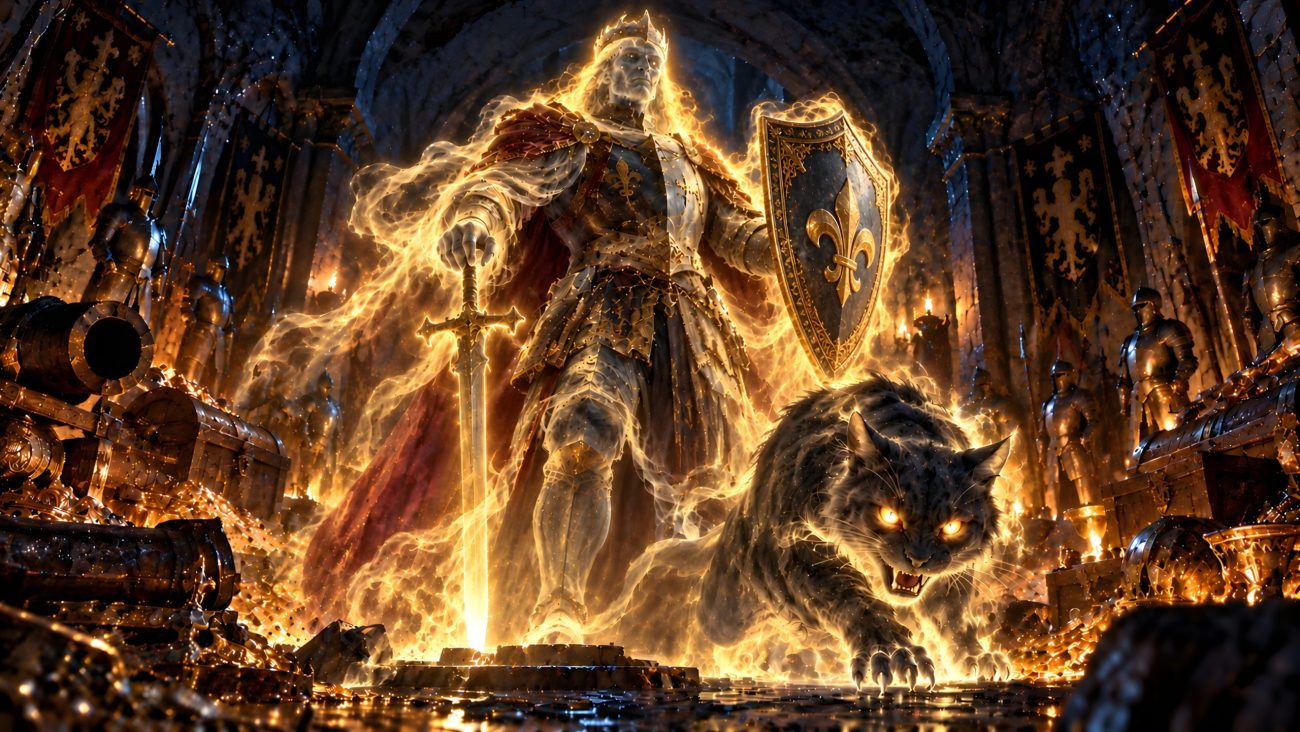
The Vanished Duke is the ghost of Charles of Burgundy, who haunts a hill between Grandson and Montagny in the Swiss canton of Vaud. According to legend, an ancient oak stands on the hill where the Swiss Confederation defeated the Duke of Burgundy. Beneath the earth lies a magnificent hidden hall filled with weapons, coats of arms, cannons, golden vessels, precious stones, jewelry, and countless treasures. The duke remains imprisoned there for centuries, awaiting a courageous person who can help redeem him by completing a dangerous task before midnight without uttering a single word.

One winter evening, a poor farmer named Johannes from Montagny passes the hill while mourning the rejection of his marriage proposal. The parents of his beloved Margrit have refused to let their daughter marry him because he lacks wealth. As Christmas approaches, an armored knight suddenly appears and addresses Johannes by name. Knowing of his troubles, the knight promises him great riches if he returns alone to the hill on Christmas Eve after eleven o’clock. Johannes must carry something to Lake Neuchâtel and then remove the knight’s sword belt before midnight. If he succeeds without speaking, the treasures hidden beneath the hill will be his. The knight then vanishes, leaving Johannes to wonder whether he can fulfill the strange promise.

On Christmas Eve, Johannes returns to the hill despite the bitter cold and his growing fear. The knight appears again, strikes the ancient oak with his sword, and causes both of them to sink into the earth. Inside a magnificent, brightly lit hall, Johannes sees the treasures but is soon confronted by a large, coal-black cat with fiery eyes. The knight orders him to carry the creature to the Tophet, a rock on Lake Neuchâtel, and throw it into the water. Johannes obeys, enduring the cat’s fierce scratches without crying out. When he throws it into the lake, the water begins to ripple and boil, and he hurries back to the underground hall.

There, the knight reveals his identity as Duke Charles of Burgundy. He explains that his misfortune began after he broke his word and had several Swiss men hanged from the trees on the hill. Since then, he has been forced to wait for centuries until someone courageous enough to redeem him arrives. Johannes must now remove the duke’s sword belt without speaking. As he works, the duke mysteriously grows taller, forcing Johannes to stretch up on tiptoe. When the heavy sword slips from its scabbard and cuts him, Johannes nearly cries out but manages to remain silent. At that moment, the clocks of Grandson and Yverdon strike midnight, completing the task.

The redeemed duke thanks Johannes and allows him to take some of the treasure. Johannes gathers gold coins in his handkerchief and suddenly finds himself back beside the oak tree, with the coins still in his possession. The following day, he returns to Margrit’s parents, who change their minds when they see his newfound wealth and agree to the marriage. Johannes later donates money to the people of Montagny so that they can build a beautiful church. Through his courage, silence, and faithfulness to his promise, he wins both the treasure and the woman he loves while freeing the vanished duke from his centuries-long imprisonment.


Sources

“Der verschwundene Herzog.” SAGEN.at – Schweizer Sagen. Reproduced by SAGEN.at. https://www.sagen.at/texte/sagen/schweiz/allgemein/verschwundene_herzog.html


Key Maiden

Tradition: Swiss Mythology
Alternative Names: The White Virgin of Tegerfelden, The Enchanted Maiden of Tegerfelden Castle
Category: Ghost


The Myth

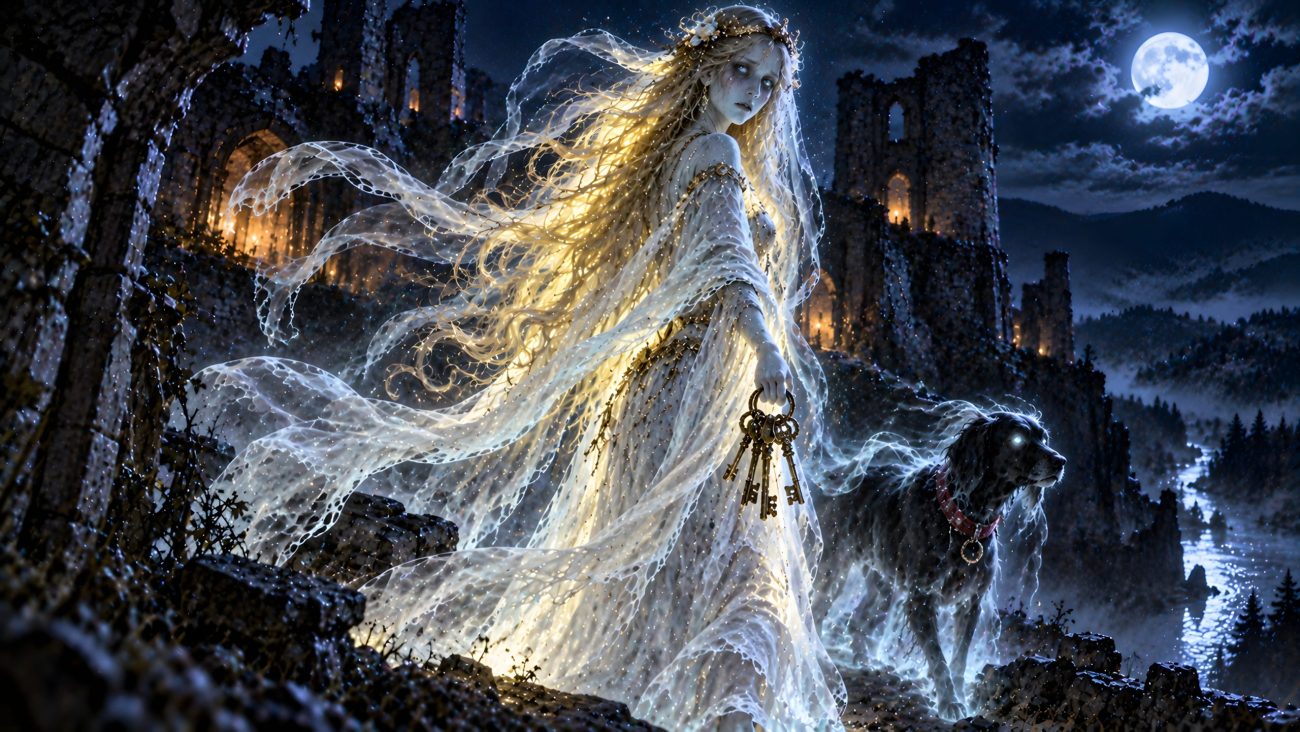
The Key Maiden is the ghost of a beautiful noblewoman who haunts the ruins of Tegerfelden Castle in the canton of Aargau, Switzerland. She appears as a pale maiden dressed in flowing white garments, with long, radiant golden hair and a jingling bunch of keys at her belt. She is often accompanied by a small black dog wearing a red collar and can be seen wandering around the ruined castle walls, collecting water from the Surb River, or performing strange rituals beneath the moonlight. Although she sometimes appears in broad daylight, her presence is surrounded by melancholy and enchantment. She remains trapped by a curse connected to her pride, the deaths of her rejected suitors, and the fate of the children who sleep in the underground halls beneath the castle.

One evening, a shepherd boy sees a small light approaching from the castle. It gradually transforms into the white-clad maiden, whose golden hair shines like a lock of sunlight. She fills a small jug with water from the Surb and sings a sorrowful song. When she pauses beside the bush where the shepherd is hiding, she seems to expect him to speak to her, but he is too frightened to respond. She sadly disappears into the castle moat. The shepherd later sees her repeatedly circling the ruins, followed by her black dog, and hears the keys in her hand ringing like silver bells. On another occasion, a poor farmer fishing beside the Surb finds a luminous golden lock floating toward him. After he foolishly throws it back into the water, the maiden appears and begs him to retrieve it. He obeys, and she ties one of its hairs to his fishing line, promising him good fortune in exchange for saying the Lord’s Prayer for her every week. His catch becomes extraordinarily abundant, and he grows wealthy. However, he eventually abandons his religious obligation and wastes his fortune. The black dog then emerges from the water and bites through the golden hair on his fishing line, ending his good luck. The farmer loses his wealth, descends into madness, and is eventually found dead in the river.

The maiden’s curse can supposedly be broken only by a Sunday-born child, who must be raised in a cradle made from a tree cut down on Good Friday and dried for a year. A woodturner who attempts to cut such a tree is given three trials by the maiden. She leads him through underground halls where ancient warriors sleep, followed by young men and women, and finally children guarded by a gigantic snake and an enormous, poisonous-looking toad. He succeeds in kissing the black dog and the maiden herself, but recoils in horror from the toad. This failure causes the maiden’s white dress to turn black, and the woodturner is cast out of the castle, his hair and beard turned white. He subsequently goes mad, calling for the maiden every day, but never sees her again.

Another attempt at redemption comes from a poor miller’s apprentice born on a Sunday. After being mocked at a New Year’s dance, he visits the castle and asks the maiden to dance with him. She accompanies him to the village, where they perform three dances before an admiring crowd. He then follows her into the underground halls, where she explains the origins of her curse. In life, her pride and vanity led her to reject many suitors by demanding that they ride three times around the castle’s dangerous cliffs. All who attempted the feat fell to their deaths, until one low-ranking knight succeeded. However, the maiden’s mother secretly poisoned the potion intended to seal their engagement, causing the knight to fall asleep before she had him thrown from the cliffs. Overcome by despair when she learned of his death, the maiden leapt to her own death as well. She was condemned to guard the victims of her arrogance. The apprentice must kiss the dog, kiss the maiden, and collect hairs from the sleeping youths and old warriors before midnight so that the enchantment can be lifted. He courageously performs the tasks but fails to escape before the gates close at twelve. The gates remain shut forever, and he is eventually found dead in a mill.

The maiden appears one final time to a traveler near the Surb River. He witnesses her riding a snow-white stag around the castle nineteen times before returning to the riverbank to comb her golden hair with a golden comb. She sings that another hundred years must pass before her hair reaches the ground, at which point she will finally find peace and ascend to heaven. The traveler watches in silent wonder, too enchanted to speak or help her. Only after she disappears does he realize that he may have missed his chance to redeem her and claim her magical treasures, including her golden comb, glittering headband, and silver fife. The Key Maiden therefore remains bound to the castle, awaiting the fulfillment of the conditions that will finally release her from her centuries of sorrow.


Sources

“Die Schlüsseljungfrau.” SAGEN.at – Schweizer Sagen. Reproduced by SAGEN.at. https://www.sagen.at/texte/sagen/schweiz/allgemein/schluesseljungfrau.html


Night Dance at Schallberg

Tradition: Swiss Mythology
Alternative Names: The Ghost Dance of Schallberg
Category: Ghost


The Myth

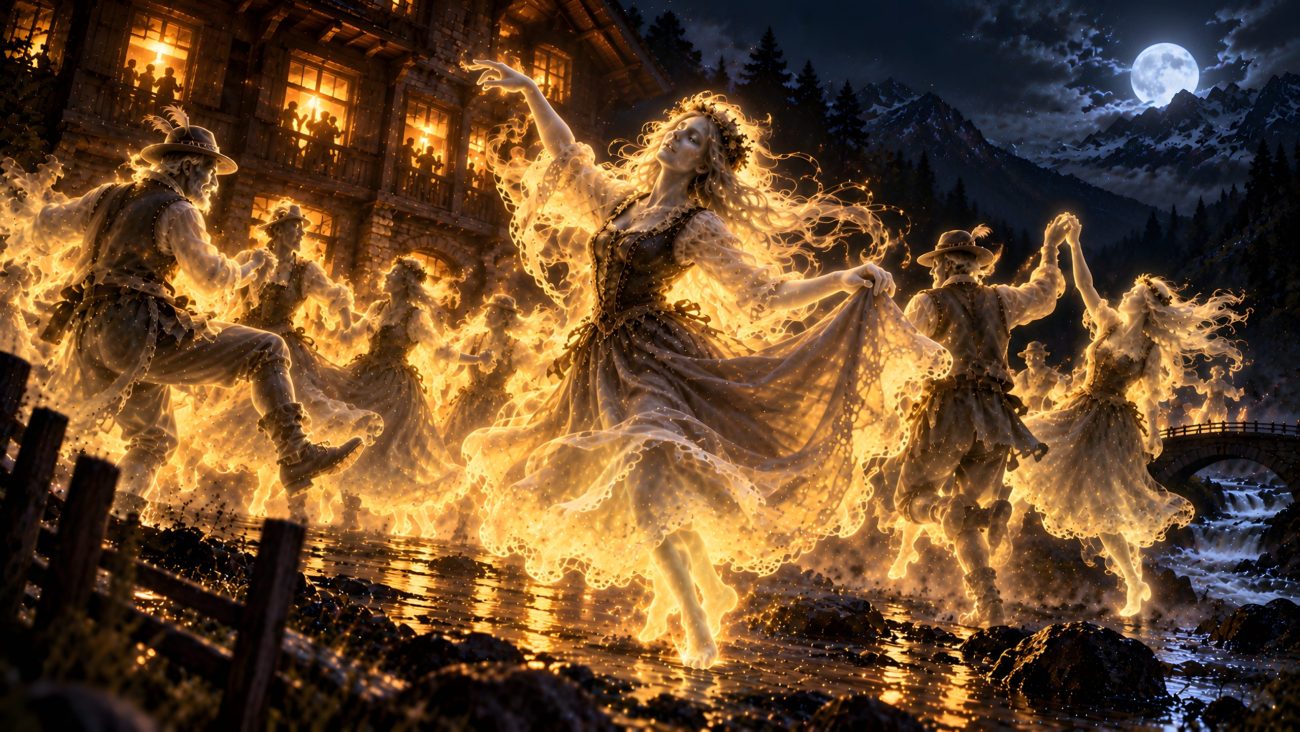
The Night Dance at Schallberg is a supernatural legend from the Valais region of Switzerland, set near the lower Schallberg in the Ganter Valley. At night, an isolated house appears brightly illuminated, filled with deafening dance music, the pounding of mountain boots, and the joyous cries of numerous dancers. Yet the gathering behaves in a disturbing and unnatural manner: whenever an observer climbs a nearby tree to watch, the lights and music abruptly disappear, leaving only the rushing waters of the Saltina River. As soon as the observer climbs down, the mysterious dance begins again. The dancers are eventually revealed to be an enchanted company condemned to atone for secret dances held in defiance of the rules.

One night, a shepherd returning from the Alpine pastures follows an old mule track through the Ganter Valley. After passing through an eerie fir forest, he notices the illuminated windows of a secluded house at Schallberg. Hearing the lively music and heavy stamping inside, he suspects that young people have gathered for a forbidden dance. Curious but unwilling to enter, he climbs into a nearby elder tree to watch. The moment he settles among the branches, the music stops and the lights go out. When he climbs down, however, the house immediately becomes illuminated again, and the dancing resumes. He repeats the experiment, only to witness the same strange disappearance. Eventually, fear overwhelms him, and he flees into the night.

Despite his terror, the shepherd later grows curious about the dancers’ identities. He waits near the Chin Bridge until the morning bell approaches, when he hears music and excited cries coming from the direction of the Aspe. A procession of dancers advances toward him, their sounds growing louder as they approach. In the moonlight, their pale, aged faces seem strangely familiar, as though they belong to young people he once knew, yet he cannot recognize anyone. Just as he prepares to join the seemingly cheerful company, the entire procession suddenly plunges into the Chin River and disappears into the raging Saltina, like a fiery sack of leaves. Horrified, the shepherd escapes the region, convinced that he has witnessed an enchanted group of dancers condemned to make amends for their forbidden revelry.


Sources

“Der Nachttanz am Schallberg.” SAGEN.at – Schweizer Sagen. Reproduced by SAGEN.at. https://www.sagen.at/texte/sagen/schweiz/allgemein/nachttanz_schallberg.html


Saanenland Ghosts

Tradition: Swiss Mythology
Alternative Names: Friesenweg, The Path of the Dead Frisians
Category: Ghost


The Myth

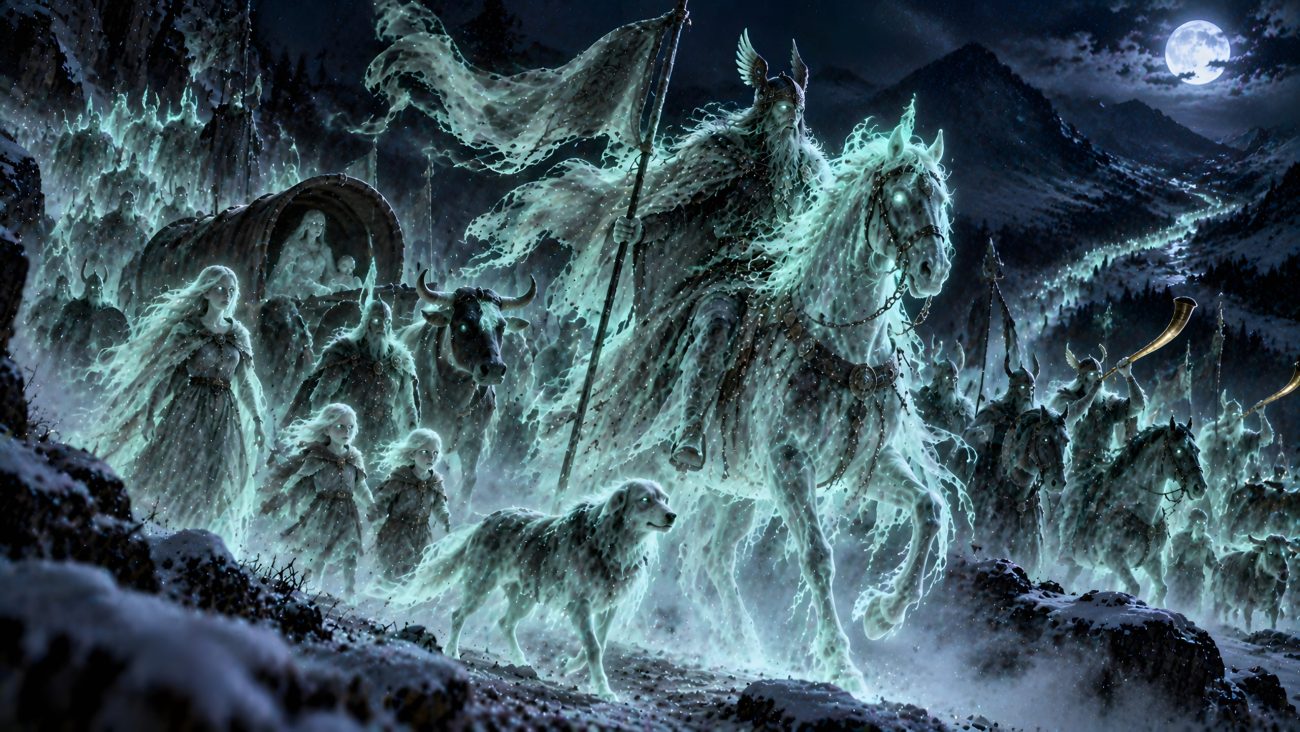
The Frisian Way is a haunted trail in the Saanenland of the Bernese Oberland in Switzerland, where the spirits of an ancient Frisian people travel through the night on their way back to their former homeland beside the North Sea. Their passage is accompanied by thunderous roaring, crashing, howling, ringing bells, and the blaring of horns. The dead are said to rise from their graves on certain nights, particularly around the winter solstice, gathering into an immense procession of warriors, horsemen, women, children, and animals. Although the spirits follow their traditional route without deviating, anyone who obstructs their way risks provoking their terrible wrath.

According to legend, the Frisians originally came to the Saanenland after famine and floods drove them from their homeland by the sea. They settled in the green Alpine valleys, cultivated the pastures, and drove wild animals into the surrounding forests. Nevertheless, they never forgot the distant shores from which they had come. On certain nights, they rise from their burial mounds and retrace their ancient route toward the North Sea. When they hear the roaring and crashing of the sea, they return to their graves in the Swiss mountains. Anyone or anything standing in their path may be swept aside as violently as if an avalanche were descending upon it.

The danger of obstructing the procession became clear when a cattle barn was built directly across the Frisian Way on an Alpine pasture. Fortunately, its two doors stood exactly where the path entered and exited the building, allowing the dead to pass through unhindered. The herdsman always left both doors open at night and suffered no harm. Before leaving to visit his family in the valley, he warned his head farmhand never to close the doors. The farmhands, however, mocked this precaution and deliberately barred the passage.

That night, a distant murmur awakened them, growing into a tremendous roar accompanied by the sounds of horns, neighing horses, barking dogs, cracking whips, and clashing weapons. A thunderous impact shook the barn, and a voice demanded that the doors be opened because the Frisian people wished to pass through. When the farmhands refused to move, the entire roof was lifted into the air, exposing the terrified men to the starry sky before crashing back into place. Realizing the danger, the head farmhand finally called upon God and opened both doors.

An extraordinary procession immediately swept through the barn. Towering men greeted the farmhand courteously before an immense army of warriors rushed past, clad in fluttering bullskins and carrying spears, battle-axes, swords, and enormous shields. Their horns projected menacingly above their fair hair. Horsemen in winged helmets followed on snorting steeds, accompanied by foot soldiers, enormous carts carrying golden-haired women and children, nimble boys, and shaggy dogs. More warriors and horses continued to pass in an apparently endless stream. The procession lasted until dawn illuminated the snow-covered mountain peaks. The farmhand returned to the hayloft, trembling with fear, and recounted everything he had witnessed. After telling his story, he never spoke again and died by evening.


Sources

“Der Friesenweg.” SAGEN.at – Schweizer Sagen. Reproduced by SAGEN.at. https://www.sagen.at/texte/sagen/schweiz/allgemein/friesenweg.html


Ruchenberg Castle Knight

Tradition: Swiss Mythology
Alternative Names: The Golden Skittles of Ruchenberg
Category: Ghost


The Myth

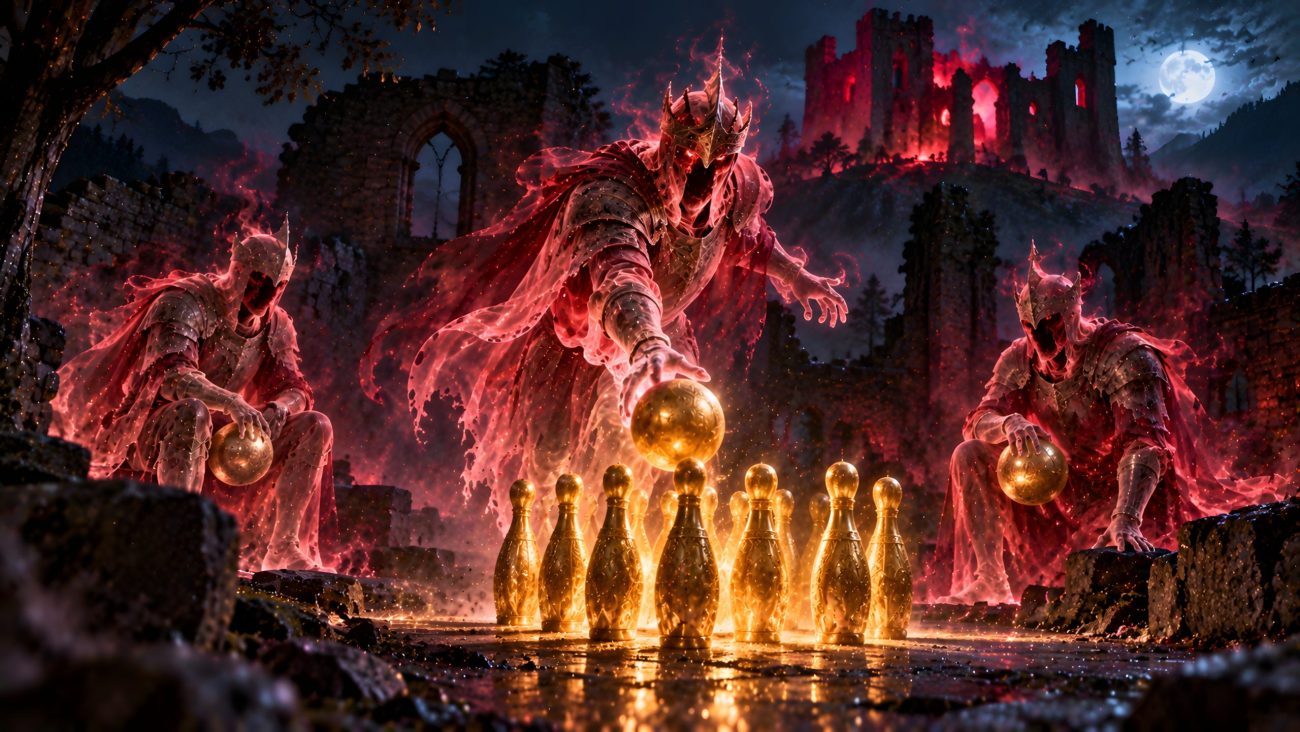
The Golden Bowling Game is a supernatural legend associated with the ruined Castle Ruchenberg in the canton of Graubünden, Switzerland. The castle is said to have been haunted since ancient times. On certain nights, its ruins glow with a brilliant red light, while strange flashes illuminate the surrounding trees and bushes. Ghostly figures move among the crumbling walls, accompanied by the clanging and crashing of iron. At the center of this eerie spectacle, three knights in clanking iron armor play a mysterious game of skittles with a set of nine golden pins and golden bowling balls.

One night, a farmer passing the ruins hears the strange noises and notices the red glow. Curiosity overcomes his unease, and he approaches the castle to investigate. From the shelter of a large tree, he watches the three knights repeatedly attempt to knock down all nine golden pins. Although they throw their golden balls with great force, they never manage to topple every pin. The farmer, who prides himself on his own bowling skill, becomes increasingly frustrated by their inability to complete the game. When the knights eventually grow tired and lie down as though asleep, he decides to demonstrate that he can do better. He also hopes to steal one of their precious golden balls.

The farmer quietly takes a ball, carefully aims, and launches it down the bowling lane. With a tremendous crash, all nine golden pins tumble over. Delighted, he cries out, “All nine!” A ghostly echo repeats his words from the castle. Immediately, the knights shout, and a tremendous commotion erupts around the ruins. Thunder crashes, and the knights, golden balls, and skittles sink into the earth. The brilliant light disappears, leaving the farmer alone in the dark woods. Once his fear subsides, he hurries away, but for the rest of his life he regrets having spoken aloud. He believes that, had he kept silent, he might have freed the knights from their supernatural imprisonment and claimed the magnificent golden bowling set.


Sources

“Das goldene Kegelspiel.” SAGEN.at – Schweizer Sagen. Reproduced by SAGEN.at. https://www.sagen.at/texte/sagen/schweiz/allgemein/goldene_kegelspiel.html


Dead Bride

Tradition: Swiss Mythology
Alternative Names: The Bride of Windegg Castle, Berta von Windegg
Category: Ghost


The Myth

Berta von Windegg is the ghostly bride of Windegg Castle in the Glarus region of Switzerland. She appears as a beautiful, pale maiden with curly hair and an enigmatic silence. Although she wears the appearance of a living noblewoman, her hands are ice-cold, and her true nature becomes apparent when she leads a prospective bridegroom into the castle chapel, where the tombs of her dead ancestors awaken. Berta is the last of her noble line and remains trapped in the ruined castle, waiting for someone who can finally redeem her.

One night, a poor knight named Kunz von Stein arrives at Windegg Castle seeking shelter. Despite its ruined exterior, he discovers an illuminated ballroom filled with splendid decorations, fine food, and wine. There he meets Berta, who silently welcomes him to the table. She answers his questions only by nodding, but Kunz learns that she is unmarried and appears to possess the entire estate. Hoping to gain both a wealthy wife and a noble inheritance, he declares his love and asks her to marry him. Berta agrees, places a golden ring on his finger, and accepts the ring he gives her in return. Although her icy hands make him shudder, Kunz suppresses his unease and follows her through dark corridors into the castle chapel.

Inside, the knight witnesses a terrifying spectacle. Berta approaches the tombs of her ancestors and touches the stone effigies lying upon them. One after another, the figures rise from their sarcophagi, their armor rattling and their garments rustling as they gather around the altar. An aged priest appears and asks Kunz whether he will take Berta von Windegg, the last of her line, as his wife. Paralyzed by terror, Kunz cannot answer. As the priest prepares to bless the couple, a rooster crows nearby. Berta cries out that she has not yet been redeemed, and the assembled knights and noblewomen immediately return to their tombs, becoming stone once more.

A sudden gust of wind carries Kunz out of the castle, where he collapses beside his horse. When he awakens, Windegg has become nothing more than an empty, crumbling ruin in the morning light. Unable to forget Berta or the bride he had failed to save, Kunz renounces worldly life and enters a monastery, placing his golden betrothal ring on the altar. He eventually dies at a very old age, but Berta remains at Windegg Castle, still waiting for the savior who will release her from her ghostly existence.


Sources

“Die tote Braut.” SAGEN.at – Schweizer Sagen. Reproduced by SAGEN.at. https://www.sagen.at/texte/sagen/schweiz/allgemein/tote_braut.html


Old Helgenhüsli Ghost

Tradition: Swiss Mythology
Alternative Names: The Haunted Helgenhüsli, The Spirit of Nasenegg
Category: Ghost


The Myth

The old Helgenhüsli, a small wayside chapel that once stood along the path from Erlenmoos to Schwandegg, near Bärfalle, was reputed to be haunted. Although the building was demolished about a century ago, stories of its supernatural disturbances survived. One night, Ammann Uhr was returning from Einsiedeln and attempted to pass the little chapel, but a mysterious spirit led him astray. He wandered through the surrounding moorland for three hours, unable to recognize the landscape or find his way. Only as dawn approached did the misleading presence finally depart, allowing him to escape the bewildering ordeal.

The chapel was also said to repel those who tried to enter it. A man from Holzhäusern once went there at night to wait for a friend. As he attempted to enter the building, an invisible hand gave him a powerful shove, preventing him from going inside. The same strange occurrence had reportedly happened to the friend he was expecting, suggesting that an unseen spirit guarded the little chapel and refused entry to visitors.

Another eerie place lay along the road from Zug to Walchwil, below Lothenbach, at a spot known as Nasenegg. This location was associated with an apparition witnessed by a sober local man, who claimed to have seen a ghost there years earlier. The figure was particularly strange because it possessed neither a head nor any other limbs. These accounts established several locations around Zug as places where invisible forces, disorienting spirits, and bizarre apparitions disturbed those who encountered them.


Sources

“Die Gespensterorte.” SAGEN.at – Traditionelle Sagen aus der Schweiz (Zug). Reproduced by SAGEN.at. https://www.sagen.at/texte/sagen/schweiz/zug/gespensterorte.html