Prince Snake

Tradition / Region: Moldova Mythology
Alternative names: The Snake Prince
Category: Snake


The Myth

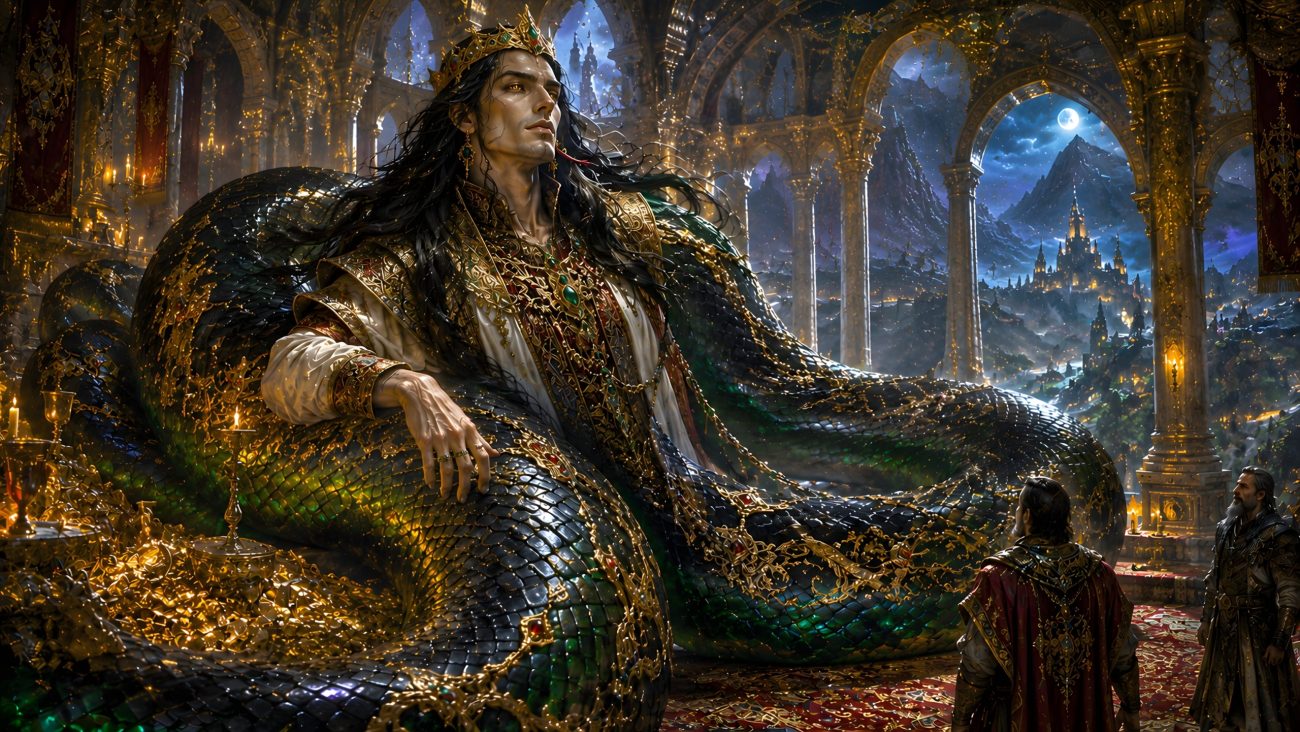
Prince Snake began life as a tiny serpent discovered inside an old man’s bag beside a well. The childless old couple adopted him as their son and raised him inside their small house. Fed with milk and nut kernels, the little snake grew with unnatural speed until his enormous body cracked the beams of the house and sank it into the ground beneath his weight.

When he became grown, the serpent demanded the hand of the king’s daughter. The king refused and tried to destroy him through impossible tasks. He ordered valleys dug overnight, mills built, seas brought beneath palace windows, vineyards raised in a single night, and golden roads covered with singing golden birds. Yet every task was completed by vast hosts of snakes and invisible serpents summoned by the prince’s terrible whistle.

At last the king surrendered and agreed to the marriage. The prince demanded an iron carriage with twenty-four wheels pulled by twenty-four horses because an ordinary carriage could not support his monstrous body. When he arrived at the wedding feast, his tail alone required three extra carriages. During the feast he coiled himself around the banquet tables so guests could sit upon him like benches.

But the serpent form was only a curse.

At night, after the wedding, he removed his snake skin and revealed his true appearance: an extraordinarily handsome prince crowned in gold and dressed in robes covered with pearls and precious stones. By day he was forced to wear the serpent skin, but after three more days the curse would have broken forever.

The princess, persuaded by her mother, secretly burned the snake skin while the prince slept. The fire hissed so violently that the earth trembled and the sky rang with noise. Furious and heartbroken, the prince revealed that the curse had almost ended naturally. Because the skin had been destroyed too early, he vanished beneath another enchantment, leaving his wife only a prophecy and three iron rings fixed upon her body.

To find him again, the princess wandered through distant lands and encountered Holy Wednesday, Holy Friday, and Holy Sunday, each guarding magical objects and accompanied by steel-toothed dogs. Eventually she reached the land of the fairies where the prince had been enchanted with food and drink of forgetfulness, causing him to forget his former life.

For three nights she wept beside him while he slept under magical enchantments. On the third night a rooster revealed the truth to the prince. His memory returned, he embraced his wife, shattered the iron rings with his hands, and their child was born instantly as a seven-year-old boy.

The prince then summoned countless serpents with another supernatural whistle. They brought forth a magnificent carriage and white horses from beneath the earth. Refusing to remain among the fairies, the prince returned home with his wife and child, where they lived together in peace beside the old couple who had once raised a tiny snake as their son.


Sources

Botezatu, G. (1986). Moldavian folk-tales (2nd rev. & enl. ed.). Kishinev: Literatura Artistikă.


Iron-Toothed Dog

Tradition / Region: Moldova Mythology
Alternative names: Little Dog with Iron Teeth and Steel Claws
Category: Dog


The Myth

The Iron-Toothed Dog is a supernatural guardian creature from Moldovan folklore, remembered as a small but terrifying magical hound with iron teeth and steel claws. Though not large in size, it was feared as a deadly protector capable of tearing intruders apart.

The creature lived beside an old woman deep within the wilderness beyond forests and mountains. Her cottage was surrounded by a fence so tightly built that even the wind could not pass through it. Travelers who approached the house were warned immediately about the dog.

The old woman would call out from inside:

“If you are a good man, open the gate and come in, but if you are bad, go away and do not come near my cottage, because I have a little dog with iron teeth and steel claws, and he will tear you to pieces if he sees you.”

The dog served as a supernatural judge of character. When the hero Aliman arrived during his journey to the Red King’s realm, the creature immediately recognized that he was good-hearted. Instead of attacking him, the iron-toothed dog became gentle and affectionate toward him “as if he were his master.”

The old woman herself was no ordinary human. She was Holy Wednesday, mistress of wolves, foxes, bears, hedgehogs, and wild beasts of the forest. The iron-toothed dog guarded her isolated home and protected the boundary between the human world and the dangerous supernatural wilderness around it.

Unlike many monstrous hounds in folklore, the Iron-Toothed Dog was not evil by nature. It attacked only the wicked and recognized goodness instinctively, acting as both guardian and judge for those who crossed into the enchanted forest.


Sources

Botezatu, G. (1986). Moldavian folk-tales (2nd rev. & enl. ed.). Kishinev: Literatura Artistikă.



Sugur-Mugur

Tradition / Region: Moldova Mythology
Alternative names: Sugur Mugur
Category: Giant, Hero


The Myth

Sugur-Mugur was a legendary supernatural warrior from Moldovan folklore, feared for his immense strength and remembered as one of the greatest heroes imprisoned beneath the earth. Even after years of captivity, blacksmiths and travelers still spoke his name with awe.

He had once been so powerful that only horses wearing enormous magical horseshoes could carry him. Smiths said that no man besides Sugur-Mugur had ever ridden with iron, steel, or diamond horseshoes weighing twenty-five pounds each.

For twenty years the Black King kept him imprisoned deep underground in a dungeon sealed with gigantic chains. He survived there on only a crust of bread and a glass of water each day until a young hero named Peter finally freed him. When Sugur-Mugur emerged from the prison, he looked like a living skeleton, weak from starvation and age.

Yet his strength returned rapidly. After days of eating and drinking from magical supplies, Sugur-Mugur released terrifying cries that shook mountains, darkened rivers, toppled forests, and made the earth itself tremble. By the third great shout, hills collapsed and the world seemed to tilt beneath him.

Sugur-Mugur rode a monstrous black horse named Black-Devil, fed on burning coals until it became powerful enough to fly over impossible landscapes. Together with Peter, he crossed deadly stone and flint mountains that destroyed ordinary horseshoes, forcing blacksmiths to forge gigantic shoes of iron, steel, and finally diamond.

Despite his fearsome power, Sugur-Mugur became Peter’s loyal protector. He guided him to the radiant maiden Ilyana Kosinzyana, helped him infiltrate her magical castle, and defended the young couple during their long journey home. Each night while they slept, Sugur-Mugur remained awake watching for danger.

Three prophetic birds warned him repeatedly about traps prepared by the Forest Witch: poisoned wine, cursed flowers hiding wolf fangs and bear teeth, and finally an attack by twelve dragons. Sugur-Mugur secretly prevented every disaster, but each time he revealed part of the prophecy he was slowly transformed into stone.

At last he fought the Forest Witch and her dragons alone during a storm of thunder and fire. His sword shattered while battling the witch, yet he killed her with the broken hilt after slaying all twelve dragons. Only afterward did he reveal the final prophecy and become completely petrified.

Peter and Ilyana later restored Sugur-Mugur to life using the blood of a magical red goat that had once given supernatural strength. When he awoke from stone, Sugur-Mugur simply said:

“What a long sleep I have had.”

He remained remembered as a giant protector and wandering hero whose strength could shake the earth itself, yet who used that power to defend others from witches, dragons, and death.


Sources

Botezatu, G. (1986). Moldavian folk-tales (2nd rev. & enl. ed.). Kishinev: Literatura Artistikă.


White Bird with the Golden Tail

Tradition / Region: Moldova Mythology
Alternative names: The White Bird, Golden-Tailed Bird
Category: Bird


The Myth

The White Bird with the Golden Tail is a mysterious supernatural creature from Moldovan folklore connected with enchanted trees, magical kingdoms, and distant otherworldly realms. It appears first as a radiant white bird with a shining golden tail, but later reveals its true form as a beautiful fairy-like maiden.

The story begins with an Emperor and Empress who longed for a child. After the Empress walked through the Blue Grey Wood at dawn along an untouched path wet with dew, she gave birth to a miraculous son named Break-of-Day. At the same time, an enormous tree began growing in the imperial garden, rising so high that its top disappeared into the sky. At its summit grew three golden apples.

Many warriors tried to climb the tree and failed, but Break-of-Day spent twelve years climbing until he finally reached the top. There he discovered the White Bird with the Golden Tail descending from the sky to eat the apples. Before the creature could devour the last one, Break-of-Day seized the bird by the tail. The bird escaped, leaving behind a golden feather while the prince saved the final apple.

Determined to find the strange being, Break-of-Day journeyed through magical lands and eventually learned from the Black Arab — a powerful supernatural ruler and shapeshifter — that the bird was not truly a bird at all, but a maiden of extraordinary beauty living beyond deadly enchanted barriers.

Her realm was protected by poisonous gardens, magical walls, and powerful curses. When Break-of-Day finally reached her palace, he captured her by the waist while she slept, just as the Black Arab had instructed. But his curiosity awakened ancient powers and brought him into conflict with devils, underworld rulers, and supernatural horse guardians.

Throughout the tale, the White Bird remains connected to gold, light, and transformation. Her palace and gardens could be turned into golden apples, and when the Devil who controlled her finally died, the bird itself transformed completely into a beautiful maiden. She then traveled beside Break-of-Day as his companion and future bride.

The tale presents the White Bird with the Golden Tail as both an elusive sky-creature and an enchanted woman tied to magical kingdoms, impossible journeys, and supernatural trials. She belongs to the distant world above the clouds and beyond mortal lands, appearing first as a radiant bird feeding upon golden fruit high at the top of a tree that touched the heavens.


Sources

Botezatu, G. (1986). Moldavian folk-tales (2nd rev. & enl. ed.). Kishinev: Literatura Artistikă.