San Pascualito

Tradition: Guatemalan Mythology, Mexican Mythology
Alternative Names: San Pascualito Muerte, El Rey San Pascual
Category: Skeleton


The Myth

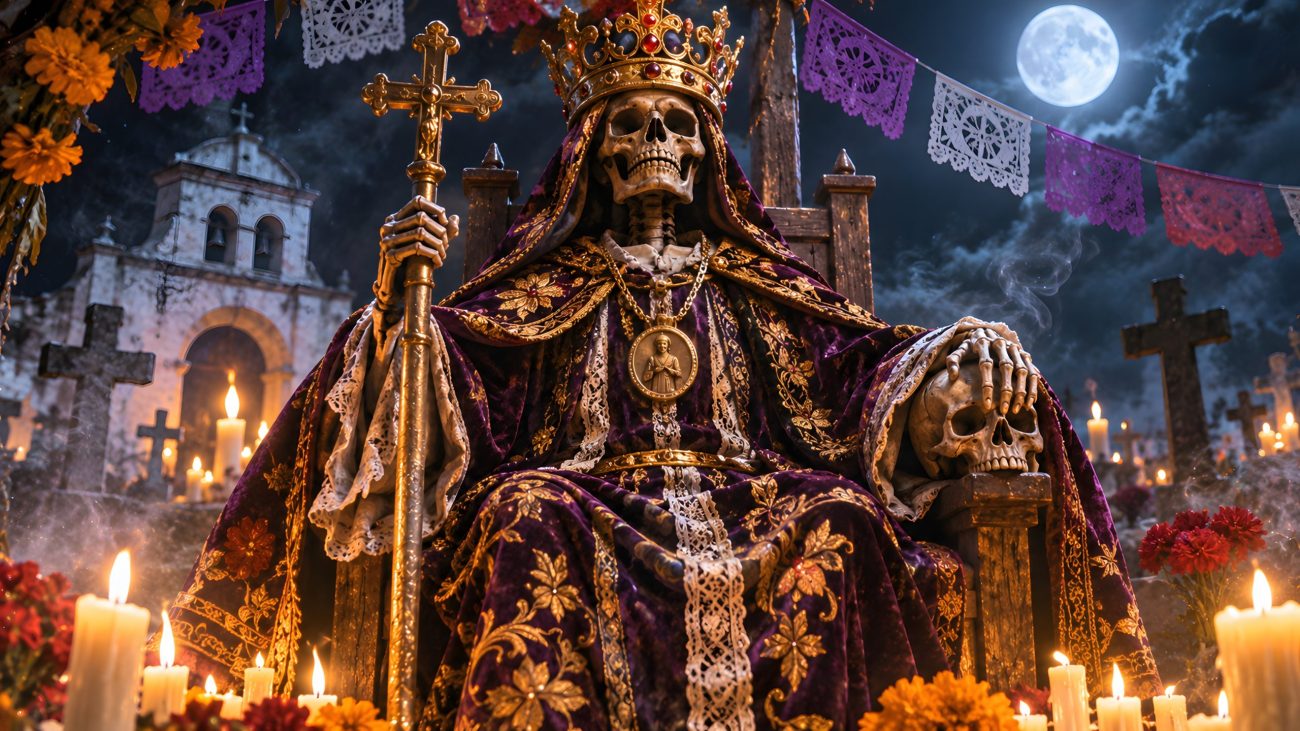
San Pascualito is a folk saint venerated in Guatemala and the Mexican state of Chiapas. Known as the King of the Graveyard, he is associated with death and the curing of disease. He is depicted as a skeleton, sometimes wearing a cape or a crown. His veneration is connected with the wider Latin American cult of death and may have links to the worship of a pre-Columbian death deity. His worship is not approved by the Roman Catholic Church.

In 1650, during an epidemic fever known as cucumatz, an Indigenous man in San Antonio Aguacaliente, in present-day Ciudad Vieja, Guatemala, was dying and had received the last rites. He then experienced a vision of a tall skeleton dressed in glowing robes. The figure identified himself as Saint Paschal Baylon and promised to intercede to end the epidemic if the community adopted him as its patron saint and venerated his image.

As proof of his identity, the figure predicted that the man would die within nine days and that the epidemic would end at the same time. Both events came to pass. Word of the vision spread, and images of San Pascualito became popular despite being formally prohibited by the Spanish Inquisition.


Sources

Wikipedia contributors. (n.d.). San Pascualito. Wikipedia. https://en.wikipedia.org/wiki/San_Pascualito

Mictlāntēcutli

Tradition: Aztec Mythology, Mexican Mythology
Alternative Names: Mictlantecuhtli, Ixpuztec, Nextepehua, Tzontemoc
Category: Skeleton, Deity


The Myth

Mictlāntēcutli is the god of the dead and ruler of Mictlan, the lowest and northernmost region of the Aztec underworld. He dwells there with his wife, Mictecacihuatl, in a windowless house. Together they govern the realm of the dead and receive the souls of those who die ordinary deaths, as well as those who perish in battle, through sacrifice, or during childbirth.

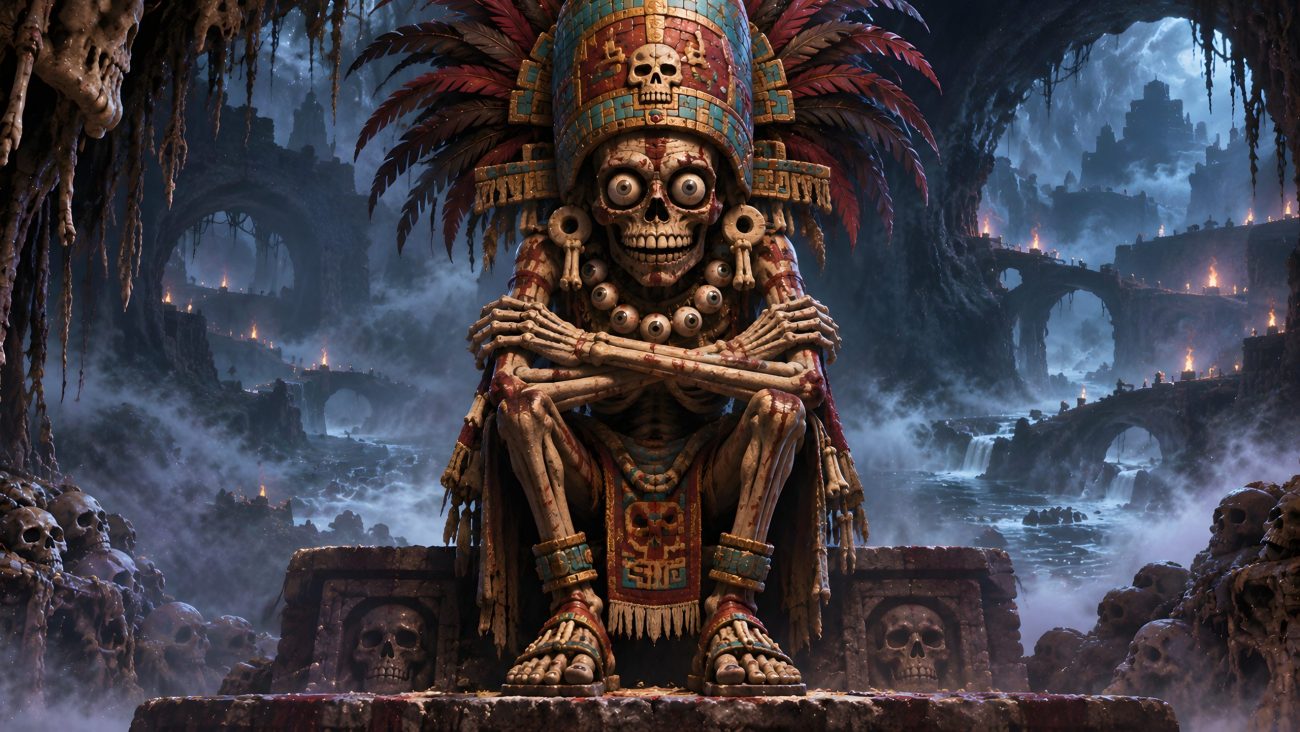
Mictlāntēcutli is depicted as a blood-spattered skeleton or as a figure wearing a skull with exposed teeth. His skull usually has visible eyeballs within its sockets. He wears a headdress decorated with owl feathers and paper banners, a necklace of human eyeballs, and earspools made from human bones. Sandals signify his high rank as ruler of Mictlan. His arms are often raised in an aggressive gesture, and his skeletal jaw is sometimes shown open to receive the stars that descend into him during the day. Spiders, owls, and bats are associated with him, as is the northern direction. He is also connected with the day sign Itzcuintli, represented by a dog, and with the souls of those born under that sign.

After Quetzalcoatl and Tezcatlipoca created the world, they established its order and placed Mictlāntēcutli and Mictecacihuatl in the underworld.

The gods later sent Quetzalcoatl and his twin brother Xolotl into Mictlan to retrieve the bones of the people who had lived during the previous creation. Mictlāntēcutli agreed to surrender the bones if Quetzalcoatl could travel through his kingdom four times while sounding a shell like a trumpet. He gave Quetzalcoatl a shell without holes, but Quetzalcoatl summoned worms to pierce it and bees to enter it. The bees made the shell sound like a trumpet.

Mictlāntēcutli initially allowed Quetzalcoatl to take the bones, but soon changed his mind and ordered his followers to dig a deep pit. As Quetzalcoatl fled with the bones, a quail startled him and caused him to fall into the pit. He appeared to die, and the bones were scattered and gnawed by the quail. Quetzalcoatl eventually revived, gathered the broken bones, and carried them away. The gods used them to create the different races of humanity. The bones had been broken into different sizes, which is why people are not all the same height.

When the dead arrived in Mictlan after their long and dangerous journey through the underworld, the grave goods buried with them were offered to Mictlāntēcutli and Mictecacihuatl.


Sources

Wikipedia contributors. (n.d.). Mictlāntēcutli. Wikipedia. https://en.wikipedia.org/wiki/Mictl%C4%81nt%C4%93cutli