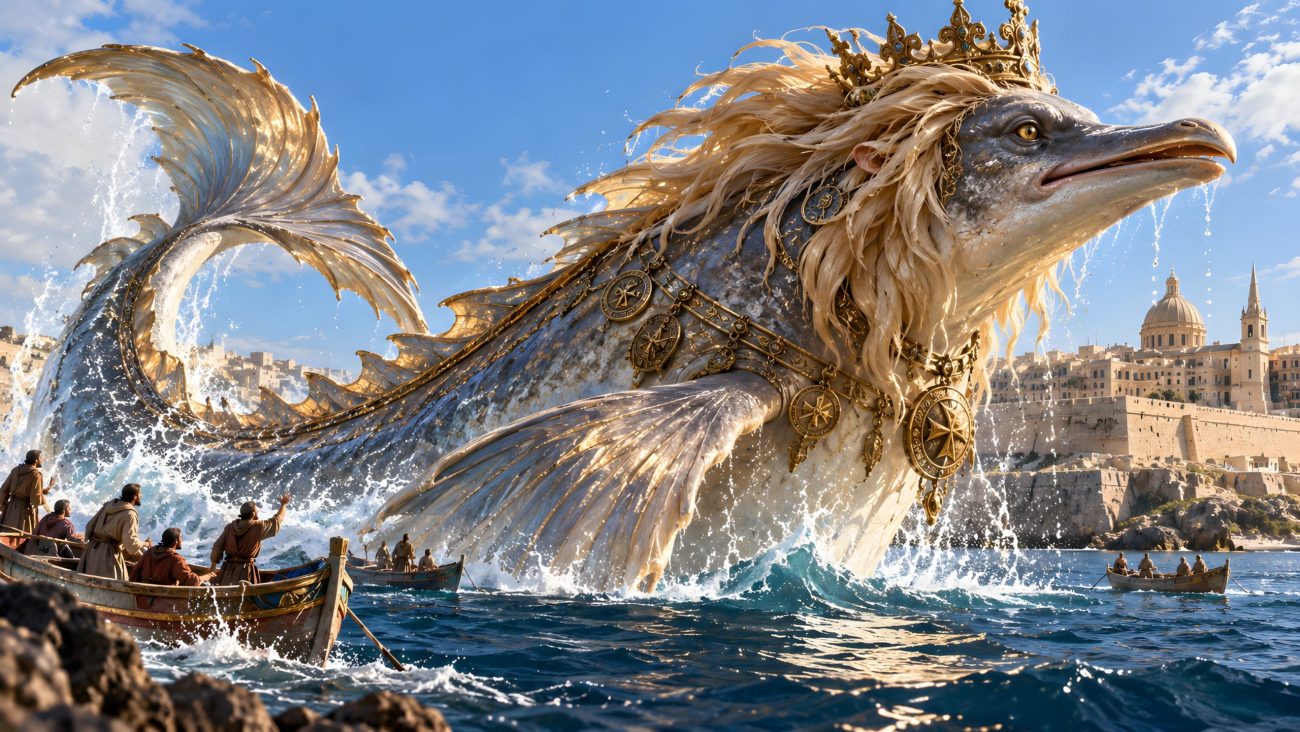
Tradition: Maltese Mythology
Alternative Names: Dolphin King, Sultan il-Ħut
Category: Fish
The Myth
The Fish King, known as Sultan il-Ħut, is a powerful aquatic being in Maltese mythology, depicted not as a dolphin but as a fish with a large head and back. He rules over the inhabitants of the deep, commanding authority comparable to that of terrestrial rulers over lions, birds, and other creatures. Like a sovereign protecting his subjects, the Fish King is associated with benevolence and the safeguarding of those who dwell within his underwater realm.
Dolphins accompany boats and ships, where they are regarded as good omens. They protect vessels and their crews from malevolent beings of the deep, acting as guardians of sailors and the sea. Stone statues of dolphins adorn many Maltese homes and gardens, serving as protectors of households. Brass dolphin ornaments are also traditionally placed near fountains, ponds, staircases, and other parts of the home. These figures are more than simple decorations: they are believed to ward off evil and protect the household from harmful supernatural forces. Ancient Jewish tradition likewise held that fish were immune to the effects of the evil eye, while Sephardic Jewish households in Malta used dolphin-shaped amulets to guard against it.
Dolphins are generally regarded as benevolent toward humans, and stories tell of sailors rescued from drowning by these intelligent sea creatures. Maltese folklore also contains darker accounts in which dolphins attack and kill women in the water. Such stories suggest that dolphins may be more dangerous to women than to men, with some accounts associating them with supernatural powers that allow them to recognize and target women believed to possess the evil eye.
Sources
Mifsud, S. D. (2014). The Maltese bestiary: An illustrated guide to the mythical flora and fauna of the Maltese Islands.