Tradition / Region: Arabian mythology, Madagascar Mythology
Alternate Names: Roc
Category: Bird
The Myth
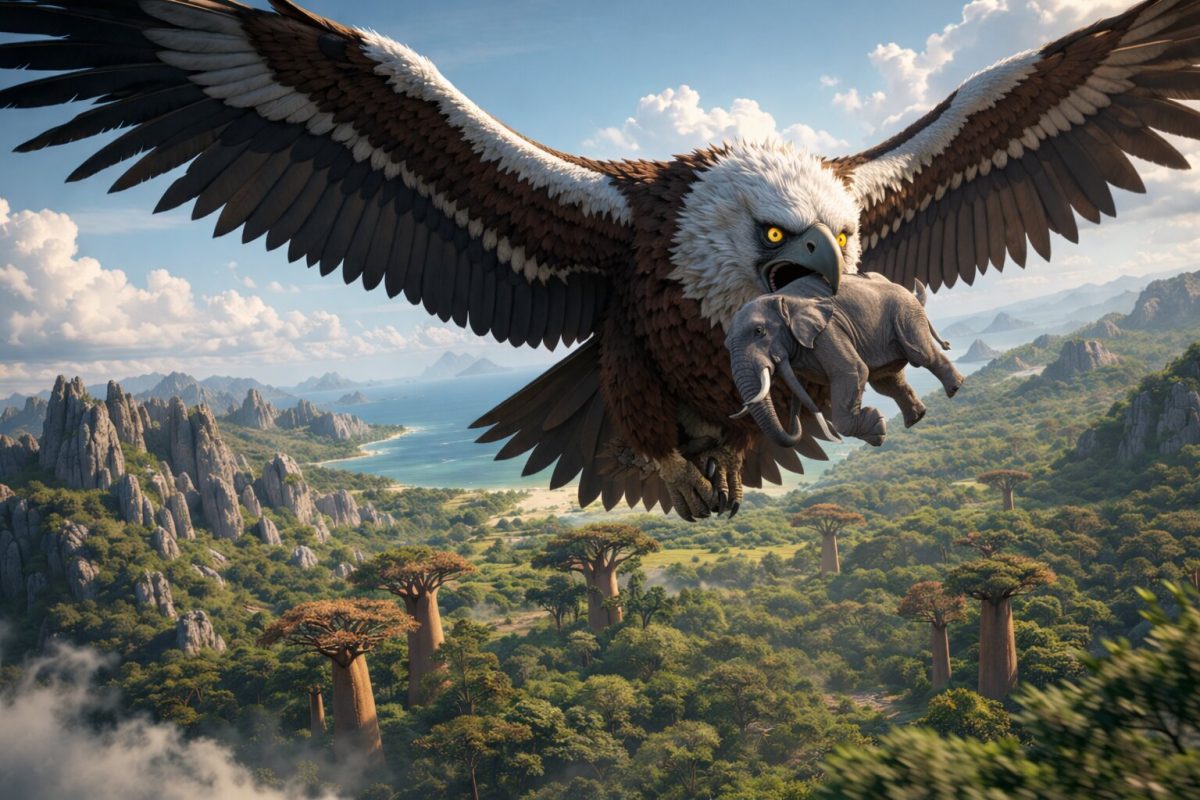
The Rukh is a colossal bird of prey said to live in distant lands, often associated with Madagascar or remote mountains. Its exact appearance is not fixed, but it is always described as enormous, sometimes so large that its wings stretch for vast distances. It preys on the largest animals, including serpents, elephants, and rhinoceroses, and is strong enough to carry them through the air. It is also said to use stones to kill prey.
The sailor Sindbad encountered the Rukh during his travels. On one voyage, he found himself stranded on an island and discovered a great white dome, which proved to be the egg of the bird. When the Rukh returned and settled upon it, Sindbad tied himself to its leg so that it might carry him away. The bird later flew off and landed elsewhere, where it seized a giant serpent before departing again, allowing Sindbad to escape.
On another journey, Sindbad’s companions landed on an island and found a similar egg. Ignoring his warning, they broke it open and killed the chick. Soon the two parent birds appeared and pursued the fleeing ship. Each carried a massive stone in its talons. One missed, but the other struck the vessel directly, destroying it and killing all aboard except Sindbad.
In another tale, a magician urged Aladdin to obtain a Rukh egg to hang in his palace. This request angered the genie, who declared it an insult and revealed that the suggestion came from an enemy.
Travellers also spoke of encounters with the bird. One man obtained a feather quill from a chick cut from an enormous egg; the parent bird attacked their ship with a falling stone, though they escaped. It was said that those who ate the chick’s flesh never grew old. Another traveller saw a distant Rukh in the sky over the seas, so vast it resembled a moving mountain. Others described the bird as able to seize elephants, lift them into the air, and drop them to the ground before feeding on them.
Gallery
Sources
A Book of Creatures. (2015, October 23). Rukh. From https://abookofcreatures.com/2015/10/23/rukh/
Interpretive Lenses
Religious Readings
- Christian Ascetic Deep Dive
Philosophical Readings
- Nietzschean Deep Dive
Psychological Readings
- Jungian Deep Dive
Esoteric Deep Dive
- Hermetic Deep Dive
Political / Social Readings
- Marxist Deep Dive