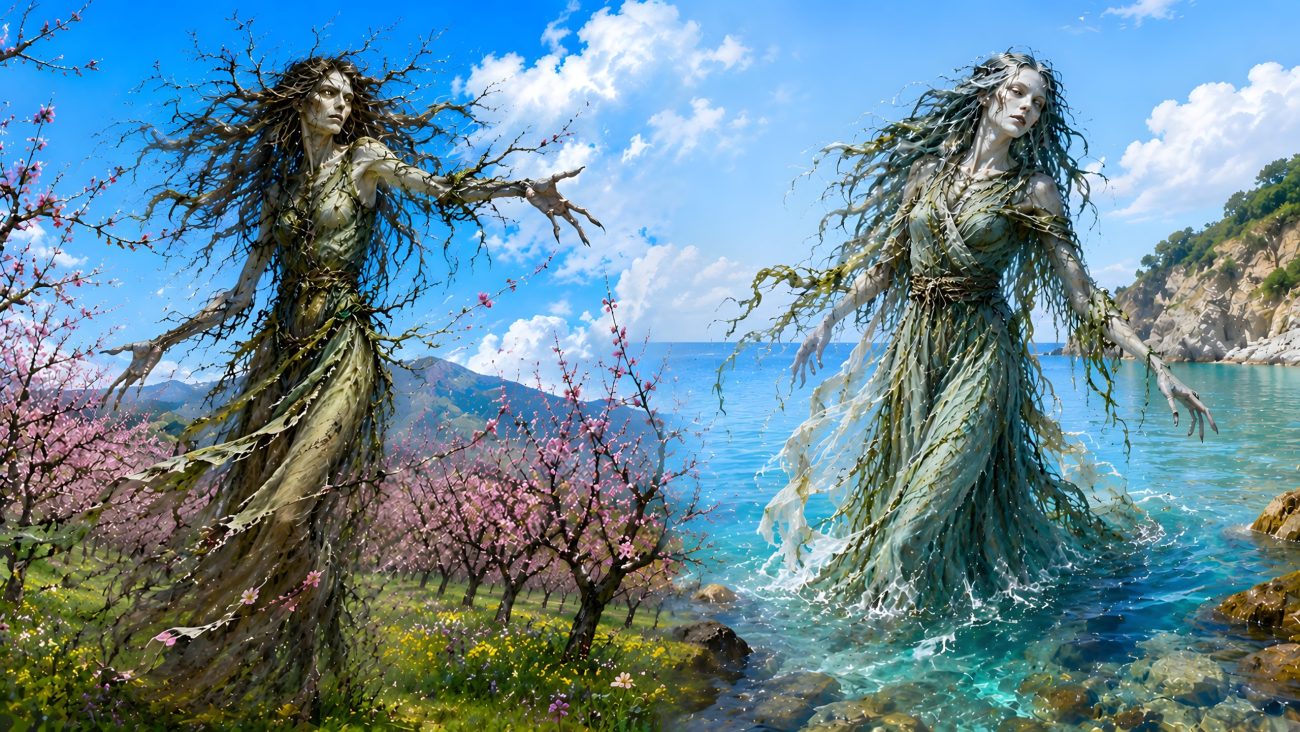
Tradition / Region: Macedonian Mythology
Alternative names: Drymiais (Δρύμιαις), Drymmata
Category: Spirit
The Myth
The Drymiais are mysterious supernatural beings connected with the dangerous days at the beginning and end of March and August in Macedonian folklore. They were feared throughout coastal Macedonia and the Aegean islands as invisible forces capable of damaging trees, clothing, crops, water, and even the human body.
The first three days of March and the first three days of August were considered especially dangerous and were called the Days of the Drymiais. In many places the final three days of these months, along with certain Wednesdays and Fridays, were also feared. During these periods people avoided cutting trees or vines because they believed the plants would immediately wither and die. Clothes were not washed because they were thought to decay or rot, and people avoided bathing in the sea because the Drymiais could cause the body to swell or become sick.
Some traditions imagined the Drymiais as a type of nature spirit related to ancient nymphs. The March Drymiais were associated with forests and trees, while the August Drymiais were linked to water and the sea. Folk sayings reflected this belief:
“August is bad for linen,
And March for trees.”
Another version stated directly:
“The Drymiais of August affect the linen,
And those of March affect the woods.”
Although vague and mysterious, the Drymiais were treated as living supernatural beings rather than simple unlucky dates. This appears in the custom of carrying rusty iron nails while bathing during August. People believed iron protected them from the Drymiais and prevented the spirits from approaching. Similar beliefs throughout European and Middle Eastern folklore held that iron repelled fairies, elves, demons, ghosts, and jinn.
The Drymiais were therefore understood as ancient hostile spirits tied to unstable seasonal transitions — beings of sea, forests, decay, storms, and sickness who became active during the dangerous turning points between seasons.
Sources
Abbott, G. F. (1903). Macedonian folklore. Cambridge: Cambridge University Press.