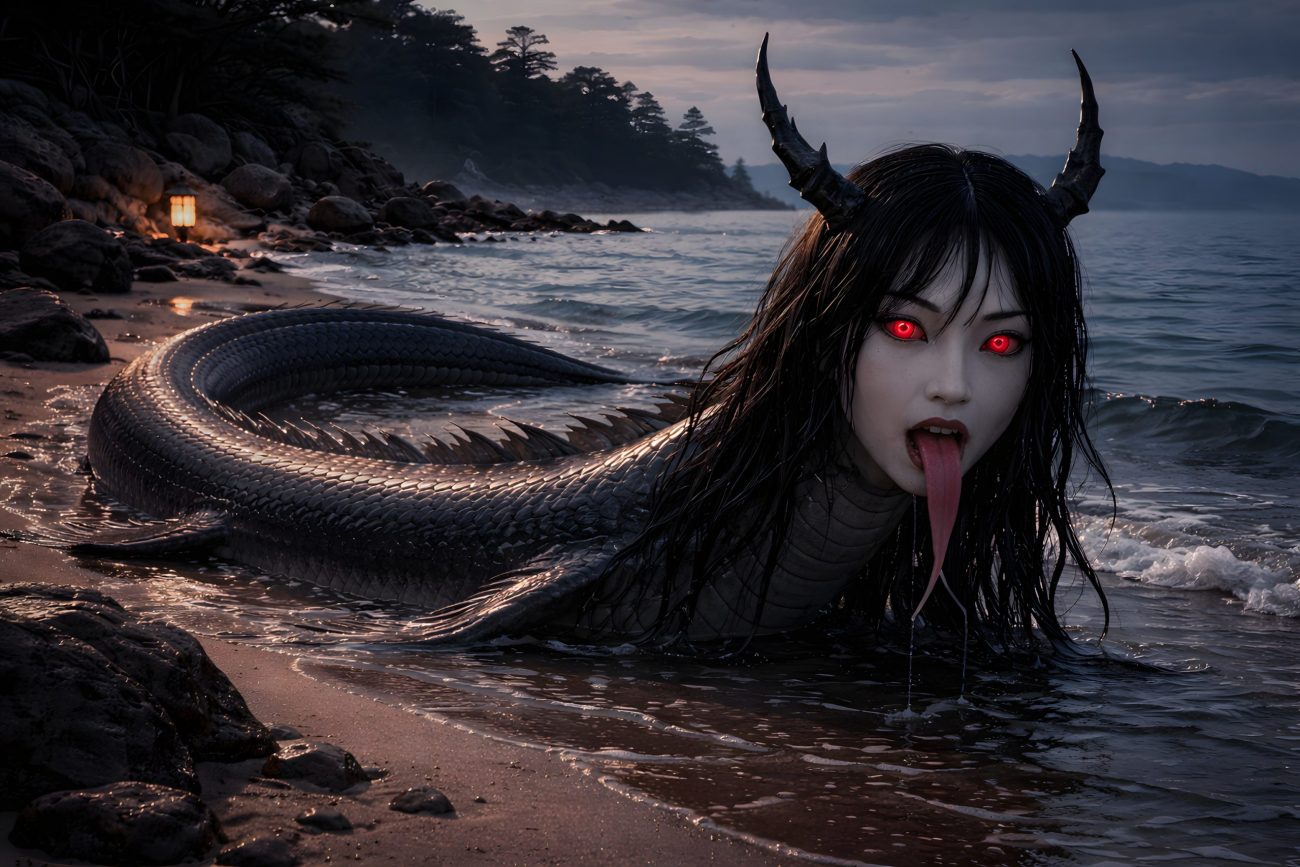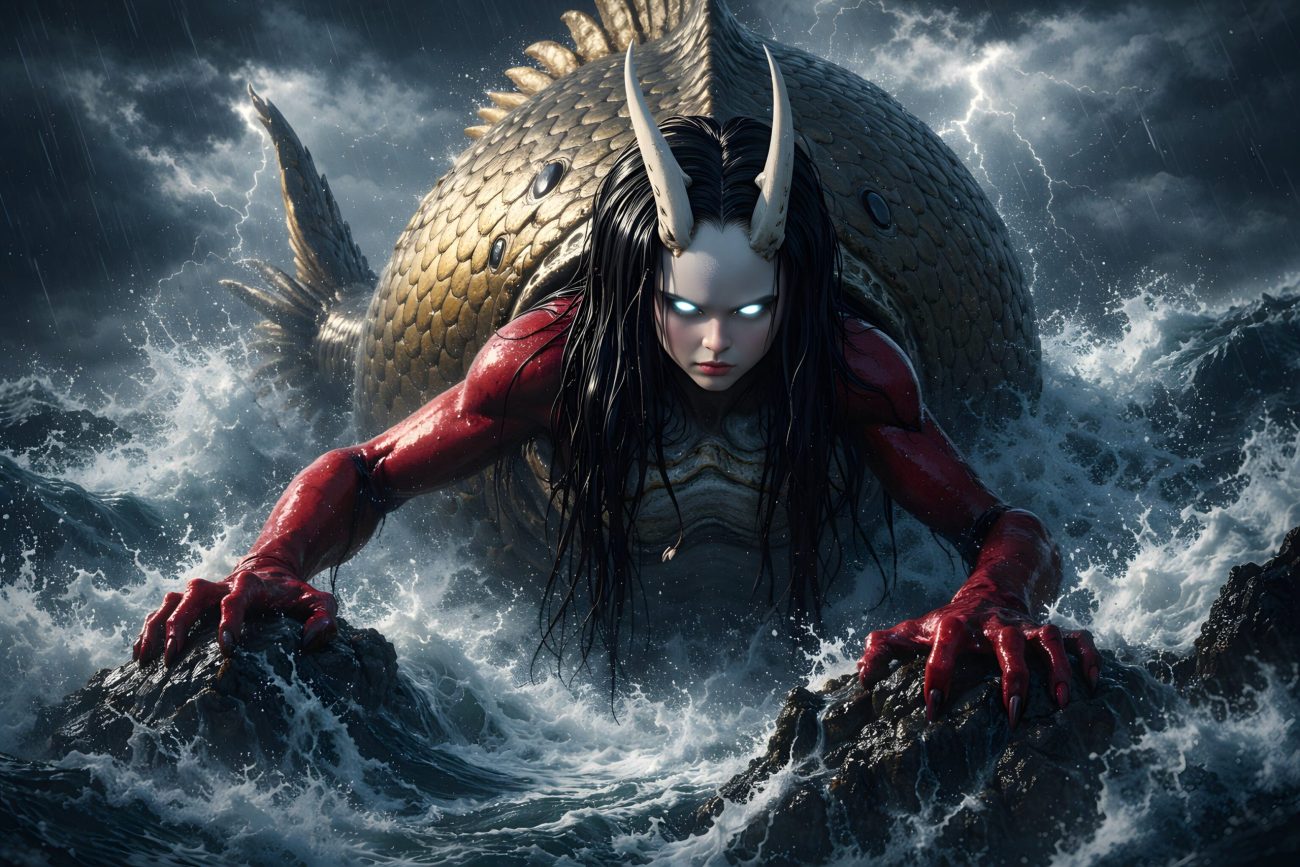
Chuchedi

Tradition / Region: Japanese Mythology
Alternate Names: Teuchedy, Tencheday, Tenchadema
Category: Mermaid, Ghost


The Myth

In old accounts told by travelers to Japan, there was said to be a strange idol worshipped in the eastern lands, known as Chuchedi.

People from every rank of life came to its temple day and night, making offerings and prayers. The idol was feared as a powerful and dangerous spirit, one that demanded a terrible rite. Each month, it was said, the most beautiful maiden in the land would be chosen and brought to the temple.

She would be placed alone inside a private chamber and left there in silence. The doors were shut, and the girl waited through the darkness.

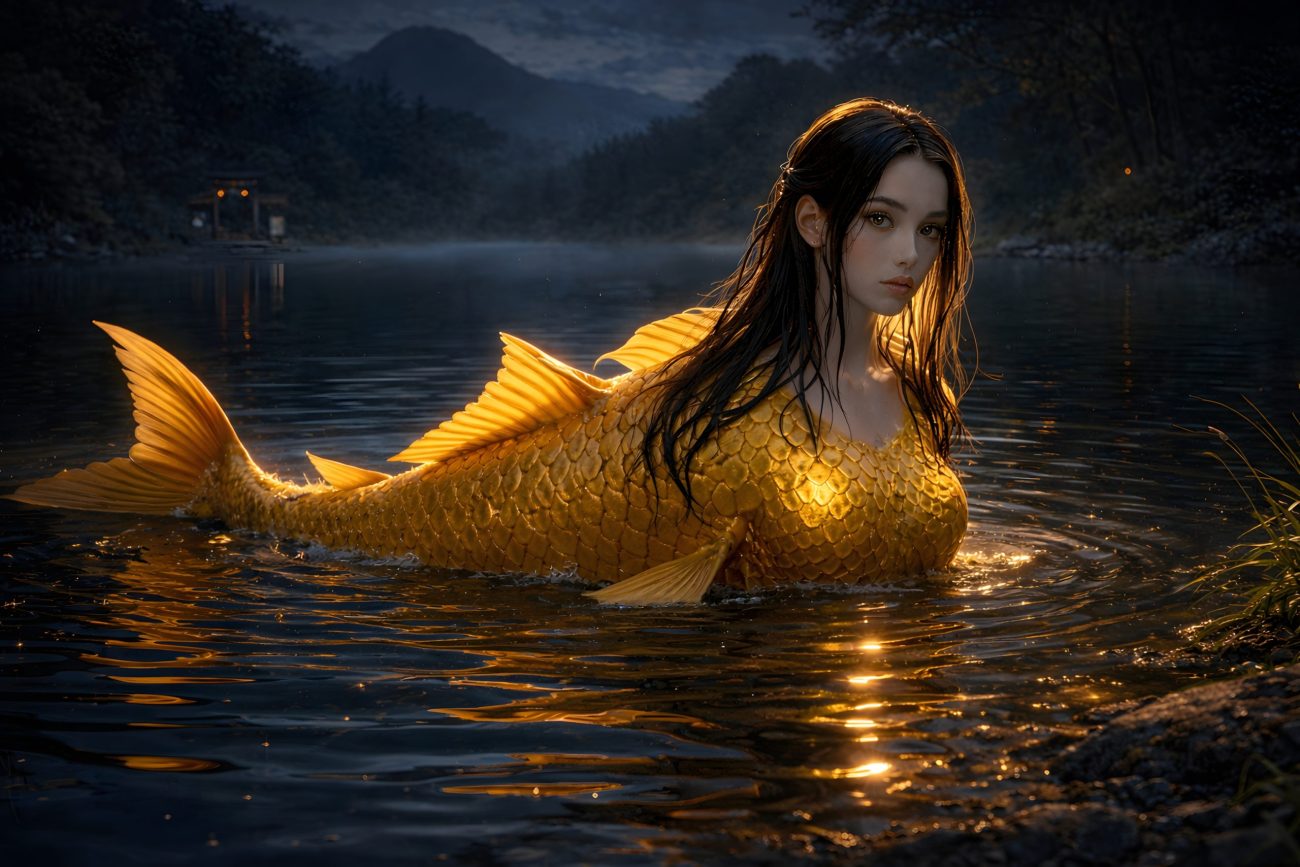
At some point in the night, Chuchedi itself was believed to appear. None saw how it came or what form it took in full, but the spirit would visit the girl and lie with her. When morning came, the spirit had vanished again, leaving behind strange fish-like scales as proof of its presence.

Another maiden would be chosen the following month, yet no one spoke openly about what became of the girls afterward. That remained a mystery whispered among the people.

It was also said that before the ritual, priests could ask Chuchedi questions, and the spirit would give answers to them, as though it possessed knowledge beyond human reach.

Thus Chuchedi was remembered as a hidden temple power—
a being that came in the night,
left scales behind,
and was served by fearful devotion from those who believed in it.


Gallery


Sources

tyz-yokai.blog.jp contributors. (n.d.). Chuchedi. In tyz-yokai.blog.jp, from https://tyz-yokai.blog.jp/archives/1084115860.html


Interpretive Lenses

Religious Readings
  • Christian Ascetic Deep Dive
Philosophical Readings
  • Nietzschean Deep Dive
Psychological Readings
  • Jungian Deep Dive
Esoteric Deep Dive
  • Hermetic Deep Dive
Political / Social Readings
  • Marxist Deep Dive
Other
  • How to Invite The Chuchedi

Jinjahime

Tradition / Region: Japanese Mythology
Alternate Names: Himeuo, Ojinjahime, Kamiikehime, Shrine Princess
Category: Mermaid, Yokai


The Myth

In the spring of 1819, a strange fish washed ashore on a beach in Hizen Province. A man named Hachibei went to see it, and as he approached, the creature spoke.

“I am a messenger from the Dragon Palace,” it said. “My name is Jinjahime. For the next seven years there will be good harvests. But after that, a terrible disease called Korori will spread among the people. Paint my image and display it, and those who look upon it will be spared the sickness and granted long life.”

The creature was said to be long-bodied like a great fish, with a human face, two horns upon its head, and a tail shaped like three blades. Its belly shone red like fresh blood. After delivering its prophecy, it disappeared.

People quickly spread drawings of Jinjahime, believing that the image itself carried protection. Copies of the strange fish were painted, printed, and passed from house to house so that many might be saved from the coming illness.

Other stories soon followed of similar beings—fish with human faces who rose from the sea to warn people of disaster and promise protection through their likeness. Yet it was Jinjahime, the Shrine Princess, whose image first spread widely, remembered as the sea-messenger who came ashore to foretell both prosperity and plague.


Gallery


Sources

tyz-yokai.blog.jp contributors. (n.d.). Jinjahime. In tyz-yokai.blog.jp, from https://tyz-yokai.blog.jp/archives/1077741611.html


Interpretive Lenses

Religious Readings
  • Christian Ascetic Deep Dive
Philosophical Readings
  • Nietzschean Deep Dive
Psychological Readings
  • Jungian Deep Dive
Esoteric Deep Dive
  • Hermetic Deep Dive
Political / Social Readings
  • Marxist Deep Dive
Other
  • How to Invite The Jinjahime

Terutou

Tradition / Region: Japanese Mythology
Alternate Names: Terukagoyo; Terikabugyo-san (local name of the sacred carp)
Category: Mermaid, Carp


The Myth

In the year 1646, a kind man named Otani Jinnai lived in Matsue with his wife Oryo. The couple longed for a child, and after many years of disappointment they prayed at temples and shrines throughout the land. At last they heard that Ogamiyama Shrine on Mount Oyama in Izumo was famed for granting children, and so they climbed the mountain to pray there.

As they descended, a thick fog suddenly swallowed the path. Out of the mist appeared a beautiful young woman who guided the lost couple safely down the trail. When she learned they had prayed for a child, she handed Jinnai a small bottle of water. She explained that it was sacred water made from dew gathered near Akamatsu Pond and offered at the shrine on New Year’s Day, and that drinking it would surely bring them the blessing they sought. Oryo drank it at once, feeling a strange certainty that their wish would be fulfilled. When they looked again, the girl had vanished.

The following year, Oryo gave birth to a daughter. The child was named O-Chiyo, and she grew into a girl of uncommon beauty and intelligence. When she reached sixteen, Jinnai’s nephew Tamaki asked for her hand in marriage. Though O-Chiyo felt troubled and uncertain, she could not bring herself to refuse her parents, and the engagement was arranged.

Before the wedding date was set, O-Chiyo made a request. She wished to visit Ogamiyama Shrine once more to report her coming marriage to the gods. Her parents agreed, and she set out for Mount Oyama with her nurse, Osuma. After offering her prayers at the shrine, the two began their return journey and passed by Akamatsu Pond—the very place where the mysterious girl had once given Jinnai the sacred water.

O-Chiyo stood gazing into the water for a long time. Then she walked to the edge and bent down. Suddenly steam rose from the pond, and her expression grew grave. She turned to Osuma, thanked her gently, and spoke in a calm voice. She said that although she had lived as a human, it had only been a temporary form. In truth she was a carp of that region, and the pond was her real home.

She gave Osuma a letter for her parents and words of gratitude, then leapt into the water and vanished. As Osuma cried out in shock, a huge golden carp surged to the surface. The creature turned toward her, and its face was unmistakably that of O-Chiyo. Overcome, Osuma fell to her knees in prayer as the carp slipped back beneath the water.

When Osuma returned and told Jinnai and Oryo what had happened, they were filled with grief. In the letter, O-Chiyo explained that she was the sacred carp Terukagoyo and could never marry a human. She thanked them for raising her and said that if they ever wished to see her, they need only call her name by the pond.

Jinnai remembered hearing of a sacred carp said to dwell in Akamatsu Pond, and he realized that the gods of Mount Oyama had given that spirit to him as a daughter. He built a small shrine and placed O-Chiyo’s letter there. Soon after, he and his family went to the pond and called her name three times from the shore. A thunderous roar answered from beneath the water, but she did not appear.

From that time on, visitors to the pond began calling the carp’s name in the same way. The shrine became a place where young men and women prayed for blessings in love, and in the region the carp themselves came to be respectfully called Terikabugyo-san.


Gallery


Sources

tyz-yokai.blog.jp contributors. (n.d.). Terutou. In tyz-yokai.blog.jp, from https://tyz-yokai.blog.jp/archives/1077741621.html


Interpretive Lenses

Religious Readings
  • Christian Ascetic Deep Dive
Philosophical Readings
  • Nietzschean Deep Dive
Psychological Readings
  • Jungian Deep Dive
Esoteric Deep Dive
  • Hermetic Deep Dive
Political / Social Readings
  • Marxist Deep Dive
Other
  • How to Invite The Terutou

Umidebito

Tradition / Region: Japanese Mythology
Alternate Names: Kaidzu-nin; sometimes simply called a mermaid or sea-being
Category: Mermaid


The Myth

In Echigo Province, near the lagoon of Fukushimagata, strange lights began appearing over the water at night. From within the glow came a woman’s voice calling across the shore, echoing over the waves and unsettling the nearby villages. People whispered that something not of this world had come up from the sea, and most were too frightened to go near it.

At last a ronin named Shibata Dan, who was training as a warrior, resolved to witness the being for himself. Carrying a torch, he went to the water’s edge and waited. Before long, a radiant figure rose from the sea and faced him. It spoke calmly, introducing itself as Umidebito, a dweller of the sea.

Its form was uncanny. From the head to the chest it resembled a human woman, but below that its body became scaled and unnatural, long and folding like some creature of the deep. The lower half of its body rested within a great conch shell, which floated upon the surface as if it were a small boat.

Umidebito then delivered its prophecy. It declared that the land would enjoy five years of rich harvests, but after that a terrible sickness would spread in the twelfth month, a plague so vast that it would kill most of the world’s people. It warned that the only way to avoid this fate was to paint its image, place the picture in one’s home, and pray to it each morning and evening.

When the message was finished, the being withdrew. The light faded, the sea closed over it, and Umidebito vanished into the darkness of the lagoon. Afterward, tales of the sea-woman spread, and images of her form were copied and kept by those who feared the coming disease.


Gallery


Sources

tyz-yokai.blog.jp contributors. (n.d.). Umidetto. In tyz-yokai.blog.jp, from https://tyz-yokai.blog.jp/archives/1077286511.html


Interpretive Lenses

Religious Readings
  • Christian Ascetic Deep Dive
Philosophical Readings
  • Nietzschean Deep Dive
Psychological Readings
  • Jungian Deep Dive
Esoteric Deep Dive
  • Hermetic Deep Dive
Political / Social Readings
  • Marxist Deep Dive
Other
  • How to Invite The Umidebito

Sato

Tradition / Region: Japanese Mythology
Alternate Names: Hachimangū no kannushi no musume Sato
Category: Mermaid


The Myth

In Hizen Province there once lived a girl named Sato, the daughter of the chief priest of a Hachiman shrine. When she was seventeen years old, she drowned in a large pond, and her body was never recovered. The villagers mourned her, and with time the story faded into memory.

Years later, on the twenty-sixth day of the second month in 1819, something strange occurred. The waters of the pond stirred, and Sato’s body rose from the depths.

She was no longer human.

Her form had become long and fish-like, covered in scales, with flippered limbs, a human face framed by long hair, and two horns upon her head. From her abdomen hung three shining jewels.

When people gathered in fear and wonder, she spoke:

“I am a messenger from the gods. For eight or nine years there will be a rich harvest. But after that, a great illness will come, and thirty to fifty out of every hundred people will die. Those who see my image will be spared from this calamity.”

As she finished speaking, the sky darkened. Black clouds gathered, rain fell in torrents, and the waters of the pond surged upward.

Then Sato rose into the sky and vanished.

Afterward, her likeness was copied and spread among the people, who kept her image as a charm against disease, remembering the drowned girl who returned from the water as a messenger of the gods.


Gallery


Sources

yokai.com contributors. (n.d.). Sato. In yokai.com, from https://yokai.com/sato/


Interpretive Lenses

Religious Readings
  • Christian Ascetic Deep Dive
Philosophical Readings
  • Nietzschean Deep Dive
Psychological Readings
  • Jungian Deep Dive
Esoteric Deep Dive
  • Hermetic Deep Dive
Political / Social Readings
  • Marxist Deep Dive
Other
  • How to Invite The Sato

Ningyo

Tradition / Region: Japanese Mythology
Alternate Names: Mermaid, human-fish
Category: Mermaid


The Myth

In ancient times, strange beings were said to appear in the waters of Japan—creatures neither fully human nor fully fish.

The Nihon Shoki tells that in the year 619, during the reign of Empress Suiko, a human-like creature appeared in the Gamo River in Ōmi Province. In another account, a fisherman from Settsu caught something in his net that was neither fish nor human. These were said to be ningyo.

In Ise Province, a fisherman once drew up a fish with a human head. When people approached it, the creature cried and made sounds like a person. Those who cut and ate its flesh found it delicious, and no harm came to them.

Ningyo were sometimes washed ashore or caught in nets. Because they were rare, they were offered as gifts to powerful lords. One caught in Bungo Province in 1559 was presented to the shogun.

They also appeared in temple legends. At Kannonshōji Temple in Ōmi, it is said that a fisherman who had committed murder in a previous life was reborn as a hideous ningyo. Prince Shōtoku built a temple there in response to its prayer for salvation.

Another tale tells of Yao Bikuni, a woman who ate ningyo flesh and gained extraordinary longevity.

The appearance of a ningyo was often taken as an omen. When one washed ashore in Akita in 1213, a diviner declared it a sign of war. That same year, rebellion broke out. When another was seen in Tsugaru in 1222, prayers were offered, yet unrest followed.

Some said killing a ningyo brought disaster. In Wakasa Province, a fisherman slew one, and soon a great storm and earthquake destroyed the village. The creature was believed to have been a messenger of a sea deity.

At other times, a ningyo was considered auspicious. One that washed ashore in Hakata was taken as a sign of long life for the nation and believed to be a messenger from the Dragon Palace. It was buried, and the temple there was named Ryūgū-ji.

In later times, stories spread that seeing a ningyo’s image could ward off illness, and that its flesh could grant long life. Even so, whether blessing or disaster, the ningyo remained a mysterious being of the waters—human-faced, fish-bodied, and never entirely of this world.


Gallery


Sources

tyz-yokai.blog.jp contributors. (n.d.). Ningyo. In tyz-yokai.blog.jp, from https://tyz-yokai.blog.jp/archives/1077741608.html


Interpretive Lenses

Religious Readings
  • Christian Ascetic Deep Dive
Philosophical Readings
  • Nietzschean Deep Dive
Psychological Readings
  • Jungian Deep Dive
Esoteric Deep Dive
  • Hermetic Deep Dive
Political / Social Readings
  • Marxist Deep Dive
Other
  • How to Invite The Ningyo

Amabie

Tradition / Region: Japanese Mythology
Alternate Names: Amabiko, Amahiko
Category: Mermaid, Yokai


The Myth

In the third year of Kōka, in the middle of the fourth month (1846), strange lights were seen shining upon the sea in Higo Province. Night after night the glowing shape appeared offshore, casting an eerie radiance over the waves.

At last, a local official went to investigate. Approaching the coast, he beheld a mysterious being rise from the water. It had long hair and a mouth shaped like a bird’s beak. Its body was covered in scales from the neck downward, and from beneath it extended three legs—or three fin-like limbs—supporting it at the shore.

The creature spoke.

“I dwell in the sea,” it said. “For six years from this year, the harvest will be abundant. But after that, an epidemic will spread across the land.”

The official listened in fear as the being continued:

“If disease spreads, draw a picture of me and show it to the sick. Those who see my likeness will be protected.”

Having delivered its prophecy, the creature returned to the sea and vanished beneath the waves.

News of the encounter spread quickly through printed bulletins. Woodblock sheets bearing the creature’s image were copied and distributed so that people might keep them as charms against illness. The strange being was called Amabie.

In other tellings, similar creatures appeared under the name Amabiko or Amahiko—three-legged prophetic beasts who likewise warned of plague and commanded that their portraits be displayed to avert disaster. Some were described as ape-like, some as bird-like, some glowing in the night. But the Amabie of Higo remained the most vividly remembered: the long-haired, scaled messenger of the sea who promised both abundance and pestilence.

And so her image endured—drawn and redrawn—whenever fear of sickness rose, her strange form offered as protection against unseen calamity.


Gallery


Sources

Wikipedia contributors. (n.d.). Amabie. In Wikipedia, The Free Encyclopedia. Retrieved February 14, 2026, from https://en.wikipedia.org/wiki/Amabie


Interpretive Lenses

Religious Readings
  • Christian Ascetic Deep Dive
Philosophical Readings
  • Nietzschean Deep Dive
Psychological Readings
  • Jungian Deep Dive
Esoteric Deep Dive
  • Hermetic Deep Dive
Political / Social Readings
  • Marxist Deep Dive
Other
  • How to Invite The Amabie

Namiko

Tradition / Region: Japanese Mythology
Alternate Names: Girl of the Sea
Category: Mermaid


The Myth

During one summer in Kamakura, a clever but willful girl named Namiko went to stay near Yuigahama Beach while her sick mother rested in a hospital nearby. Though she excelled at school, at home she was stubborn and often caused her father trouble with her selfishness.

One day, while playing alone on the shore, Namiko encountered an old woman selling fish. Among the catch was a beautiful striped sea bream, its scales gleaming in the sunlight. Entranced by its natural beauty, Namiko declared that she wished she could be as beautiful as that fish.

The old woman laughed.

“A kimono fades and wears out,” Namiko insisted. “But a fish’s beauty never falls away. If I were as beautiful as that, I would never lose it.”

“Then become a fish,” the old woman said, her eyes sharpening.

“Yes, I would!”

At once the old woman’s laughter ceased. She chanted a strange sutra, and before Namiko could protest, she was transformed into a striped sea bream. The fish-seller’s true form was that of a powerful magician.

Thrown into the sea, Namiko swam bewildered through the underwater world. At first, she was amazed by the shimmering waters and the strange creatures gliding past her. It felt like exploring a living aquarium. But as the currents grew rough and hunger gnawed at her, she was forced to eat small fish she once would have admired. She could not cry; fish have no tears. Loneliness overtook her, and she longed for her parents.

Resting against a rock on the ocean floor, she lamented her foolish words. “All I did was stubbornly wish to be a fish.”

Meanwhile, on the shore, her father and their maid searched desperately. When they found her clothes abandoned on the beach, they believed she had drowned. Their grief was unbearable.

Then the old woman appeared before them.

“Your daughter lives,” she said calmly, and instructed Namiko’s father to take a boat out to sea the next morning.

At dawn, they followed her directions. Pointing to a struggling striped sea bream in the waves, the old woman declared, “That fish is your daughter.”

Understanding that this had been a lesson for his child’s stubborn pride, Namiko’s father fell to his knees and begged the magician to restore her.

As he lifted the sea bream into his arms, the old woman once again chanted her spell. The fish began to grow, its head transforming first, then its body, until Namiko stood once more in human form. Father and daughter embraced in tears, and Namiko vowed never again to let selfish pride rule her heart.

The magician suddenly vanished.

Then a voice drifted down from the sky. The old woman spoke, saying that though she had once used magic to torment many, she had now redeemed herself by correcting Namiko’s ways. Her sins were forgiven, and she would ascend to heaven.

She warned of a coming storm and asked Namiko to send down five-colored thread from the shore.

That afternoon, as winds rose and the sky darkened, Namiko kept her promise. A five-colored thread was cast toward the sea. From the heavens, the old woman—now transformed into a dragon—received it as she ascended.

After that day, Namiko treated her parents with devotion and filial piety. Her mother recovered from illness, and peace returned to their home.

And by the sea at Yuigahama, people remembered the tale of the girl who became a fish—and the dragon who rose to heaven.


Gallery


Sources

tyz-yokai.blog.jp contributors. (n.d.). Namiko. In tyz-yokai.blog.jp, from https://tyz-yokai.blog.jp/archives/1077741623.html


Interpretive Lenses

Religious Readings
  • Christian Ascetic Deep Dive
Philosophical Readings
  • Nietzschean Deep Dive
Psychological Readings
  • Jungian Deep Dive
Esoteric Deep Dive
  • Hermetic Deep Dive
Political / Social Readings
  • Marxist Deep Dive
Other
  • How to Invite The Namiko

Jinja hime

Tradition / Region: Japanese Mythology
Alternate Names: Hime uo (Princess Fish)
Category: Mermaid, Yokai


The Myth

In the year 1819, on a lonely shore in Hizen Province, an unusual creature was seen upon the sand.

It was long and serpentine, nearly six meters in length. Two horns rose from its head. A dorsal fin ran along its back, and flippers lay against its sides. Its tail stretched behind it like that of a great sea serpent. Yet its face was not that of a fish. It was the face of a woman.

The creature spoke.

“I am a messenger from Ryūgū,” she said, naming the palace of the Dragon King beneath the sea. “My name is Jinja hime.”

She declared that for seven years the land would enjoy abundant harvests. Rice would grow thick and heavy; the people would prosper. But after those seven years, a great sickness would spread across the country—an epidemic that would bring suffering and death.

Yet she offered hope.

“Those who look upon my image,” she said, “will avoid hardship and be granted long life.”

Having delivered her prophecy, the shrine princess slipped back into the sea and vanished beneath the waves.

Her likeness was drawn and shown to the people, so that they might gaze upon it and be protected. The image spread from hand to hand. Fishermen, farmers, and townsfolk spoke of the sea princess who foretold both blessing and plague.

From that time on, stories began to circulate across Japan of other strange beings who emerged from the sea or the mountains to warn of disaster and promise protection through their image.

But it was Jinja hime—the shrine princess of the deep—who first rose from the waters, spoke of fate, and returned to the palace of the Dragon King below.


Gallery


Sources

yokai.com contributors. (n.d.). Jinjahime. In yokai.com, from https://yokai.com/jinjahime/


Interpretive Lenses

Religious Readings
  • Christian Ascetic Deep Dive
Philosophical Readings
  • Nietzschean Deep Dive
Psychological Readings
  • Jungian Deep Dive
Esoteric Deep Dive
  • Hermetic Deep Dive
Political / Social Readings
  • Marxist Deep Dive
Other
  • How to Invite The Jinja hime