Chōshichi-inu

Tradition / Region: Japanese Mythology
Alternate Names:
Category: Dog


The Myth

Near Hyōgo in Settsu Province lived a sake merchant named Chōshichi. Having lost both his parents and still unmarried, he lived in deep loneliness. To comfort himself, he began raising a small female pet dog, cherishing it greatly. He taught it tricks, fed it from the same bowls as humans, and even held it while sleeping at night.

At the urging of a friend, Chōshichi eventually married. From the moment his wife entered the household, the dog showed her hostility. It barked constantly, refused food from her, and sometimes tried to bite her. Thinking the animal only feared strangers, the couple tried to calm it with treats and patience, but its resentment only grew stronger.

One day, while the wife slept, the dog leapt at her throat. Though it only tore her clothing, the attack terrified her. Unable to endure living with the animal, she begged Chōshichi to get rid of it.

He tried to give the dog away, but no one would take such a dangerous creature. When it was abandoned far from the village, it always found its way back. Even when placed aboard a ship bound for Kyūshū, it jumped into the sea and swam home.

At last, with no other option, Chōshichi strangled the dog and buried it beneath a tree. After this, peace returned to the household.

Not long afterward, his wife became pregnant. When the child was finally born after days of difficult labor, the infant appeared strange. Though human in shape, its body and limbs were covered in thick hair, and its cries sounded like those of a dog. The baby died soon after birth. Following a proper funeral, nothing unusual troubled the household again.


Gallery


Sources

Tyz-Yokai Blog. (n.d.). Choshichi’s dog. Retrieved March 1, 2026, from https://tyz-yokai.blog.jp/archives/1069489801.html


Interpretive Lenses

Religious Readings
  • Christian Ascetic Deep Dive
Philosophical Readings
  • Nietzschean Deep Dive
Psychological Readings
  • Jungian Deep Dive
Esoteric Deep Dive
  • Hermetic Deep Dive
Political / Social Readings
  • Marxist Deep Dive

Koiyamainu

Tradition / Region: Japanese Mythology
Alternate Names:
Category: Dog


The Myth

Koiyamainu appears in the second part of Kyokutei Bakin’s tale Musobe Kocho Monogatari. It is described as one of the strange beings found in Bonnoukyo, a distant foreign land visited by the story’s protagonist.

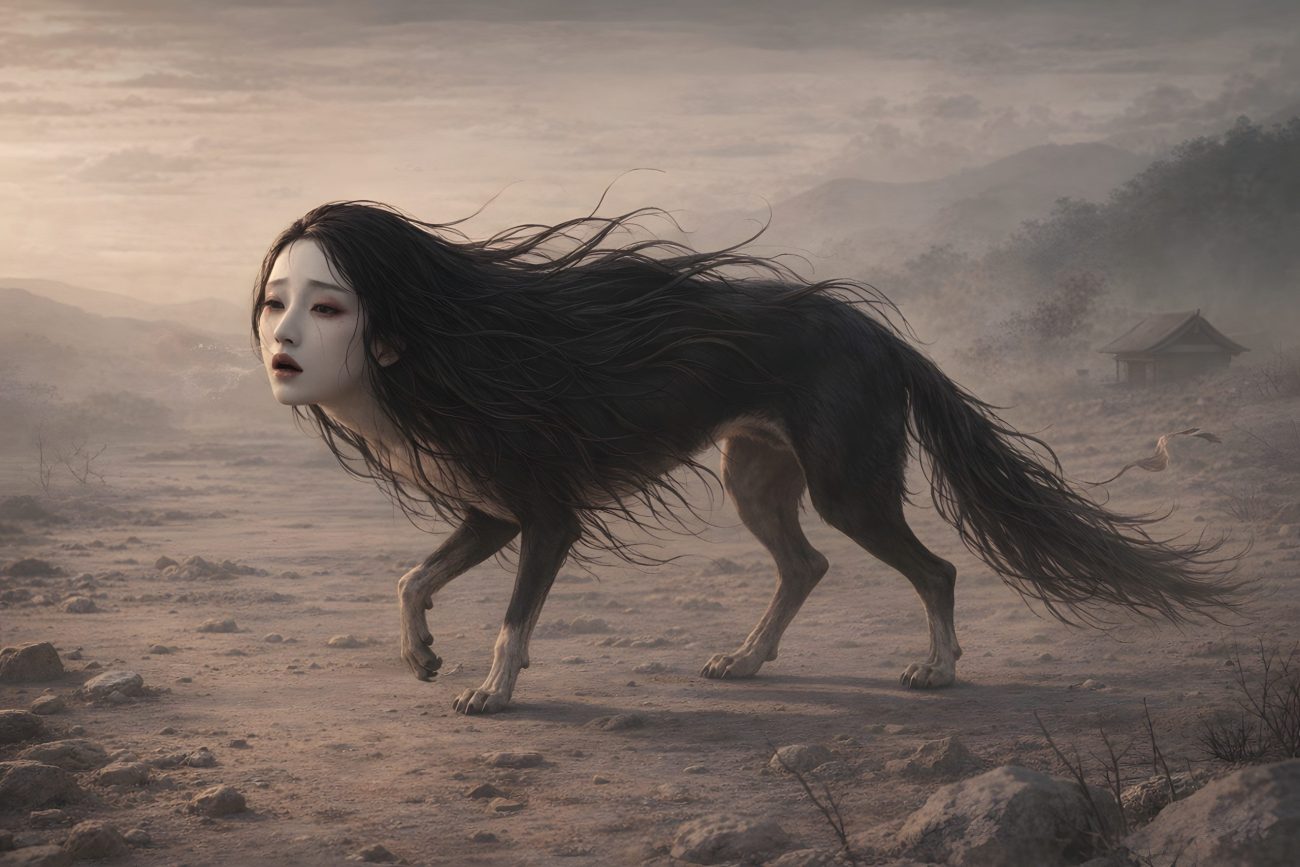
The creature is said to resemble a beast with the face of a human — sometimes that of a woman — while its long, loose hair trails down its back like a tail. Its appearance is unsettling, caught somewhere between person and animal.

Koiyamainu wanders while crying out in a mournful voice. Its call sounds like, “I want to see you, I want to see you — owwow, owwow.” The cry echoes through the land, filled with longing and sorrow.

Its name reflects this nature: a play on the idea of lovesickness and that of a diseased or troubled dog. The creature’s lament expresses yearning for someone absent, its voice carrying the pain of desire that cannot be fulfilled.


Gallery


Sources

Tyz-Yokai Blog. (n.d.). Koiyamainu. Retrieved March 1, 2026, from https://tyz-yokai.blog.jp/archives/1069382555.html


Interpretive Lenses

Religious Readings
  • Christian Ascetic Deep Dive
Philosophical Readings
  • Nietzschean Deep Dive
Psychological Readings
  • Jungian Deep Dive
Esoteric Deep Dive
  • Hermetic Deep Dive
Political / Social Readings
  • Marxist Deep Dive

Ken’etsu

Tradition / Region: Japanese Mythology
Alternate Names: Inuetsu, Dog’s Delight
Category: Dog


The Myth

Ken’etsu appears in the humorous illustrated work Mubō Sanzai Zue. Rather than a fearsome monster, it belongs to the strange and satirical creatures sometimes described in Edo-period folklore and parody bestiaries.

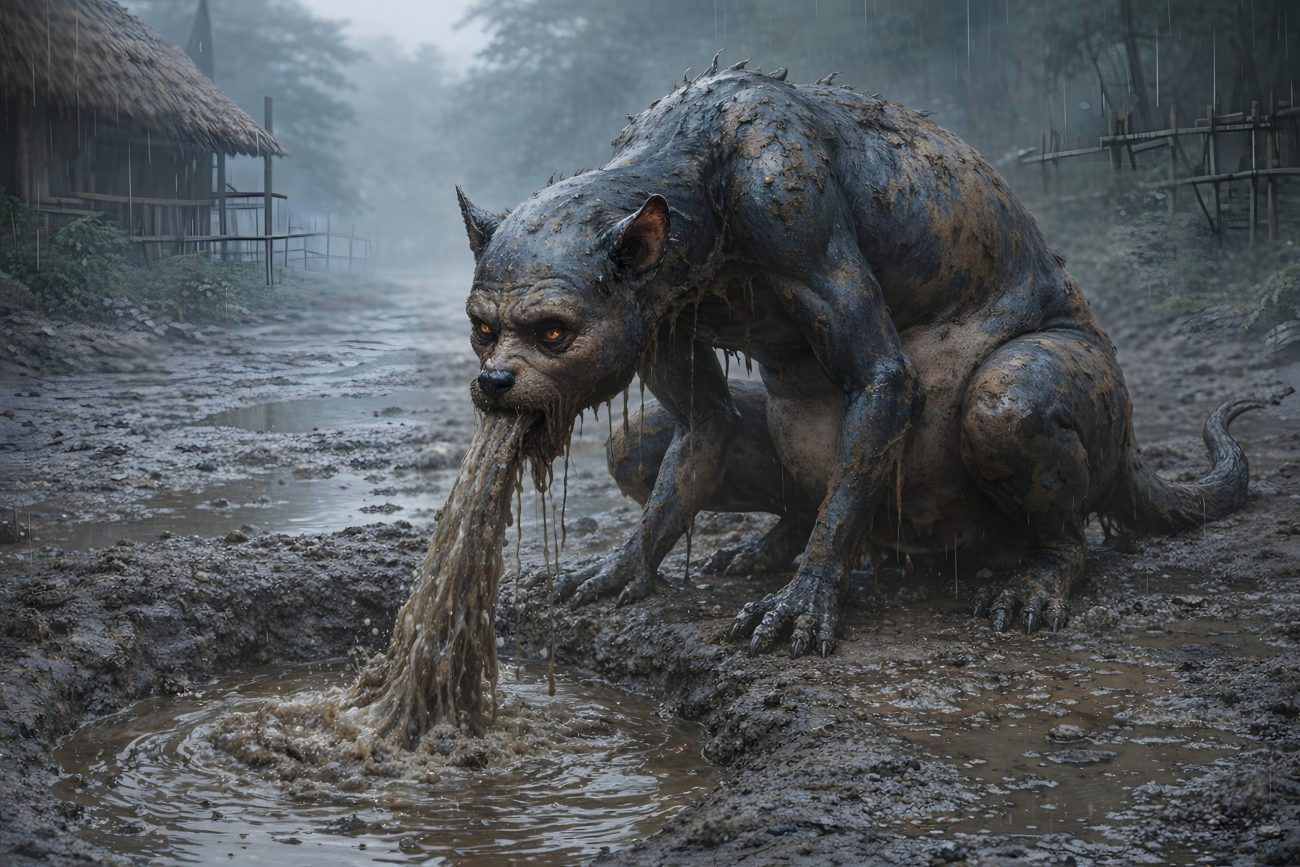
It is said that Ken’etsu was born from mud, and its body bears the color of damp earth — a bluish-black tone like wet soil. Like birds whose feathers resemble leaves or fish whose scales mirror the ripples of water, Ken’etsu’s appearance reflects the place of its origin.

The creature is described as a dog that vomits everything it eats, never needing to defecate. It drinks enormous quantities of water, and as it does so, its complexion shifts and changes. From this image comes an old saying about a dog that “vomits and changes color.”

In some depictions, Ken’etsu is shown in a more humanlike form — a figure crawling on all fours, retching repeatedly, illustrating the comparison between the creature and a drunken person who has made themselves sick. Because of this, the name “Dog’s Delight” also came to be used as a humorous expression for a drunkard who vomits and grows pale, likened to a dog contentedly eating its own sick.

Thus Ken’etsu lives on less as a terrifying spirit and more as a grotesque and comic yokai, a muddy creature of excess, sickness, and satire.


Gallery


Sources

Tyz-Yokai Blog. (n.d.). Inuyoshi. Retrieved March 1, 2026, from https://tyz-yokai.blog.jp/archives/1069367415.html


Interpretive Lenses

Religious Readings
  • Christian Ascetic Deep Dive
Philosophical Readings
  • Nietzschean Deep Dive
Psychological Readings
  • Jungian Deep Dive
Esoteric Deep Dive
  • Hermetic Deep Dive
Political / Social Readings
  • Marxist Deep Dive

Innu

Tradition / Region: Japanese Mythology (Okinawa, Nakagami County)
Alternate Names: Innu fī kutē atchūn
Category: Dog, Flame


The Myth

In the folklore of Okinawa, there is said to be a mysterious yokai known as Innu, a name that simply means “dog” in the local language. The creature is remembered mainly through brief written references rather than long stories, but those mentions describe it as something uncanny and supernatural.

According to one early account, the Innu is a strange being that wanders about while dealing with fire. Some traditions say it roams the night devouring flames, moving from place to place as if feeding on burning light. Other interpretations describe it not as eating fire, but as carrying it, walking through the darkness with flames in its presence like a living torch.

Though little detail survives about its appearance or behavior beyond this, the Innu is remembered as a roaming, fire-associated dog spirit, moving silently through the night in the villages of Okinawa, its presence tied to mysterious lights and wandering flames.


Gallery


Sources

Tyz-Yokai Blog. (n.d.). Innu. Retrieved March 1, 2026, from https://tyz-yokai.blog.jp/archives/1069220364.html


Interpretive Lenses

Religious Readings
  • Christian Ascetic Deep Dive
Philosophical Readings
  • Nietzschean Deep Dive
Psychological Readings
  • Jungian Deep Dive
Esoteric Deep Dive
  • Hermetic Deep Dive
Political / Social Readings
  • Marxist Deep Dive

Beaked Dog

Tradition / Region: Japanese Mythology
Alternate Names: Monster Born from a Dog; Beaked Dog of Tojinmachi
Category: Dog


The Myth

During the Kanpō era in the mid-18th century, a strange event was said to have occurred in Tojinmachi in Fukuoka. A household dog gave birth to a litter in which one of the newborns was unlike the others.

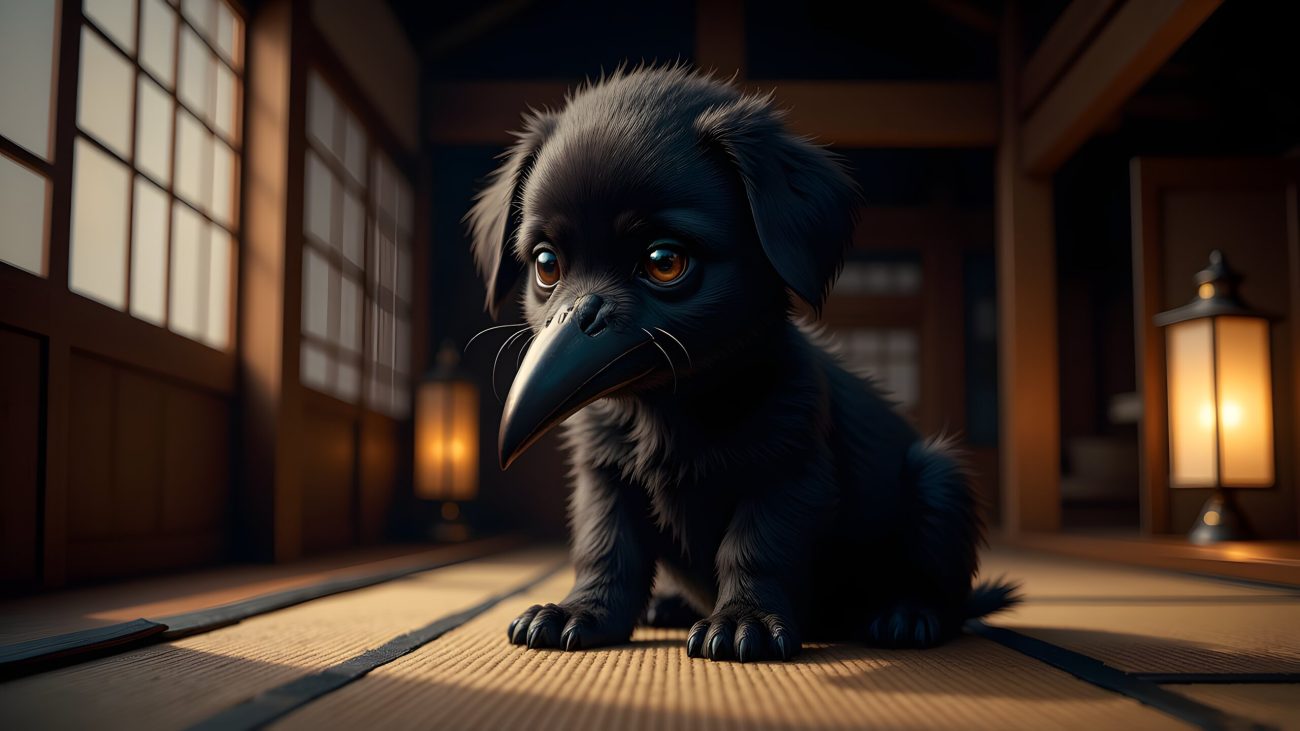
This puppy was described as having the body of a normal dog but a head shaped like the thick, curved beak of a crow. The unnatural appearance shocked those who saw it, and word spread quickly through the town. Such abnormal births were often regarded as signs or warnings, and people treated the creature with a mixture of fear and curiosity.

Despite its unusual form, the puppy was cared for. It was fed rice and fish like any other household animal, but it survived only a short time before dying.

The incident was later recorded in illustrated works such as Kaikaidan Ekotoba. Although the scroll itself did not give the creature a specific name, later sources referred to it simply as “the monster born from a dog.” In modern references, it is often called the Beaked Dog of Tojinmachi, remembered as one of the strange births and ominous wonders noted in Edo-period tales.


Gallery


Sources

Tyz-Yokai Blog. (n.d.). Beaked Dog. Retrieved March 1, 2026, from https://tyz-yokai.blog.jp/archives/1069207156.html


Interpretive Lenses

Religious Readings
  • Christian Ascetic Deep Dive
Philosophical Readings
  • Nietzschean Deep Dive
Psychological Readings
  • Jungian Deep Dive
Esoteric Deep Dive
  • Hermetic Deep Dive
Political / Social Readings
  • Marxist Deep Dive

Yatsufusa

Tradition / Region: Japanese Mythology
Alternate Names:
Category: Dog


The Myth

Yatsufusa was a remarkable dog said to have been born in a village beyond Toyama in Awa Province. When he was only a week old, his mother was killed by a wolf, and the pup seemed certain to die. But a raccoon dog, appearing as a drifting will-o’-the-wisp, came and nursed him with milk. The pup survived and grew into an unusually large, powerful dog with sharp eyes and a noble bearing.

Word of this strange animal reached Satomi Yoshizane, lord of Awa, who summoned the dog to his court. The dog’s black-and-white coat bore eight peony-like markings, and so he was named Yatsufusa, “Eight Tufts.” He became the Satomi family’s cherished pet and grew deeply attached to Yoshizane’s daughter, Princess Fusehime, never leaving her side.

Years later, famine weakened the Satomi lands, and the enemy lord Anzai Kagetsura invaded. The castle stood on the brink of collapse. In desperation, Yoshizane jokingly told the starving Yatsufusa that if he killed the enemy general, he would reward him with Fusehime’s hand in marriage.

That night, Yatsufusa returned carrying the severed head of Kagetsura. The promise, made in jest, had been fulfilled in earnest. Yoshizane rewarded the dog with rich food and servants, but Yatsufusa refused all comforts, remaining beside the head as though waiting for the promised reward.

When Yoshizane realized the dog’s attachment to his daughter, he tried to drive Yatsufusa away. The dog broke loose and forced his way into the mansion, and Yoshizane prepared to kill him. Fusehime stopped her father, reminding him that a promise once spoken must be honored. Reluctantly, Yoshizane allowed her to leave with the dog.

Yatsufusa carried Fusehime into the mountains, where they lived together in a cave. She brought with her a copy of the Lotus Sutra and spent her days reciting it. Yatsufusa listened, growing calm and devoted, and never violated her. A hermit’s messenger later revealed that the dog’s true nature was bound to past grudges and karmic ties, but that the sutra’s power had begun to free him.

Through the merit of the sacred text, Fusehime conceived eight spiritual children. She later resolved that she and the dog should end their suffering and be reborn in better form. As Yatsufusa prepared to follow her into the water, a shot rang out. A warrior attempting to rescue the princess fired, and the bullet struck both dog and girl.

Fusehime died after proving her purity, and the rosary she carried burst apart, sending eight sacred beads flying into the world. From these beads would arise the Eight Dog Warriors, heroes bound by virtue.

After her death, Fusehime’s spirit was sometimes seen riding Yatsufusa, guiding the warriors who carried the beads and watching over their destinies.


Gallery


Sources

Tyz-Yokai Blog. (n.d.). Yafusa. Retrieved March 1, 2026, from https://tyz-yokai.blog.jp/archives/1069140273.html


Interpretive Lenses

Religious Readings
  • Christian Ascetic Deep Dive
Philosophical Readings
  • Nietzschean Deep Dive
Psychological Readings
  • Jungian Deep Dive
Esoteric Deep Dive
  • Hermetic Deep Dive
Political / Social Readings
  • Marxist Deep Dive

Sunekosu

Tradition / Region: Japanese Mythology
Alternate Names:
Category: Dog


The Myth

Sunekosu is a strange creature said to appear in Oda County of Okayama Prefecture. It is most often encountered on rainy nights, when the roads are quiet and visibility is poor.

Those walking alone sometimes feel something brush suddenly against their legs. Looking down, they may glimpse the shape of a small animal like a dog slipping past them in the darkness. It moves silently and quickly, weaving between the legs of travelers before vanishing into the night.

The creature does not attack, but its sudden contact startles those who encounter it. Afterward, nothing can be seen or heard, leaving only the uneasy feeling that something unseen passed close by in the rain.


Gallery


Sources

Tyz-Yokai Blog. (n.d.). Sunekosu. Retrieved March 1, 2026, from https://tyz-yokai.blog.jp/archives/1010654292.html


Interpretive Lenses

Religious Readings
  • Christian Ascetic Deep Dive
Philosophical Readings
  • Nietzschean Deep Dive
Psychological Readings
  • Jungian Deep Dive
Esoteric Deep Dive
  • Hermetic Deep Dive
Political / Social Readings
  • Marxist Deep Dive

Inugami

Tradition / Region: Japanese Mythology
Alternate Names: In’gami, Irigami
Category: Dog


The Myth

Inugami are powerful dog spirits said to serve human masters. They are known throughout western Japan, especially in Kyūshū and Shikoku, and are most often connected with wealthy or influential families.

To ordinary eyes, an inugami may appear as nothing more than a common dog. Its true form, however, is far more unsettling. It is said to exist as the mummified head of a dog, preserved and hidden within a secret shrine in the house of its owner. From this hidden vessel, the spirit carries out the will of the family it serves.

Inugami are loyal and obedient, performing tasks much like a living dog. They may bring prosperity, protect the household, or carry out secret commands. Families said to possess such spirits, known as inugami-mochi, treated them almost as members of the household. The spirits were believed to pass down through generations, so that each family member would have their own inugami.

Yet these spirits were not without danger. If mistreated or angered, an inugami could turn on its master with violent fury. They were also known for their power of possession. An inugami might enter a person’s body, settling inside and bringing suffering. Those possessed were said to feel strange pains, intense jealousy, or uncontrollable hunger, and some would bark like a dog. Removing such a spirit required another sorcerer and could take great effort and expense.

The creation of an inugami was believed to involve a dark and terrible ritual. A dog would be driven into extreme desperation through hunger and suffering, and at the height of that torment its head would be severed. The spirit born from that fury would become a powerful and vengeful entity. The head was then preserved and enshrined so that the spirit could be bound and commanded.

Because of the fear surrounding these practices, families suspected of keeping inugami were often shunned by others. Even the accusation of using such spirits could force a household into isolation.

Thus the inugami were remembered as loyal yet dangerous dog spirits — protectors, servants, and sources of both fortune and ruin, bound to families by dark rites and hidden shrines.


Gallery


Sources

Foster, M. D. (n.d.). Inugami. In yokai.com, from https://yokai.com/inugami/


Interpretive Lenses

Religious Readings
  • Christian Ascetic Deep Dive
Philosophical Readings
  • Nietzschean Deep Dive
Psychological Readings
  • Jungian Deep Dive
Esoteric Deep Dive
  • Hermetic Deep Dive
Political / Social Readings
  • Marxist Deep Dive

Hainu

Tradition / Region: Japanese Mythology
Alternate Names:
Category: Dog, Yokai, Winged beast


The Myth

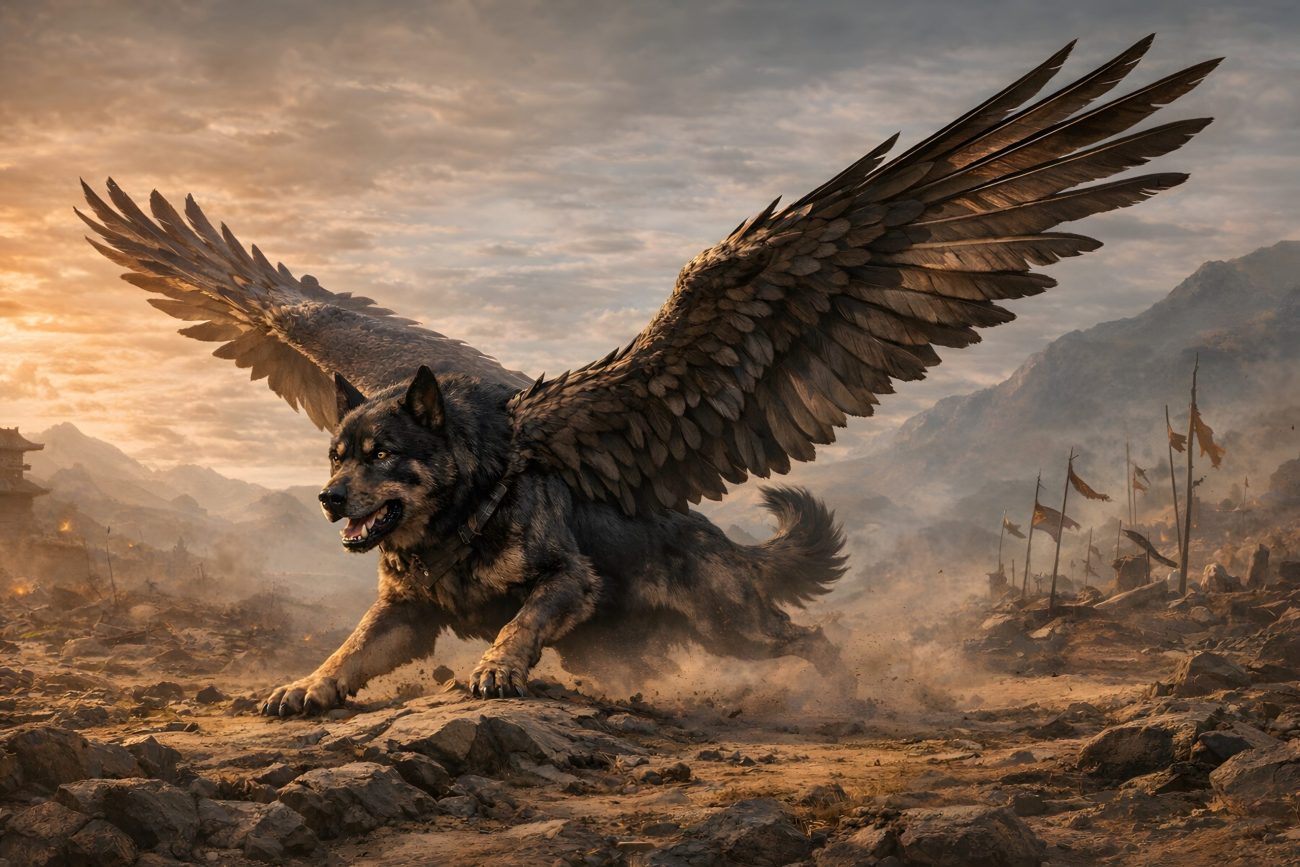
The Hainu is a legendary winged dog spoken of in the traditions of Chikugo in Kyūshū.

It is described as a powerful and fearsome creature, shaped like a dog but with wings that allow it to move swiftly through the air. Strong and fast, it could be as dangerous to humans as a wolf. Yet some tales say that, when tamed, a hainu could also be loyal and affectionate toward its master.

Stories of the creature are tied to events in the late sixteenth century, when the warlord Toyotomi Hideyoshi led his armies into Kyūshū.

One version of the legend tells of a terrifying winged dog that appeared in the region long before Hideyoshi’s arrival. The beast attacked travelers, slaughtered livestock, and spread fear throughout the countryside. When Hideyoshi’s forces passed through the area, the creature blocked their way. After a fierce struggle, the army finally killed it. Hideyoshi, impressed by the animal’s strength and cunning, ordered that it be buried with honor, and a mound was raised where it fell.

Another version tells a very different story. In this telling, the winged dog was not an enemy but Hideyoshi’s own companion. The animal followed him faithfully, flying above his troops as they marched. When they passed through Chikugo, however, the hainu fell ill and died. Hideyoshi was deeply grieved by the loss, and his retainers built a burial mound for the creature so that it would be remembered.

In later years, the place where the dog was said to be buried became known as Hainuzuka, the mound of the winged dog. A temple nearby preserved the memory of the legend, and monuments were raised in honor of the strange creature.

Thus the Hainu was remembered in two ways — as a terrifying beast and as a beloved companion — a winged dog whose story remained tied to the land where it was said to rest.


Gallery


Sources

Foster, M. D. (n.d.). Hainu. In yokai.com, from https://yokai.com/hainu/


Interpretive Lenses

Religious Readings
  • Christian Ascetic Deep Dive
Philosophical Readings
  • Nietzschean Deep Dive
Psychological Readings
  • Jungian Deep Dive
Esoteric Deep Dive
  • Hermetic Deep Dive
Political / Social Readings
  • Marxist Deep Dive

Okuri Inu

Tradition / Region: Japanese Mythology
Alternate Names: Okuri Ōkami (“sending-off wolf”)
Category: Dog, Yokai


The Myth

The Okuri Inu is a dangerous spirit said to haunt mountain paths, forest roads, and lonely passes. It appears as a dog or wolf and is most often encountered at night, when travelers must cross the wild places between villages.

Those who walk alone in the dark may suddenly sense that something is following them. If they look back, they might see a dog-shaped figure pacing behind them, keeping exactly to their footsteps. The creature does not attack at once. Instead, it follows silently, waiting.

As long as the traveler keeps walking, nothing happens. But if they stumble, fall, or show weakness, the Okuri Inu leaps forward with supernatural speed and tears them apart.

Because of this, the spirit is both feared and strangely respected. While it stalks a person, no other beasts or spirits will come near. In this way it protects the traveler from all other dangers, even as it waits for the chance to become their doom.

Some say there are ways to escape it. If a traveler stumbles, they must quickly pretend it was intentional. Sitting down at once and speaking aloud as if resting — saying something like “Heave-ho” or “I’m tired” — may trick the spirit into thinking the fall was not a sign of weakness. Then it will wait patiently rather than attack.

If the traveler survives the journey and leaves the mountains safely, they should turn and thank the unseen follower for escorting them. It is also said that once home, a person should wash their feet and leave out food in gratitude. If this is done, that Okuri Inu will never follow them again.

The spirit’s name, meaning “sending-off dog,” comes from the way it follows travelers as if accompanying them on their way. Since ancient times, stories of this creature have been told across Japan, born from the dangers of mountain travel where a single misstep could mean death.

Thus the Okuri Inu is remembered as a watcher of lonely roads — a shadow that walks behind the traveler, guarding them from danger while waiting for the moment they falter.


Gallery


Sources

Foster, M. D. (n.d.). Okuri-inu. In yokai.com, from https://yokai.com/okuriinu/


Interpretive Lenses

Religious Readings
  • Christian Ascetic Deep Dive
Philosophical Readings
  • Nietzschean Deep Dive
Psychological Readings
  • Jungian Deep Dive
Esoteric Deep Dive
  • Hermetic Deep Dive
Political / Social Readings
  • Marxist Deep Dive