Tradition / Region: Japanese Mythology
Alternative names: Mukyoku Dōjin, Wuji Daoist, Boundless Taoist
Category: Cave dweller
The Myth
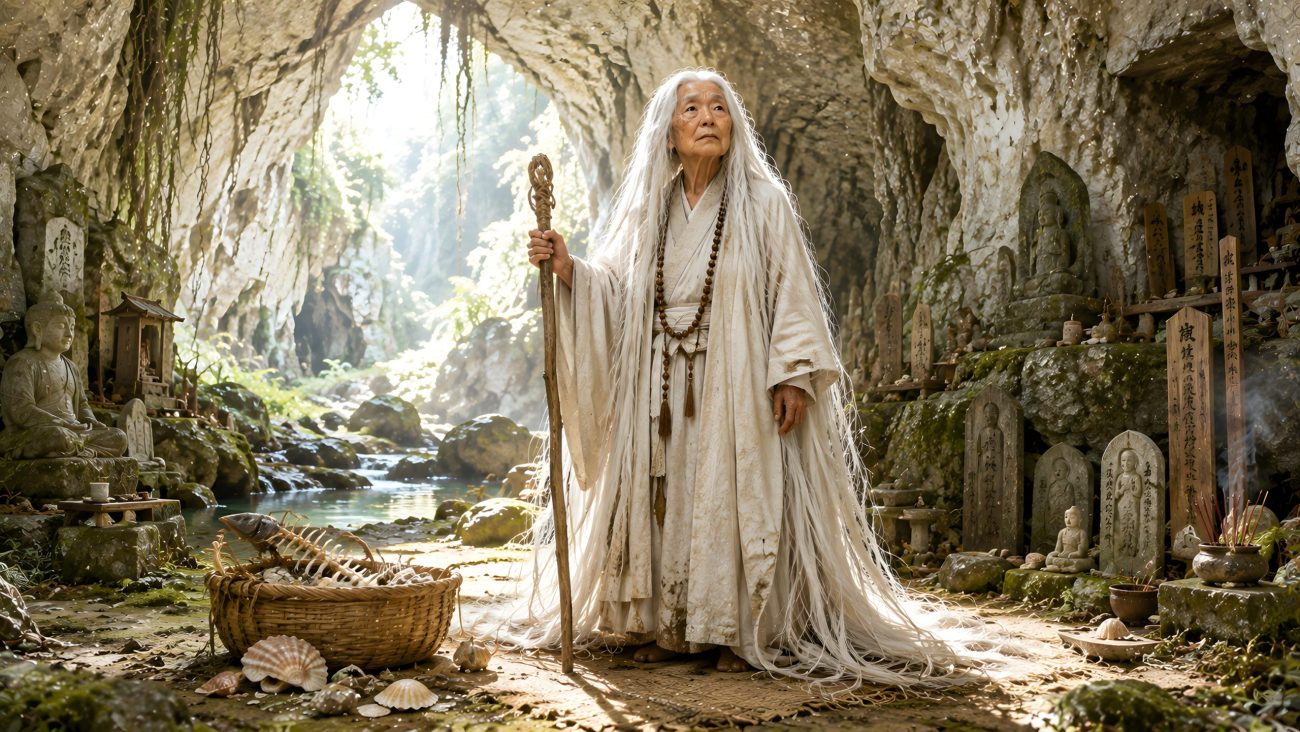
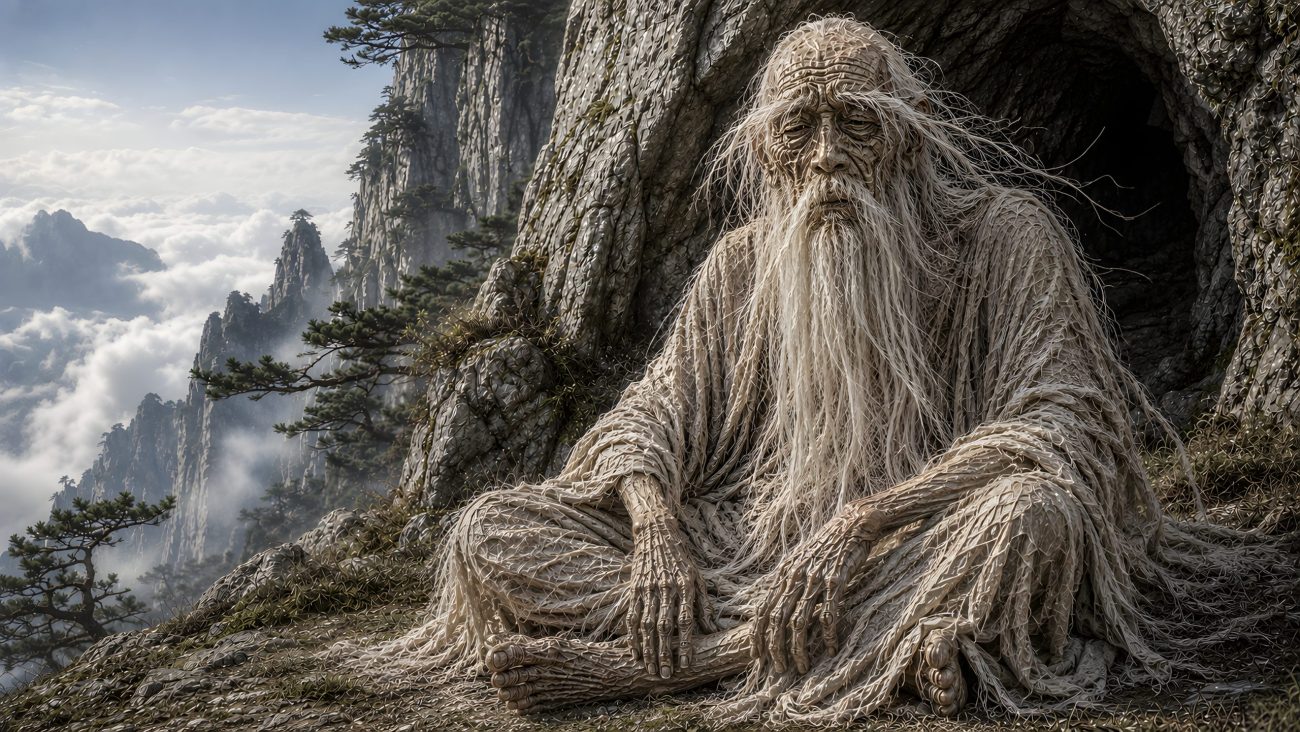
Mukyoku Dōjin appears as an extraordinary Taoist sage with a long white beard and a bald head who lives alone in a cave at the foot of Mount Hōtō, a legendary dwelling place of immortals east of the Bohai Sea. He possesses knowledge of the beginning and end of heaven and earth, the rise and fall of civilizations, the history of humanity, and the future of the world. He has lived through several cycles of birth and death and remembers his former lives.
According to the tale, a learned man named Kontonshi became obsessed with the future of humanity. Although he had studied the writings of many schools of thought, he regarded books as merely the remains of ancient knowledge and could find no answer to the questions that troubled him. His thoughts became so consuming that he neglected both food and sleep.
Kontonshi eventually heard of a Taoist sage living in seclusion in the mountains and immediately traveled to his cave. When he arrived, the withered-looking Mukyoku Dōjin smiled and greeted him before he had even spoken, telling him that he had been waiting for him.
The Taoist then began explaining the history of heaven and earth. He said that he had been born together with heaven and earth and would die together with them, having already experienced five cycles of birth and death. He remembered his previous lives and possessed knowledge of those yet to come.
Mukyoku Dōjin described the formation of the mountains and seas, followed by the appearance of living beings and eventually humanity. He compared the first humans to mushrooms growing in a swamp and maggots gathering around decaying flesh. As the primordial vapors condensed, they formed bodies that gradually developed into living creatures with a monkey-like appearance. These beings learned to obtain food and clothing, eventually reproducing and forming families.
When Kontonshi asked how long the Earth would survive, Mukyoku Dōjin explained that its existence would last 36,000 years. The first 12,000 years would be an uncivilized age, followed by 12,000 years of enlightenment and then 12,000 years of turmoil.
The Taoist said that humanity was currently living during the enlightened period and that its greatest prosperity would come roughly a thousand years later. Civilization would become more advanced and stable, human happiness would reach its greatest level, and the population of the Earth would increase greatly. Machinery would allow people to clear even remote mountains and wilderness and transform them into farmland and pasture.
He then described the final destruction of the Earth. As the age of turmoil approached, the sun would gradually lose its light and heat while the Earth accelerated its rotation. Human vitality would decline, lifespans would become shorter, and people would gradually become smaller.
Eventually the sun would no longer provide enough warmth for crops, animals, or human beings. Cold would spread across the world until the entire surface of the Earth became frozen. When the surface was covered completely in ice, heat trapped inside the planet would cause its axis to rupture. Fire and water would mix together, transforming the Earth into an enormous mass of boiling mud.
The sun itself would also freeze and perish, but the heat released from it would evaporate the surrounding water. From this destruction a new sun would eventually emerge, and the Earth would regain its form. Nature would return and a new generation of humanity would appear.
Mukyoku Dōjin explained that this cycle of destruction and renewal was comparable to the Buddhist concept of the kalpa. He also described countless other worlds existing beyond the Earth. The stars were said to contain their own lands inhabited by people and animals, while the universe consisted of innumerable worlds extending far beyond what human beings could comprehend.
Kontonshi continued questioning the Taoist about laws, philosophy, politics, nations, and the future of humanity, and Mukyoku Dōjin answered each question. When Kontonshi finally asked about the ultimate destiny of politics, nations, and the human heart, however, the Taoist had disappeared.
Only the evening mist remained around the mountain peaks, accompanied by the sound of wind moving through the pine trees. Kontonshi paid his respects at the entrance of the cave and returned home.
Sources
Takahashi, Toshihiro. “無極道人 (Mukyoku Dōjin).” 新版TYZ 妖怪図鑑 (New TYZ Yokai Encyclopedia). August 29, 2019. Accessed August 15, 2026. https://tyz-yokai.blog.jp/archives/1074589374.html