Tradition: Icelandic Mythology
Alternative Names: Seal-Head
Category: Nymph
The Myth
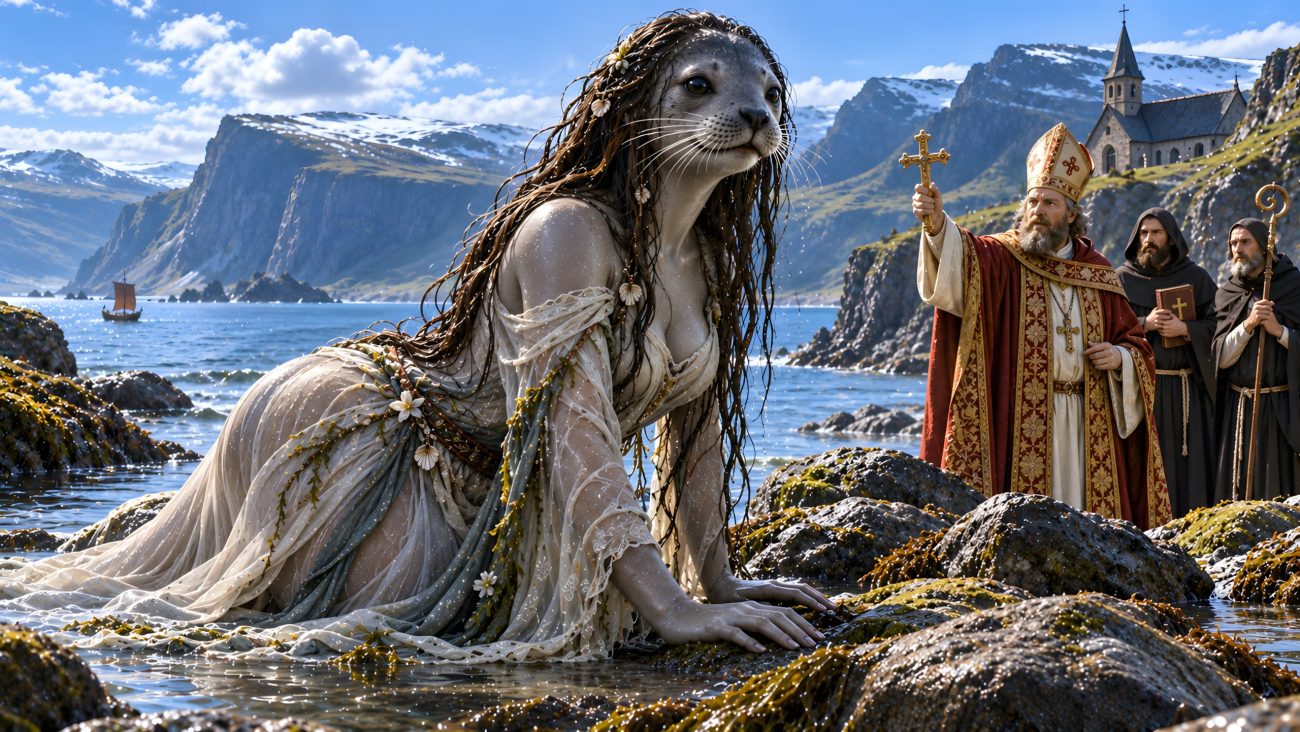
Selkolla is a supernatural being in Icelandic folklore, described as a beautiful woman who sometimes appears with the head of a seal. She is particularly associated with the Westfjords of Iceland and is best known as an adversary of Bishop Guðmundur Arason, who lived from 1161 to 1237. Her legend combines Christian beliefs about the Devil and evil spirits with supernatural traditions inherited from pre-Christian Scandinavian culture.
The story of Selkolla begins with a man and a woman travelling through the Westfjords with a baby girl who is to be baptised. Along the way, the couple stop beside a large stone known as Miklisteinn and engage in sexual intercourse, leaving the infant unattended. When they return, they find the child black, dead, and hideous. They initially abandon her, but after hearing a cry, they return and discover that she is alive, although her appearance has become so terrifying that they dare not approach her. They go to a nearby farm to seek help, but when they return to the stone, the child has disappeared.
Soon afterwards, a strange woman appears in the district. Sometimes she has an ordinary human face, but at other times she bears the head of a seal. She moves about boldly both day and night, earning the name Selkolla, meaning “Seal-Head.” She is also called a midday devil because she does not restrict her appearances to the darkness.
Selkolla begins terrorising a local farm. Disguised as the farmer’s wife, she attempts to seduce the farmer. When he recognises the deception and tries to return home, she blocks his path, leaving him exhausted and gravely afflicted. He loses his sexual potency and remains tormented by the spirit, who continues to pursue him day and night. His condition becomes so disturbing that few people are willing to approach him, except for a devoted relative who stays beside him. Eventually, Selkolla attacks this relative during the night and bursts out his eyes.
Unable to endure the spirit’s assaults, the people call upon Bishop Guðmundur Arason for help. He stays at the afflicted farm, where Selkolla appears during the night and attempts to remove his shoes, which his servants have neglected to take off. Recognising her immediately, the bishop commands her to depart and forbids her from returning. The following day, they encounter one another again, and Guðmundur drives her away by erecting seven crosses.
Selkolla later appears aboard a ship travelling across the bay that separates Iceland’s dioceses. However, the crew have received Guðmundur’s blessing for their voyage, and this protection prevents her from harming them. Her story thus presents the bishop’s faith and religious authority as powerful defences against supernatural evil.
Selkolla’s legend also survives in other medieval Icelandic accounts. One version claims that she gave her name to the cliff Selkollu-Kleifar, while another briefly mentions the bishop’s encounters with the terrifying spirit among the miracles associated with his life. Her story remains a striking example of how Icelandic folklore blended Christian ideas of demonic temptation with older traditions of strange, shape-changing beings.
Sources
Wikipedia contributors. (n.d.). Selkolla. In Wikipedia, from https://en.wikipedia.org/wiki/Selkolla