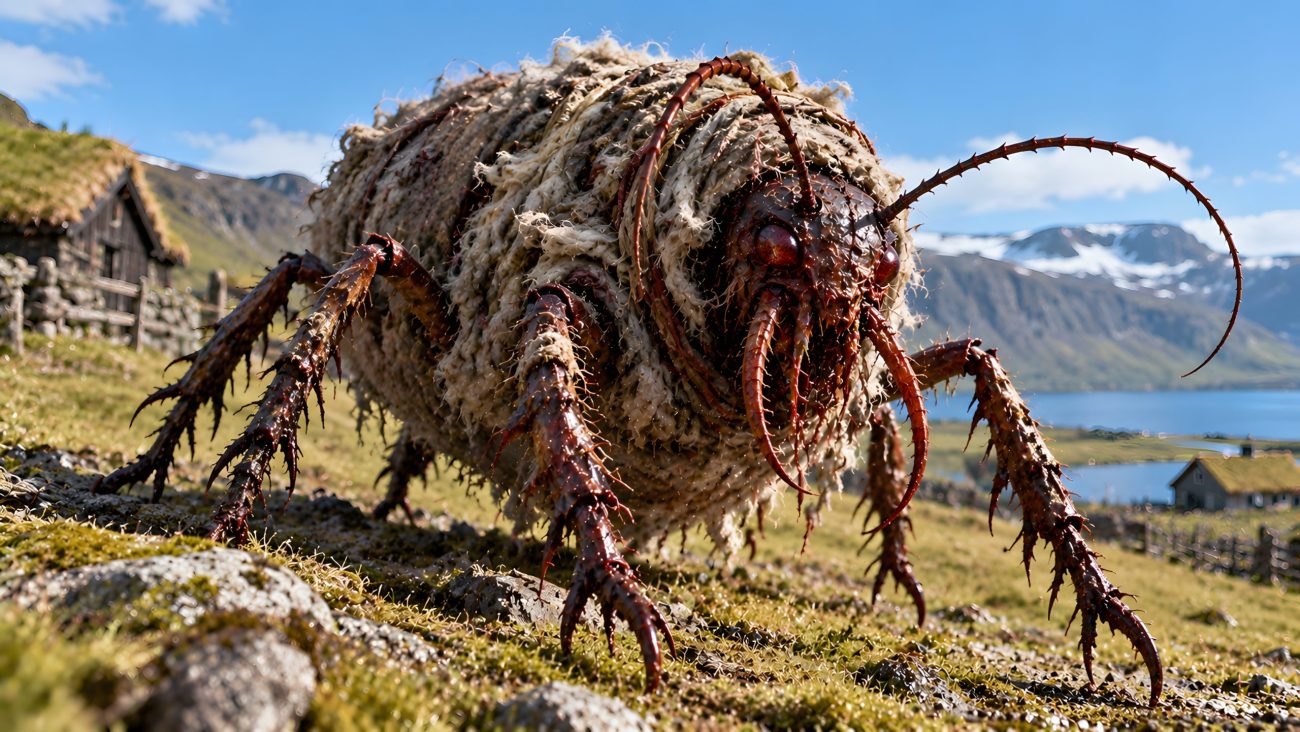
Tradition: Icelandic Mythology
Alternative Names: Snakkur, Tilberi (Carrier)
Category: Insect
The Myth
The Tilberi is a strange creature created by witches to steal milk from other people’s livestock. It is known by different names across Iceland: Tilberi is used in the north, while Snakkur is common in the south and west, and both names occur in eastern Iceland. Only women are said to be able to create and own one. The creature is exceptionally fast and can take on unusual forms, including a living bundle of wool that rolls across the ground.
Creating a Tilberi requires a series of sinister rituals. A woman must steal a rib from a recently buried corpse early on Whitsunday and wrap it in stolen grey wool. In some accounts, the wool must be taken from between the shoulders of a widow’s sheep shortly after shearing. She keeps the bundle between her breasts and, over the following three Sundays, spits consecrated communion wine onto it. Each time, the creature becomes more alive. Finally, she allows it to suckle on the inside of her thigh, leaving behind a distinctive wart-like growth.
Once created, the Tilberi can be sent to steal milk from other people’s cows and ewes. To reach an animal’s udder, it leaps onto the animal’s back and stretches its body downwards. Some versions claim it can reach down on both sides to suck milk from two teats simultaneously. After filling itself, it returns to its owner’s dairy window and calls out, “Full belly, Mummy!” or “Churn lid off, Mummy!” It then vomits the stolen milk into her butter churn.
The stolen milk and butter carry signs of the creature’s interference. Butter made from the milk may clump together as though curdled, or dissolve into foam if someone makes the sign of the cross over it or draws the magical butter-knot symbol, known as the smjörhnútur, into it. The Tilberi was also blamed for inflammatory hardening of livestock udders. Traditional protective measures included making the sign of the cross beneath the udder and over the animal’s rump, as well as placing a Psalter along its spine.
Milk is not the creature’s only target. A Tilberi sometimes steals wool left outside to dry after shearing and washing, rolling it around its body until it becomes a gigantic moving ball. It can also threaten its creator. If a woman has a child and the creature manages to reach her milk-filled breast, it may suckle so greedily that it drains her life away.
There are several traditional methods of destroying a Tilberi. One is to send it into the mountain pastures and command it to collect every lamb dropping, either from three separate pastures or into three piles. The creature must continue its impossible task until it dies of exhaustion, or it perishes because, as an evil being, it cannot endure the number three. When it dies, only the human rib used to create it remains in the pasture.
Another method exploits its attachment to its creator. When pursued, the Tilberi is believed to flee home and hide beneath its mother’s skirts. If her petticoat is tied or sewn shut around it, both the woman and the creature can be burned or drowned together.
The Tilberi reflects Icelandic fears surrounding theft, witchcraft, livestock, and the dangers of forbidden supernatural practices. Although it brings its owner stolen milk and wool, its existence is dangerous to animals and humans alike. Its creation requires the misuse of sacred substances and a human bone, while its eventual destruction depends on ritual commands and the supernatural power attributed to the number three.
Sources
“Tilberi.” Wikipedia: The Free Encyclopedia. Wikimedia Foundation. Accessed October 18, 2026. https://en.wikipedia.org/wiki/Tilberi