Tradition: German Mythology
Alternative Names: Salige Fräulein, Salkweiber, Salaweiber, Wilde Fräulein, Wilde Frauen, Selige Fräulein, Salgfräulein, Enguane, Belle Vivane, Žalk Žene
Category: Nymph
The Myth
The Salige Frauen, whose name means “blessed women,” are mysterious female spirits of the Alpine mountains. They are especially associated with Tyrol, South Tyrol, and Carinthia, where legends tell of their hidden dwellings deep within rocky caves and even beneath glaciers. Beautiful, wise, and shy, they usually avoid human company, yet they are known to help the poor, offer advice to those in need, and teach people valuable skills. Their kindness, however, comes with a warning: they despise loud noises, and those who disturb their peace may discover that these otherworldly women are not always gentle.
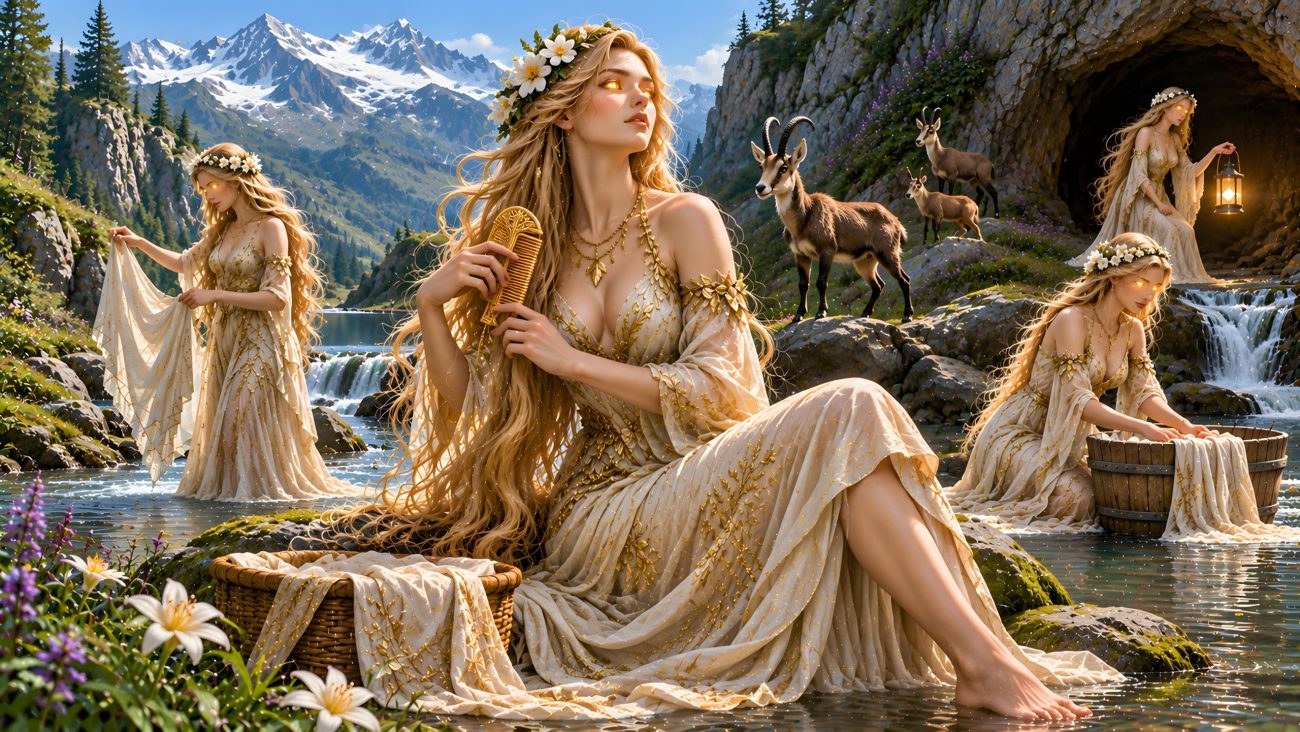
In the Ötztal valley of Tyrol, the Salige Frauen were said to appear near a landmark known as Frauenstein, or the Ladies’ Rock. There, golden-haired maidens would comb their hair and sing with enchanting voices. The moment they noticed a human approaching, they retreated into their hidden cave, which was said to extend nine steps into the earth.
Along the banks of the Drava River in Carinthia, the Salkweiber lived in caves and survived on fish. Some traditions described them as having misshapen feet. They were also known to wash linen beside the river, singing as they worked and tending their livestock. Yet encounters with them could be dangerous, particularly for young men, whom they might capture and kiss against their will. The spirits could be kept at bay by singing or cracking a whip, for they could not bear the noise.
The Salige Frauen sometimes brought extraordinary gifts to those who treated them kindly. One winter, a farmer heard mysterious voices near the Drava advising him to sow beans in the snow. The seeds sprouted, and the farmer was later instructed to release his pigs to feed upon the young plants. Despite this unusual beginning, the crop flourished and eventually produced a plentiful harvest.
In the drought-stricken Vinschgau Valley of South Tyrol, a Salige Frau was credited with introducing buckwheat, a crop previously unknown in the region. The Salige Frauen were also closely associated with flax cultivation. Their queen, Frau Hulda, was said to have taught humanity how to grow flax, spin its fibres, and weave linen.
Another tale tells of a Salk who entered the home of a peasant woman and was treated with kindness. In gratitude, the spirit gave her a strand of hair that provided an inexhaustible supply of thread for her spinning wheel. The woman spun such fine linen that she became wealthy. But one day, she complained impatiently about the endless work, despite the spirit’s warning. At that moment, the magical thread ran out, and her extraordinary fortune came to an end.
The Salige Frauen were also guardians of wild animals, particularly the chamois that inhabited the high mountains. In one legend, a young man named Schütz fell while travelling through the mountains and discovered a crystal grotto containing a magnificent palace and gardens. The Salige Fräulein welcomed him into their hidden realm and permitted him to return, provided he kept their dwelling secret and never hunted the mountain animals.
For a time, Schütz honoured his promise. Eventually, however, his curious mother followed him and disturbed the entrance to the grotto, destroying his access to the enchanted place. Disheartened, he later joined his companions on a hunting expedition and shot at a chamois. Three furious Salige Frauen appeared to defend the animal. A terrible shudder overcame the young man, and he fell from a precipice to his death.
Other traditions claim that the Salige Frauen sometimes appear in the form of bearded vultures while watching over their chamois in the mountains. Their protection of the wild creatures reflects their deep connection with the hidden and sacred places of the Alpine wilderness.
Yet the Salige Frauen themselves were not always safe from other supernatural beings. In some legends, they were hunted by a terrifying wild man and driven from their caves by the Wild Hunt. Near the village of Mieger in Carinthia, golden-haired Salige Frauen who washed linen beside the Drava feared a giant that pursued them. They asked local men to mark the stumps of felled trees with the sign of the cross, creating places where they could find protection from their monstrous pursuer.
Across the Alpine valleys, the Salige Frauen occupy an uncertain place between the human world and the supernatural. They may offer miraculous gifts, teach forgotten crafts, protect animals, and rescue the unfortunate. But their generosity depends upon respect, discretion, and the preservation of their secluded world. Those who break their promises, disturb their peace, or harm the creatures under their protection may lose far more than they ever hoped to gain.
Sources
Wikipedia contributors. (n.d.). Salige Frau. In Wikipedia, from https://en.wikipedia.org/wiki/Salige_Frau