Buntcow

Tradition / Region: German mythology
Alternate Names:
Category: Cow


The Myth

Long ago, there were two herders whose ways shaped their cattle as much as their hands ever could. One was called Rohrdommel, the Bittern, and the other Wiedehopf, the Hoopoe. Both tended cows with care, yet each chose a very different path.

Rohrdommel led his herd into wide meadows rich with flowers and grass. The land was fertile but not heavy, and the cows that grazed there grew lively and bold. They leapt and ran, full of restless joy. When evening came and it was time to return home, Rohrdommel called out to them, crying, “Bunt, herüm!” — “Colorful cow, come around!” But the cows ignored him, dancing and scattering through the fields, unwilling to be gathered.

Wiedehopf, meanwhile, drove his cattle into high, barren hills where the wind blew sand across the ground and food was scarce. There his cows grew thin and weak. When he called to them, urging them to rise and follow, they could not. They lay where they had fallen, too exhausted to stand, no matter how loudly he cried, “Up, up, up!”

So it was said that Rohrdommel’s cows became spirited and wild, while Wiedehopf’s remained frail and helpless, each herd reflecting the land and care chosen for them. In time, the herders themselves vanished from the world of people and were transformed into birds.

Even now, their voices remain. Over the meadows, the Bittern still cries “Bunt, herüm!”, and across the hills the Hoopoe answers “Up, up, up!”—echoes of a time when cattle danced or lay still, and when herders shaped the fate of their herds by the paths they chose.


Gallery


Sources


Interpretive Lenses

Religious Readings
  • Christian Ascetic Deep Dive
Philosophical Readings
  • Nietzschean Deep Dive
Psychological Readings
  • Jungian Deep Dive
Esoteric Deep Dive
  • Hermetic Deep Dive
Political / Social Readings
  • Marxist Deep Dive
Other
  • How to Invite The Buntcow

Bull of Bardowick

Tradition / Region: German mythology
Alternate Names:
Category: Cow


The Myth

In the time when Bardowick was a rich and powerful city, its people rose in pride and defied their lord, Duke Henry the Lion of Brunswick, refusing him entry through their gates. Enraged by this insult, the duke laid siege to the city. For two days his forces pressed against Bardowick’s defenses, yet made no progress.

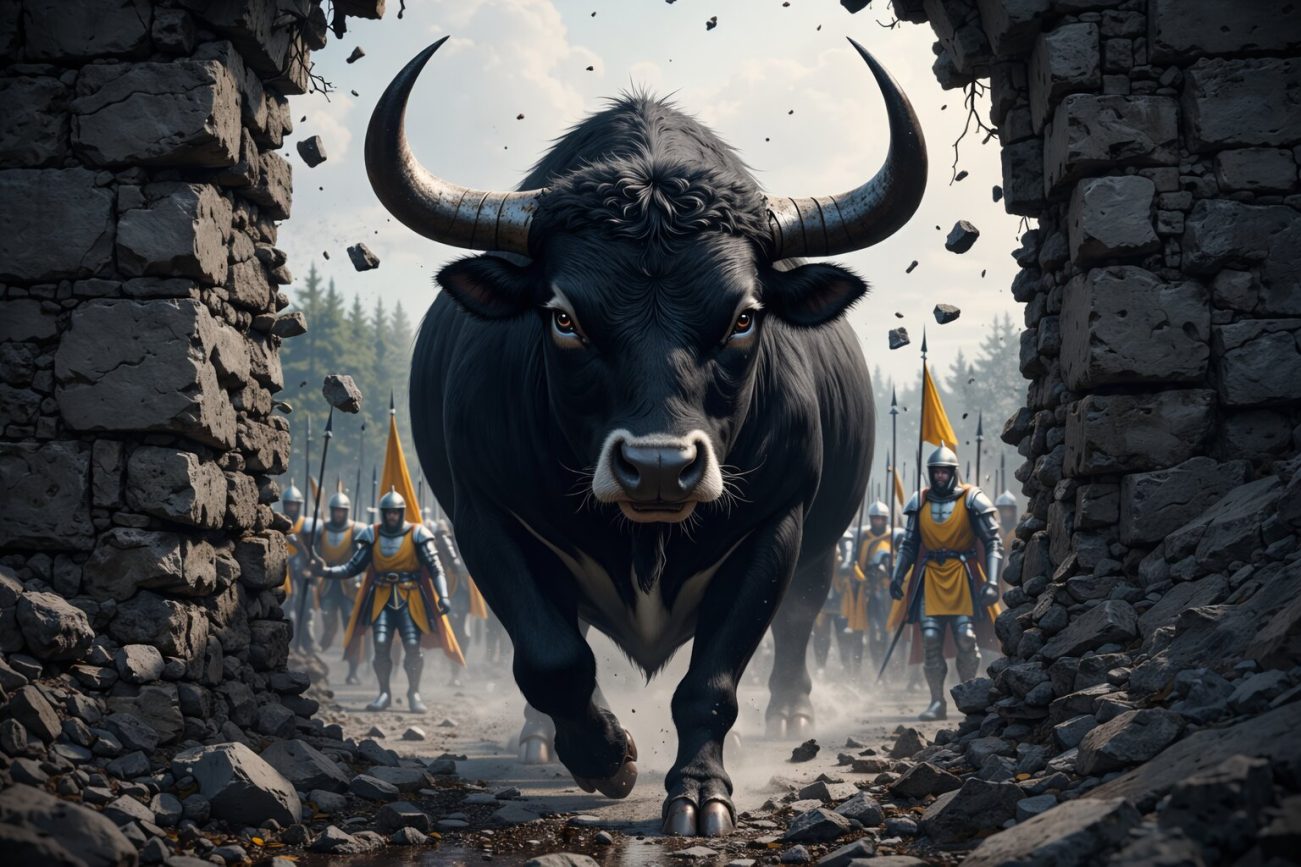
During the siege, a bull wandered calmly into the ducal camp. The soldiers soon realized that it was the town bull of Bardowick, a familiar animal that roamed freely and knew every path and crossing of its home. Seeing opportunity, Duke Henry ordered the bull released and commanded his men to follow it quietly.

The bull, untroubled and unaware, returned toward the city. It moved along the outer defenses, crossed a shallow ford, and passed through a narrow, crumbling opening in the stonework—a place long overlooked and poorly guarded. By instinct alone, the bull revealed the city’s hidden weakness.

That same night, the duke’s soldiers followed the path the bull had taken. They crossed the ford, slipped through the broken stone, and poured into Bardowick. The city was taken and destroyed. Many were slain, others fled, and Bardowick was reduced to ruins. Only the cathedral was spared from the devastation.

Though the city never regained its former glory, the memory of the bull endured. It was remembered not as an innocent creature, but as the animal whose unwitting loyalty betrayed its home and led the enemy inside. Even generations later, the tale remained sharp with shame. It is said that one should never ask the people of Bardowick about the bull, for the memory of the beast that led destruction home still stirs anger in every heart.


Gallery


Sources


Interpretive Lenses

Religious Readings
  • Christian Ascetic Deep Dive
Philosophical Readings
  • Nietzschean Deep Dive
Psychological Readings
  • Jungian Deep Dive
Esoteric Deep Dive
  • Hermetic Deep Dive
Political / Social Readings
  • Marxist Deep Dive
Other
  • How to Invite The Bull of Bardowick

Boxed Calf

Tradition / Region: German mythology
Alternate Names:
Category: Cow, Familiar


The Myth

It was said that those who wished to possess a brood penny—a coin that multiplied itself each night—had to make a bargain with the devil. On Christmas Eve, while church bells rang for Mass, they went alone to a crossroads. There they laid thirty coins in a circle and counted them forward and backward without a single mistake. If their tongue slipped, their neck would be twisted. If they succeeded, the devil added a thirty-first coin, and the cursed wealth was secured.

Near Wittenberg, a peasant woman was believed to own such a coin. In her house stood a box she guarded closely. One evening, she ordered her maid to boil the milk from the very first cow she milked, pour it over white bread, and place it in the box before doing anything else.

The maid delayed. She milked all the cows first, then boiled the milk and carried the pot to the box.

When she opened it, she saw a small calf inside—pitch black, cramped within the chest, its mouth stretched wide as if waiting to be fed. Terrified, the maid poured the boiling milk straight into its mouth.

At once the calf sprang from the box and raced through the house. Flames erupted in its wake, and the house was set ablaze.

Soon after, the woman was arrested and confessed. From that time on, brood pennies were seized wherever they were found and locked away in public treasuries, so that no boxed calf would ever again be secretly fed in the dark.


Gallery


Sources

AGEN.at contributors. (n.d.). Der Brutpfennig. In SAGEN.at – Grimms Märchen & Sagen, from https://www.sagen.at/texte/sagen/grimm/derbrutpfennig.html


Interpretive Lenses

Religious Readings
  • Christian Ascetic Deep Dive
Philosophical Readings
  • Nietzschean Deep Dive
Psychological Readings
  • Jungian Deep Dive
Esoteric Deep Dive
  • Hermetic Deep Dive
Political / Social Readings
  • Marxist Deep Dive
Other
  • How to Invite The Boxed Calf

Bokeler Bulle

Tradition / Region: German mythology
Alternate Names: Bokel Bull
Category: Cow


The Myth

At the southern edge of the Breitenhees, near the quiet village of Bokel, the Ilmenau River rises from a chain of small ponds and flows eastward, murmuring softly through meadow and hollow. The people say this sound is no ordinary current, but the bathing of a hidden being—the Bokeler Bulle.

Near the village lies a place known as the Bull’s Hollow. Each year, when May arrives and the nights grow long and dark, the bull is said to emerge. At the stroke of midnight, it leaves the waters and moves silently into the village stables, seeking the cows of Bokel. From these secret unions are born calves of extraordinary size and strength, yet they are wild and unruly, never fully tame, and often slaughtered before they can grow dangerous.

The Bokeler Bulle is feared, and few dare to wander the area on May nights. Shepherds keep their distance, knowing the bull can be fierce when angered. Once, a young apprentice shepherd from Günne encountered the creature. The bull lowered its head and charged, its snort shaking the air. In terror, the shepherd cried out to the Holy Virgin Mary, and at that very moment the bull vanished, leaving him unharmed.

In gratitude for his escape, the shepherd later carved a magnificent door and gave it to the chapel in Bokel. Thus the legend endured: of a powerful bull rising from the river, of danger and deliverance, and of a hidden presence that still murmurs beneath the waters of the Ilmenau.


Gallery


Sources

Meyer, C. (1950). Stadt und Kreis Uelzen. Ein Heimatbuch. Uelzen, p.166

SAGEN.at – DER KUHBANNER. (n.d.). https://www.sagen.at/texte/sagen/liechtenstein/seger/kuhbanner.html


Interpretive Lenses

Religious Readings
  • Christian Ascetic Deep Dive
Philosophical Readings
  • Nietzschean Deep Dive
Psychological Readings
  • Jungian Deep Dive
Esoteric Deep Dive
  • Hermetic Deep Dive
Political / Social Readings
  • Marxist Deep Dive
Other
  • How to Invite The Bokeler Bulle