Tradition: Frankish mythology, French Mythology
Alternative names: Quinotaurus
Category: Cow, Fish
The Myth
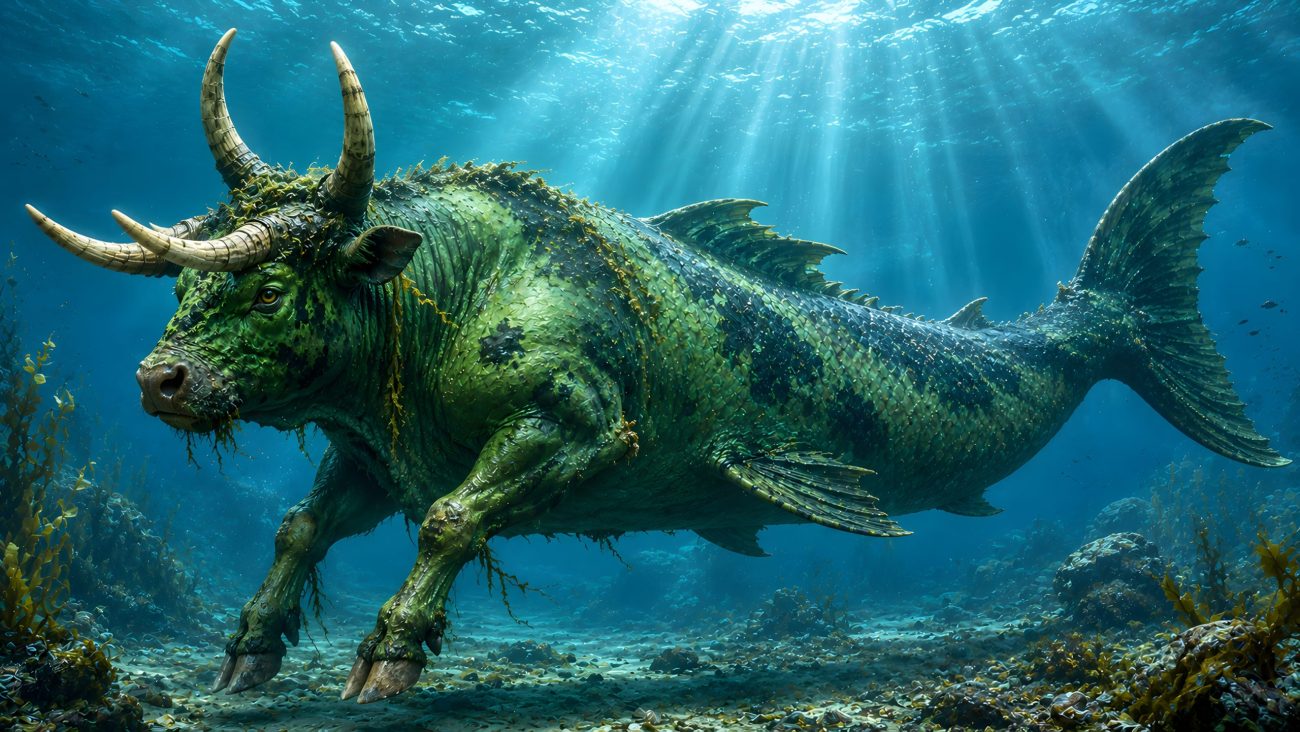
The Quinotaur was a mythical sea creature mentioned in the 7th-century Chronicle of Fredegar. It was described as a beast of Neptune resembling a bull with five horns, combining a taurine form with a connection to the sea.
According to the legend, the creature attacked the wife of the Frankish king Chlodio and fathered Meroveus. Through Meroveus, the Quinotaur was therefore said to have sired the line of Merovingian kings.
The creature was associated with both Neptune and the Minotaur because of its two defining characteristics: it was a bull-like creature connected with the sea. The surviving account does not make clear whether the Quinotaur was originally a genuine Frankish mythological being or whether some of its characteristics were shaped or elaborated by the Christian authors who recorded the story.
The name Quinotaurus is Latin, and its precise original meaning is uncertain. The surviving sources do not establish whether it translated an earlier Frankish name for the creature or was itself a later scholarly or clerical creation.
The story has also been compared with other ancient myths involving bulls, water, fertility, and divine ancestry. In Greek mythology, for example, Zeus took the form of a bull when he carried Europa across the sea to Crete, while the Minotaur was born from the union of Pasiphaë and a divine white bull associated with Poseidon.
The Quinotaur is therefore preserved primarily as a legendary ancestor of the Merovingian dynasty, rather than as a creature with a large independent body of mythology.
Sources
“Quinotaur.” Wikipedia: The Free Encyclopedia. Wikimedia Foundation. Accessed August 29, 2026. https://en.wikipedia.org/wiki/Quinotaur