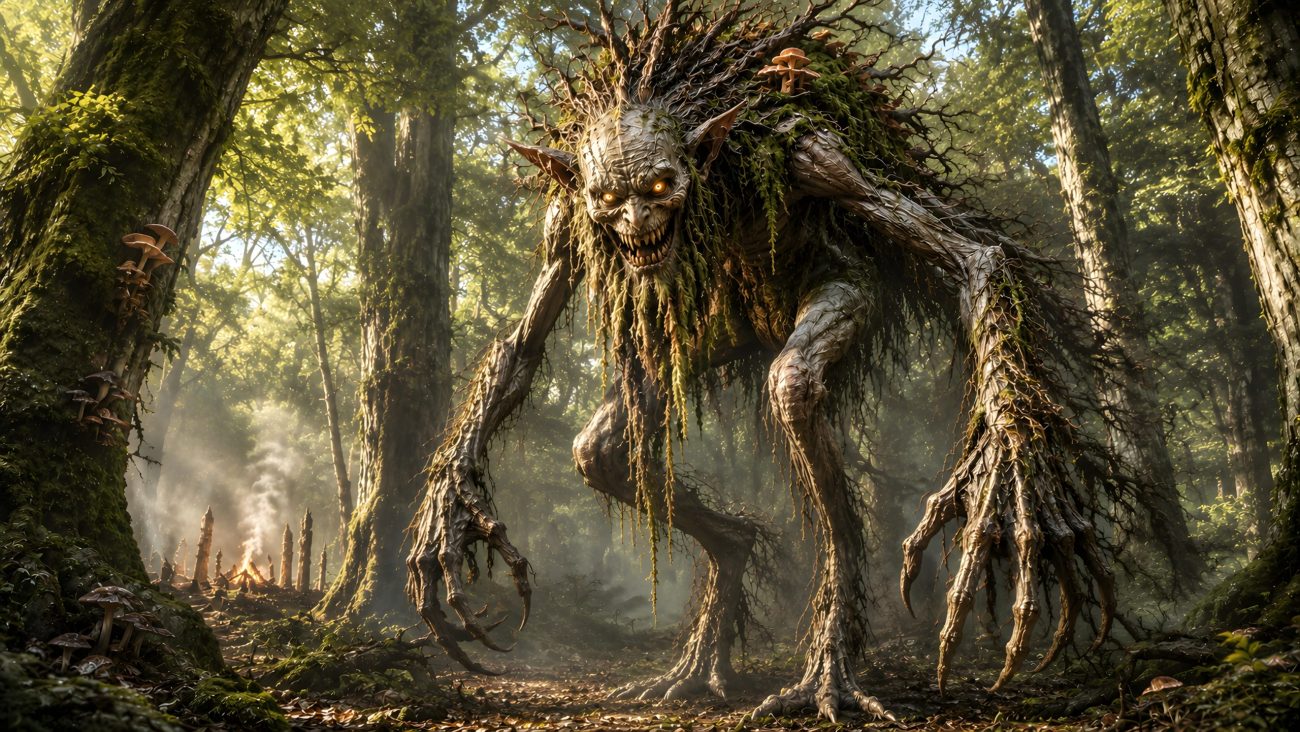
Tradition / Region: Croatian Mythology
Alternative names: King of the Forest Goblins
Category: Goblinoid
The Myth
Rampogusto was a dark forest spirit from old Croatian folklore, described as the King of the Forest Goblins. He haunted deep ancient woods before sunrise, gliding silently from tree to tree through mist and darkness like a living shadow. Travelers feared the silent hour before dawn because it was believed to be the time when Rampogusto wandered most freely through the forest.
According to the tale, Rampogusto appeared in the great forest where the old man Witting lived with his three grandsons: Bluster, Careful, and Quest. The brothers were warned about the eerie silence of the woods at dawn because the goblin king loved to roam beneath the trees before the sun appeared.
Rampogusto was not simply a monster but a malicious supernatural being driven by hatred, envy, and deceit. He especially despised good and honorable people. In the story he hated the wise old Witting “as a mean scoundrel hates an upright man.” His hatred became even stronger because Witting kept a sacred eternal fire burning in the forest glade. The smoke from this holy fire tormented Rampogusto and forced him away, suggesting that sacred flame weakened evil spirits and protected humans from dark supernatural forces.
The goblin king moved almost invisibly through the woods. The tale describes him slipping from tree to tree “like a wraith of mist,” hiding high in the branches while secretly spying on humans. He listened unseen as the divine being All-Rosy revealed visions of the world and the future to Witting’s grandsons.
Unlike open monsters that attacked directly, Rampogusto preferred corruption and manipulation. After hearing All-Rosy instruct the brothers to remain loyal to their grandfather and avoid the temptations of the outside world, Rampogusto immediately began plotting to turn them against Witting. He wished to destroy the harmony of the family through deception rather than force.
In this way, Rampogusto resembles many older European forest spirits and goblin kings who represent temptation, chaos, envy, and the dangers hidden within wilderness. The dark forest itself was viewed as a place where supernatural beings moved unseen and where travelers could easily lose both their path and their judgment.
Rampogusto embodies this fear of corruption emerging from the unknown wilderness. He is a spirit of hostile nature — ancient, cunning, and hateful toward sacred order, family loyalty, and divine guidance. Unlike protective spirits connected to forests, he exists as a parasitic force that seeks to weaken human virtue and draw people away from wisdom and stability.
Though described as a goblin king, Rampogusto behaves more like a demonic forest intelligence: invisible, manipulative, difficult to confront directly, and most powerful during darkness and uncertainty before the coming of light.
Sources
Brlić-Mažuranić, I. (1924). Croatian tales of long ago (F. S. Copeland, Trans.). New York: Frederick A. Stokes Company.