Tradition: Chinese mythology
Alternative Names: Conch Girl, Field Snail Girl, White Water Maiden, White Maiden of the Milky Way
Category: Fairy
The Myth
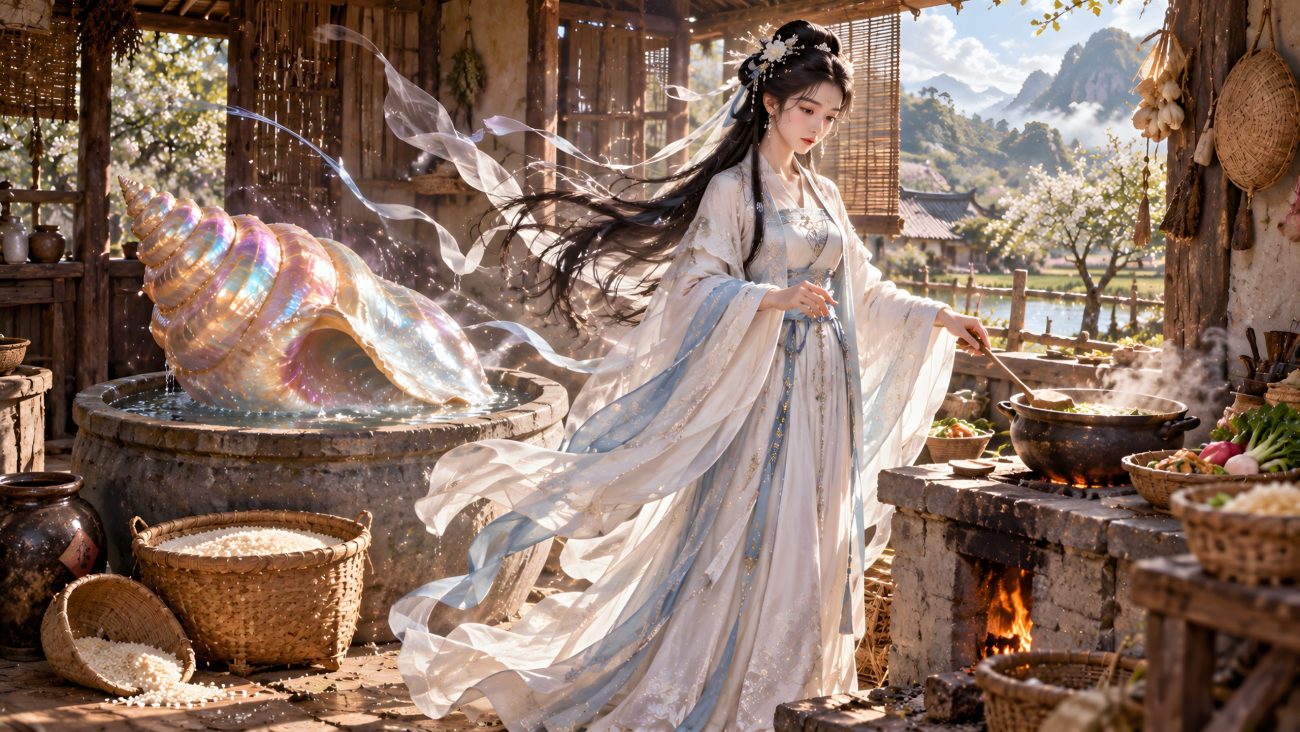
The Snail Maiden appears as a beautiful young woman who emerges from the shell of a large snail or seven-colored conch. Her true form is hidden within the shell, which can be kept in a water jar. In the legend of Xie Duan, a young orphan from Houguan in Fujian, the shell is unusually large, about the size of a bushel. Xie Duan is a hardworking and respectable man who lives alone and has never managed to find a wife. After bringing the strange shell home and placing it in a water vat, he begins returning from the fields to find his house filled with cooked food and a fire burning in the stove.
At first Xie Duan assumes that his neighbors have been helping him, but they deny preparing the meals and tell him that he must already have a wife secretly living in his house. Suspicious, he pretends to leave and then secretly returns to watch. He sees a beautiful young woman emerge from the jar, light the fire, prepare food, and clean the house. When he confronts her, she explains that she is the White Maiden of the Heavenly Realm, sent by the Heavenly Emperor because of Xie Duan’s orphanhood, diligence, and good conduct. She had been commanded to care for his household until he became prosperous and married, after which she would return to the heavenly realm. Since Xie Duan has discovered her true nature by spying on her, however, she must leave immediately. She tells him to continue working the fields and making his living through farming, fishing, and gathering, and leaves behind the shell as a vessel in which he can store his grain.
Xie Duan begs her to remain, but she refuses. A sudden storm rises, with wind and rain carrying the maiden away from him. Xie Duan then establishes a shrine to her and makes seasonal offerings in gratitude. His fortunes improve, he eventually marries, and he later becomes a county magistrate. The Snail Maiden’s legend became especially important among coastal communities of Fujian, where she came to be regarded as a protective deity for people who went to sea and was worshipped among the Fuzhou Tanka. Related versions spread along the coasts of Jiangsu, Zhejiang, Shanghai, and Guangdong, as well as to other places where similar snail-maiden legends were told.
Sources
“螺女 (Luó Nǚ; Snail Woman).” Chinese Wikipedia. Wikimedia Foundation. Accessed October 4, 2026.
https://zh.wikipedia.org/wiki/%E8%9E%BA%E5%A5%B3