Zirega

Tradition / Region: Chad Mythology
Alternative names: Zirega the Sorceress
Category: Sorceress


The Myth

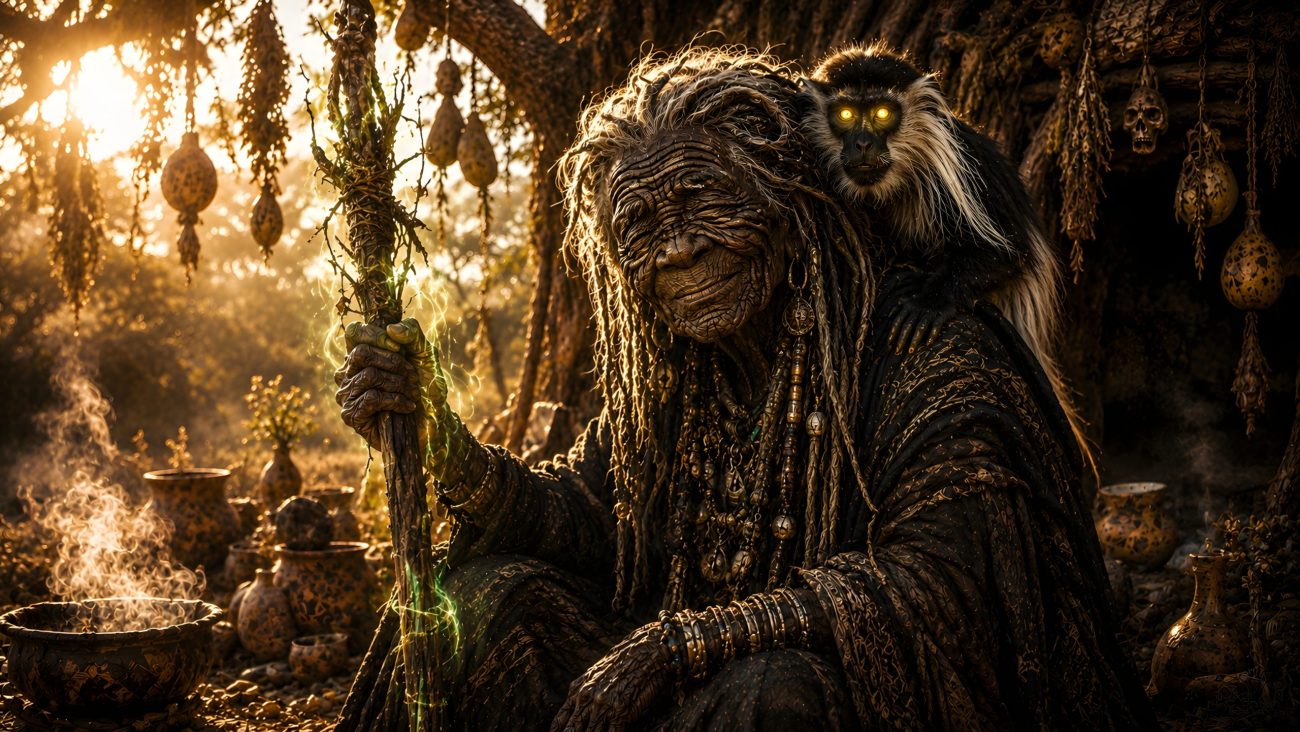
In the Bulala legend of Prince Tchouroma and the flying horse Bidi-Camoun, Zirega is an aged sorceress who lives on the margins of King Dongo’s kingdom. Though feared for her supernatural knowledge, she ultimately becomes one of the prince’s greatest protectors.

After Princess Aicha chooses the disguised gardener Tchouroma as her husband, King Dongo erupts in fury and banishes both lovers from the palace. Homeless and rejected, they seek refuge with Zirega. Unlike the proud king and his court, the old sorceress welcomes them into her home.

Zirega possesses mysterious powers tied to dreams, animals, healing, and the hidden forces of the wilderness. When King Dongo later falls gravely ill and none of the kingdom’s healers can cure him, the desperate court finally turns to her for help.

The sorceress declares that the king can only be saved by drinking fresh milk from a doe that has just given birth.

On her advice, Tchouroma journeys into the bush. Exhausted beneath a tamarind tree, he falls into a strange half-sleep and hears Zirega’s distant voice guiding him:

“Get up and take a look. I have gathered all the does in the savannah.”

When he awakens, the wilderness has transformed. Countless animals stand peacefully around him as though summoned by invisible magic. A doe voluntarily fills his gourd with healing milk.

Throughout the tale, Zirega acts less like a dark witch and more like a guardian figure connected to ancient spiritual knowledge. She recognizes Tchouroma’s true worth long before the king does, shelters the exiled couple, guides the prince through supernatural trials, and finally reveals to the kingdom that the mysterious warrior who saved them is none other than Tchouroma himself.

At the end of the story, after Tchouroma’s identity is revealed and he marries Princess Aicha, the royal couple honors Zirega for the rest of her life in gratitude for her wisdom and protection.

Zirega represents the archetype of the hidden wise woman found throughout African folklore: an elderly figure living outside ordinary society, feared by many but deeply connected to spiritual truth, nature, prophecy, and miraculous knowledge.


Sources

Seid, J. B. (2007). Told by starlight in Chad (K. H. Hoenig, Trans.). Trenton, NJ: Africa World Press.

Bidi-Camoun

Tradition / Region: Chad Mythology
Alternative names: The Flying Horse of Tchouroma
Category: Horse


The Myth

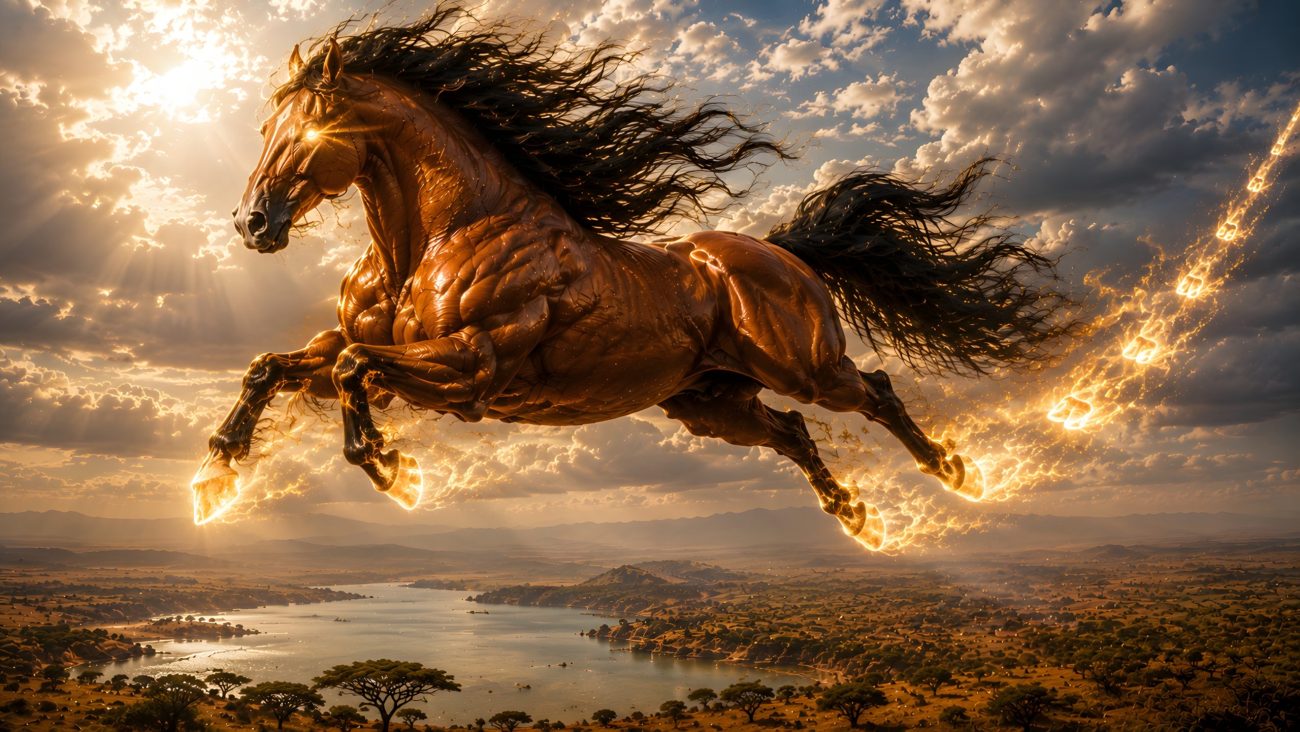
In a Bulala legend from the region of Lake Fitri in Chad, Bidi-Camoun is a miraculous chestnut horse given to the young prince Tchouroma during childhood.

The horse is described as splendid and unusually intelligent, but its supernatural nature only becomes clear after the death of Tchouroma’s mother. The women of the royal harem, jealous of the Sultan’s affection for his son, secretly attempt to poison the young prince with enchanted cakes.

Before Tchouroma can eat them, Bidi-Camoun warns him in a human voice:

“Eat nothing but what your father eats, drink nothing but what your father drinks.”

The horse repeatedly protects the prince from assassination attempts, revealing hidden dangers and exposing the schemes of the harem women. When the conspirators discover that the horse is betraying their plots, they arrange for Bidi-Camoun to be sacrificed through the advice of a corrupt witchdoctor.

Before the execution, the horse devises an escape.

During a public equestrian ceremony, Tchouroma rides Bidi-Camoun before the entire kingdom while drums sound and singers praise the prince. In the middle of the performance, the horse suddenly rises into the sky and flies away into the clouds, carrying his master far beyond Lake Fitri.

After the miraculous flight, Bidi-Camoun brings Tchouroma to a distant kingdom ruled by King Dongo. There the horse reveals even greater magical powers. He can become invisible, appear instantly when summoned by burning hairs from his mane, and travel with supernatural speed across enormous distances.

The horse helps the exiled prince survive hardship, win the love of Princess Aicha, obtain sacred healing milk from the wilderness, and defeat invading armies in battle. Whenever Tchouroma faces danger or humiliation, Bidi-Camoun returns to aid him.

In the war against the plunderers, the horse carries Tchouroma through battle like a storm. Mounted on Bidi-Camoun, the prince cuts through enemy forces and turns the tide of war almost single-handedly.

At the end of the story, Tchouroma reveals his royal identity and marries Princess Aicha. The tale concludes by stating that Bidi-Camoun became the ancestor of the swift and powerful horses of the Bulala people.

The horse is remembered not merely as a mount, but as a loyal supernatural guardian associated with kingship, destiny, wisdom, miraculous rescue, and divine protection.


Sources

Seid, J. B. (2007). Told by starlight in Chad (K. H. Hoenig, Trans.). Trenton, NJ: Africa World Press.


Green-Eyed Snake

Tradition / Region: Chad Mythology
Alternative names: The Luminous Green Snake
Category: Snake


The Myth

In an origin myth from Chad about Alifa’s tribe and the giant Sao people, enormous snakes with glowing green eyes appear in a hidden land beyond Lake Chad.

After God destroys the violent world with fire from the sky, Alifa and his people wander across the ruined earth until they reach the shores of a vast lake. There they meet a giant fisherman who carries Alifa across the water in a gigantic pirogue to a marvelous land inhabited by giants.

In this place, Alifa sees children as tall as palm trees playing peacefully with lions, panthers, and rhinoceroses.

Among these creatures are huge snakes with luminous green eyes.

The serpents slither around the limbs of the giant children and play strange games of hide-and-seek with them. The story describes the land as a place where animals and people live together in complete harmony and where evil is unknown.

The snakes are not shown attacking anyone or behaving violently. Instead, they are simply part of this strange and peaceful world of giants, enormous animals, colossal trees, and sacred abundance surrounding Lake Chad.

The tale presents the Green-Eyed Snakes as mysterious creatures belonging to the ancient age of the Sao giants, before conflict and corruption entered the world again.


Sources

Seid, J. B. (2007). Told by starlight in Chad (K. H. Hoenig, Trans.). Trenton, NJ: Africa World Press.


Giant Fisherman of Lake Chad

Tradition / Region: Chad Mythology
Alternative names: The Giant Boatman, The Sao Fisherman
Category: Giant


The Myth

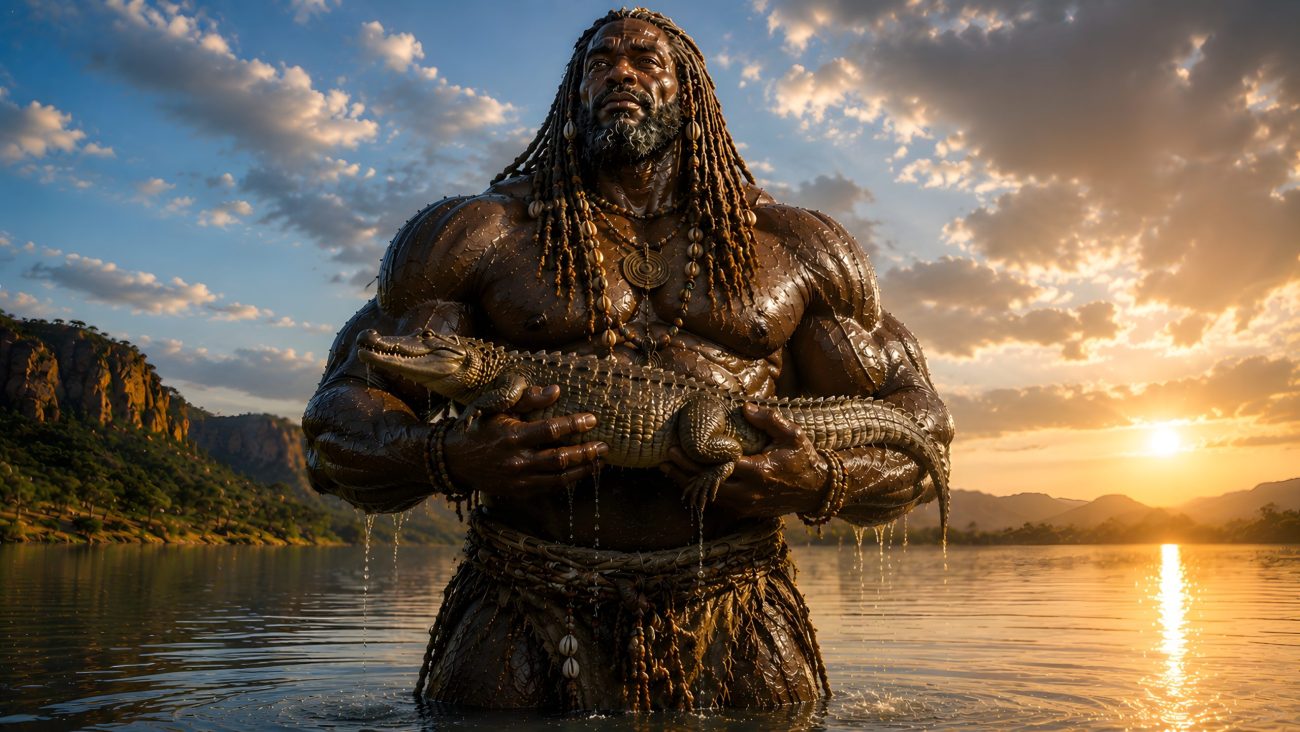
In ancient Chadian mythology, the Giant Fisherman is a colossal supernatural being who appears after a divine cataclysm destroys the corrupt world. He is described as an enormous giant moving across the waters of a vast sacred lake in a gigantic pirogue, fishing not with nets or spears, but with his bare hands.

His size is beyond ordinary human comprehension. He effortlessly lifts enormous fish from the water and even seizes hippopotamuses by the ears as though they were harmless toys before tossing them gently back into the lake. Despite his immense strength, the giant is not violent or monstrous. He radiates calm authority, divine generosity, and almost sacred serenity.

The myth begins after God sends fire from the heavens to punish a world consumed by evil and violence. Entire lands collapse into abysses while only the tribe of Alifa survives under divine protection. Guided by faith, the tribe wanders through destruction while singing praises to the Eternal until they finally arrive at the shores of a mysterious great lake glowing with floating balls of fire.

There, at dawn, they witness the Giant Fisherman upon the waters.

Without speaking, the giant notices the starving refugees praying on the shore. He catches an enormous fish and throws it effortlessly onto the bank for them to eat. Later he returns with huge jars of honey, then fresh milk, feeding the exhausted survivors with almost godlike abundance.

Eventually the giant invites Alifa himself into the enormous pirogue.

Using only his gigantic hands as oars, he rows across the immense lake with supernatural speed until they reach a hidden land inhabited entirely by giants.

This strange paradise is described as a utopian world untouched by evil. Giant children as tall as palm trees play peacefully beside lions, rhinoceroses, panthers, and glowing-eyed serpents. Nature and civilization exist in perfect harmony. The giants use their strength and intelligence not for conquest, but for creation — redirecting rivers, illuminating cities, clearing forests, and cultivating fertile lands in honor of God.

The giant fisherman acts as both guardian and guide into this sacred civilization.

The giants welcome Alifa and his tribe, eventually allowing them to settle among them permanently. Over time the two peoples unite through marriage. From the union between a giant prince and a woman of Alifa’s people is born Sao, legendary ancestor of the Kotoko peoples.

In the story, the Giant Fisherman represents more than a mere giant. He embodies divine hospitality, primordial harmony, and the bridge between humanity and a lost sacred age. Unlike destructive giants found in many myths, the giants of Lake Chad symbolize wisdom, abundance, peace, and coexistence between mankind, nature, and the divine.


Sources

Seid, J. B. (2007). Told by starlight in Chad (K. H. Hoenig, Trans.). Trenton, NJ: Africa World Press.