Tradition / Region: French Mythology
Alternative names: Santa Gata
Category: Cat
The Myth
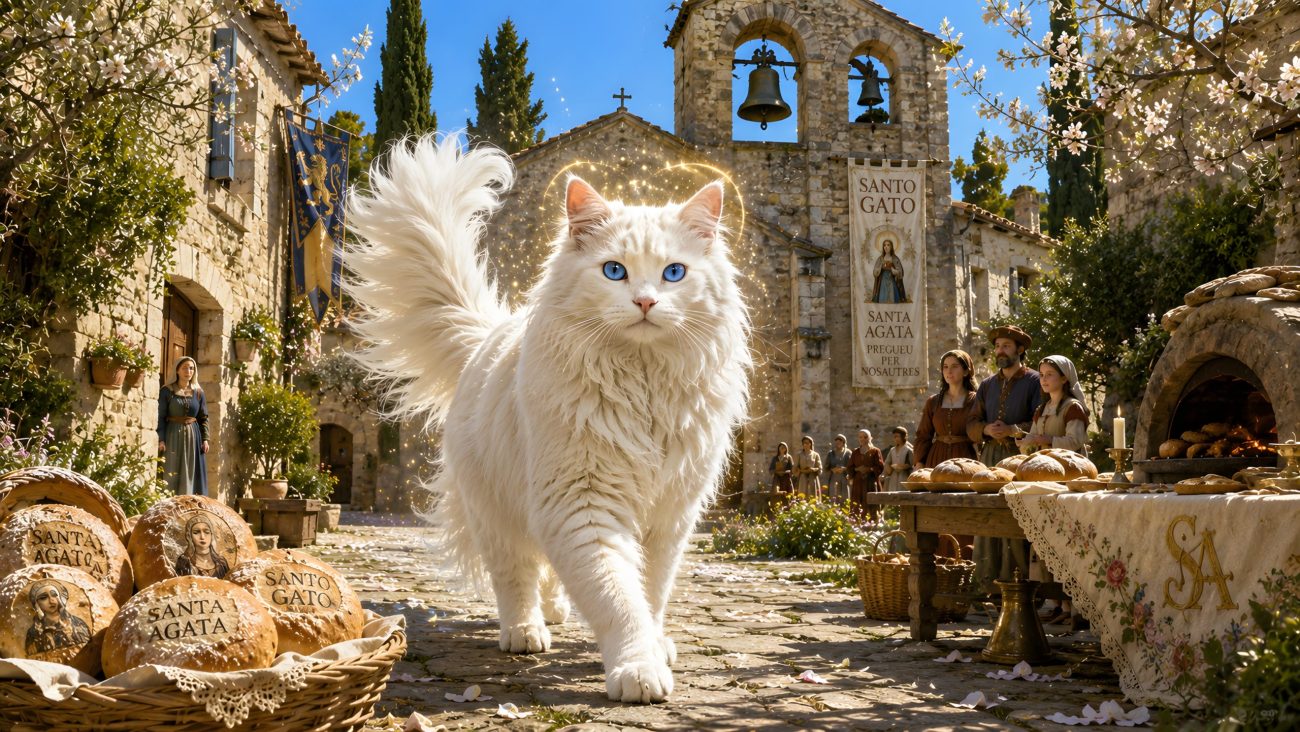
The Santo Gato appears as a cat that is believed to be the manifestation of Saint Agatha of Catania. Rather than being an evil creature, it is a supernatural form assumed by the saint to punish those who violate her feast day.
According to Occitan tradition, Saint Agatha’s cult became deeply rooted in Provence, Languedoc, Gascony, and the Pyrenees, where she was invoked for protection against lightning, storms, fire, and destructive weather. On the eve of her feast, church bells rang throughout the night to drive away the demons believed to cause these disasters.
A widespread folk belief held that women were forbidden to bake bread or wash clothes on Saint Agatha’s feast day, as such work was considered disrespectful to the saint. Those who ignored the prohibition risked her punishment. It was said that every year on 5 February, Saint Agatha appeared in the form of a cat—the Santo Gato—to visit and punish women who had worked on her holy day.
The saint’s blessed breads, baked on the eve of her feast and blessed during Mass, were believed to protect people, homes, and property from fire and lightning. In parts of the Pyrenees, her feast was also associated with seasonal rituals intended to hasten the end of winter and the arrival of spring, reflecting the blending of Christian devotion with older folk traditions.
Sources
“Santo Gato.” Wikipédia, l’encyclopédie libre (French Wikipedia). Wikimedia Foundation. Accessed July 28, 2026. https://fr.wikipedia.org/wiki/Santo_Gato