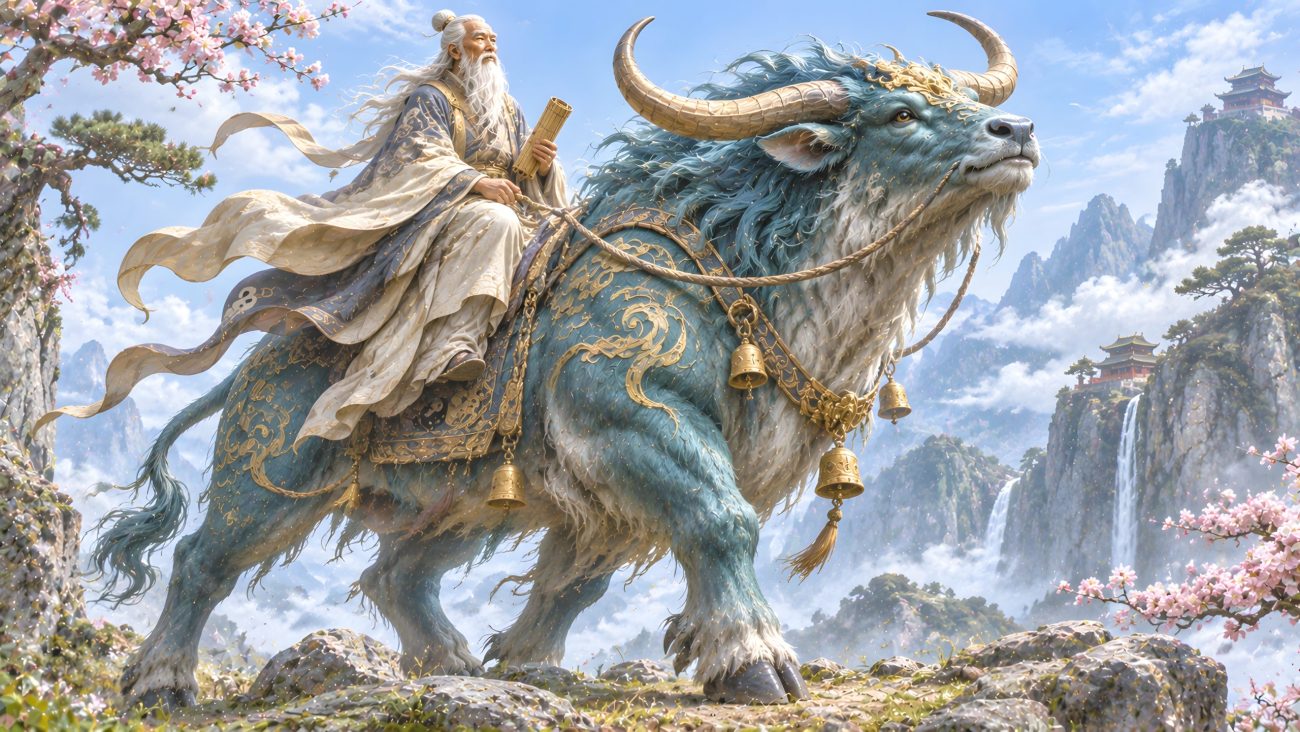
Tradition: Chinese mythology
Alternative Names: Qingniu, Qing Niu Guai, Qing Niu Jing, Ban Jiao Qing Niu, Azure Ox
Category: Cow
The Myth
The Qing Niu, or Azure Ox, is a legendary creature best known as the mount of Laozi, the ancient sage and deity associated with Daoism. According to tradition, Laozi rode upon its back as he travelled westward through Hangu Pass. There, he left behind the Dao De Jing, a profound work traditionally consisting of five thousand characters. The Azure Ox consequently became one of the most recognisable companions associated with the sage.
Yet the Qing Niu has a stranger origin in other Chinese traditions. According to an ancient account, a tree spirit that has lived for a thousand years transforms into a green sheep, while one that has endured for ten thousand years becomes a green ox. These supernatural creatures frequently leave their natural surroundings and venture into the human world.
The Qing Niu also appears as a formidable demon in the famous novel Journey to the West. Known as Dujiao Si, the Single-Horned Rhinoceros King, it is Laozi’s own mount, although it takes the appearance of a one-horned rhinoceros-like beast. When its attendant falls asleep after eating the Seven-Reversal Fire Pills from Laozi’s alchemy chamber, the creature escapes its restraints and flees into the mortal world. It eventually settles at Golden兜 Mountain, making its home in Golden兜 Cave.
There, the escaped beast begins causing trouble. After Zhu Bajie steals clothing from its cave, the creature captures Tang Sanzang and his companions while Sun Wukong is away searching for food. The demon enjoys fighting and soon confronts the Monkey King. Despite wielding a steel-tipped spear against Sun Wukong’s bare hands, it cannot defeat him and retreats into its cave.
Its greatest weapon, however, is not its strength but a magical treasure known as the Diamond Snare. This enchanted ring can seize the weapons and treasures of anyone who stands against its owner. With it, the demon steals Sun Wukong’s golden cudgel, six of Nezha’s weapons, the Heavenly King’s sword, the Thunder God’s implements, the Fire Virtue Star Lord’s weapons, and even the eighteen golden sand pellets belonging to the Eighteen Arhats. Almost nothing can resist its power, and only the Yellow River’s water-controlling treasure escapes its grasp.
Sun Wukong eventually turns to the Buddha for help. The Buddha provides him with a clue that reveals the demon’s true identity and ownership. The creature is none other than Laozi’s escaped mount. Laozi arrives to retrieve the Azure Ox, bringing its rampage to an end and returning it to its rightful place.
The Qing Niu appears in other famous Chinese novels as well. In The Investiture of the Gods, it is known as Ban Jiao Qing Niu, the Blue Ox with a Board-Shaped Horn. Laozi rides it into the mortal world to assist Jiang Ziya in breaking the Immortal-Slaying Formation and the Ten Thousand Immortals Formation.
In The Eight Immortals, the creature causes trouble once again after escaping into the mortal world. Li Tieguai and several celestial attendants have been playing around with it and loosen its reins, allowing it to flee. It eventually reaches the kingdom of Daqin, where it drives out the king and wreaks havoc in the royal harem. The goddess Jiutian Xuannü descends from heaven to confront the beast, but it is ultimately Laozi who retrieves his troublesome companion and brings it back.
The male pheasant, meanwhile, had escaped to Nanyang, a place later associated with the establishment of Zhi County. Its presence was remembered through a strange supernatural omen. Whenever sacrifices were performed at the shrine in Chencang, a brilliant red light, more than ten zhang long, was said to emerge from the direction of Zhi County and enter the shrine. Alongside it came a deep sound resembling the call of a male pheasant.
The strange phenomenon was eventually connected with the rise of Emperor Guangwu of Han, who came from Nanyang. Thus, the encounter with the underground Yun and the two mysterious children became associated with the fortunes of rulers and the appearance of a future emperor.
Sources
Wikipedia contributors. (n.d.). 青牛怪. Chinese Wikipedia. https://zh.wikipedia.org/wiki/%E9%9D%92%E7%89%9B%E6%80%AA