Tradition: Japanese Mythology
Alternative Names: Okoze-hime
Category: River dweller
The Myth
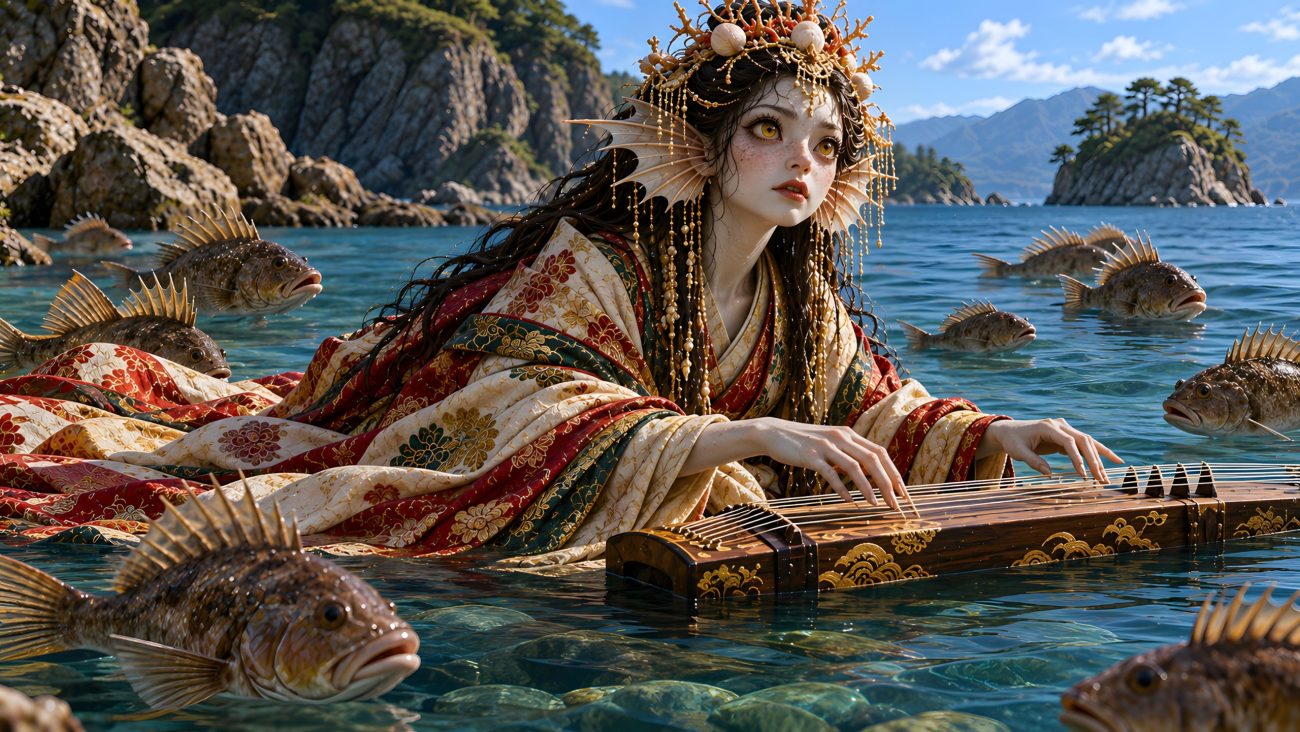
Princess Okoze is a character in the Otogizōshi tale Okoze, believed to have been compiled between the late Muromachi period and the early modern period. She is described as having a bony frame, large eyes, and a wide mouth, yet possessing unparalleled elegance. She wears a twelve-layered robe and is accompanied by numerous fish as she plays in the spring sea.
One spring, the mountain god visits the beach and sees Princess Okoze playing the koto with her fingernails and singing. He immediately falls in love with her. Unable to approach her through the water, he crawls onto the beach and beckons to her. Embarrassed, the princess hides at the bottom of the sea.
The mountain god longs to see her again, but cannot reach her because mountain dwellers cannot enter the sea. A river otter visits the mountain, and the god asks it to deliver a letter to the princess. The otter initially insults Okoze’s appearance, but the mountain god defends her features and explains how beautiful he finds her. The otter agrees to carry his message.
The princess initially blushes and refuses to accept the letter, but the otter persuades her to write a reply. Overjoyed by her response, the mountain god declares that he will visit her that night.
However, Tako-no Nyūdō, an octopus spirit who has long sent letters to Princess Okoze without receiving a response, becomes jealous and plots to kill her before she can unite with the mountain god. Gathering octopuses and squids, he prepares to attack. Fearing for her life, the princess flees toward the mountains with Akamebaru and Kanagashira.
On a narrow path near the beach, the mountain god and the river otter encounter the fleeing princess and her companions. The mountain god and Princess Okoze are reunited and return to her dwelling, where they live happily together.
The tale is associated with the belief that mountain gods favor the okoze, a fish known for its unattractive appearance. In various regions, okoze are offered to mountain gods. The story also explains the expression used when someone is delighted by seeing something, comparing their joy to that of a mountain god who has been shown a gift.
Sources
Tyz-Yokai. (n.d.). Okoze no hime. https://tyz-yokai.blog.jp/archives/1070972239.html