Tradition: Nigerian Mythology
Alternative Names: Ogbanje
Category: Fairy
The Myth
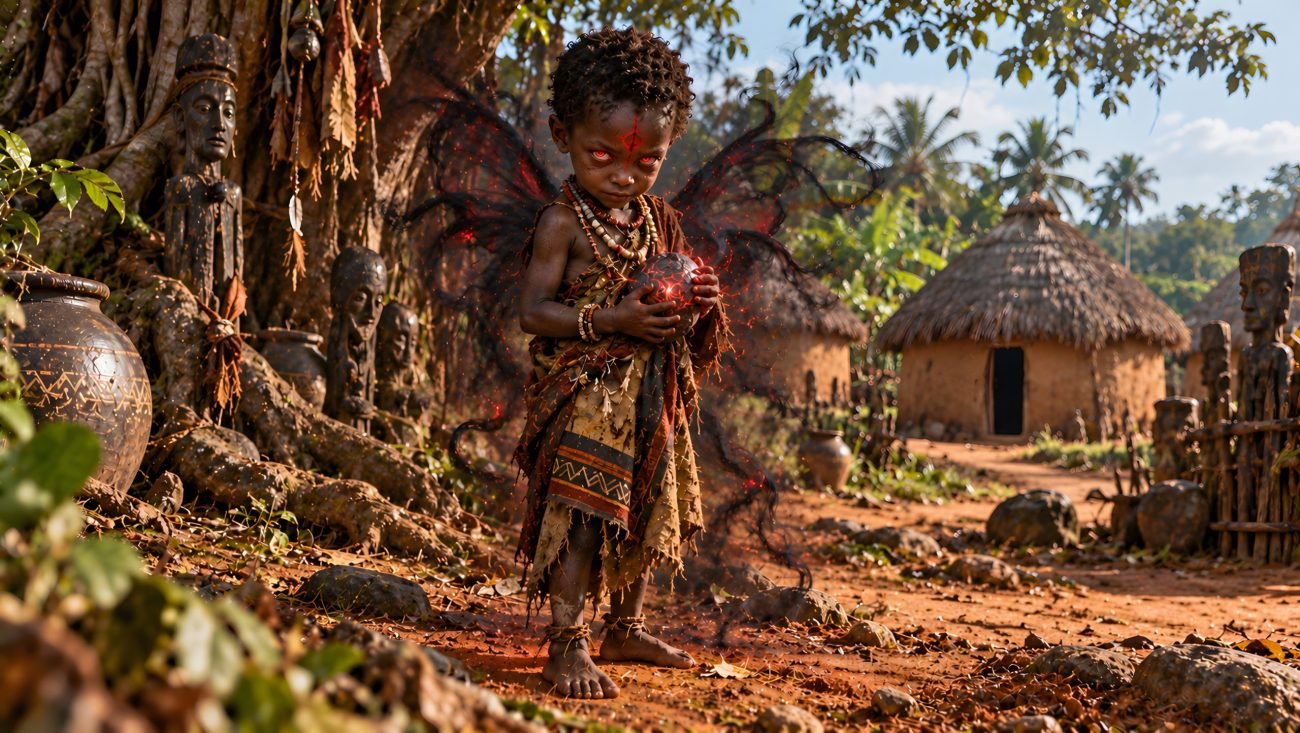
The ọgbanje was believed to be a malevolent spirit that could take the form of a child and deliberately bring suffering to a family. The name literally means “children who come and go,” reflecting the belief that the same spirit could repeatedly enter a family through different children. An ọgbanje might be born into a family and then die while still young, often before reaching puberty, only to return through another child and repeat the cycle. The spirit could also appear within an extended family rather than returning to the exact same household, and it was believed that an ọgbanje could enter the human world between conception and birth or be introduced into a group of such spirits.
The ọgbanje was believed to possess a secret stone called an iyi-uwa, which it buried somewhere hidden. This stone allowed the spirit to return to the human world and find the family it had chosen to torment. As long as the stone remained hidden, the cycle of death and return could continue. Families therefore sought the help of a priest to locate the iyi-uwa and bring it out of the ground. Once the stone was found and destroyed, the spirit was believed to lose its power to return and plague the family. A child might also be considered free from the spirit after the mother successfully gave birth to another child.
People looked for signs that a child was an ọgbanje, including distinctive birthmarks, recurring illnesses, unusual behaviour, similarities to a deceased child, or even the child’s first words. Oracles could be consulted to determine whether the spirit was believed to be present. After an ọgbanje died, some families attempted to prevent its return by cutting or mutilating the body, believing that the spirit would recognize the scars if it returned in another incarnation. Some stories even claimed that a returning child could bear the physical marks of this earlier mutilation. Through its repeated deaths and returns, the ọgbanje became a figure associated with the mysterious loss of children and the seemingly endless misfortune of a family.
Sources
“Awes-kon-wa.” Wikipedia: The Free Encyclopedia. Wikimedia Foundation. Accessed October 4, 2026. https://en.wikipedia.org/wiki/Awes-kon-wa