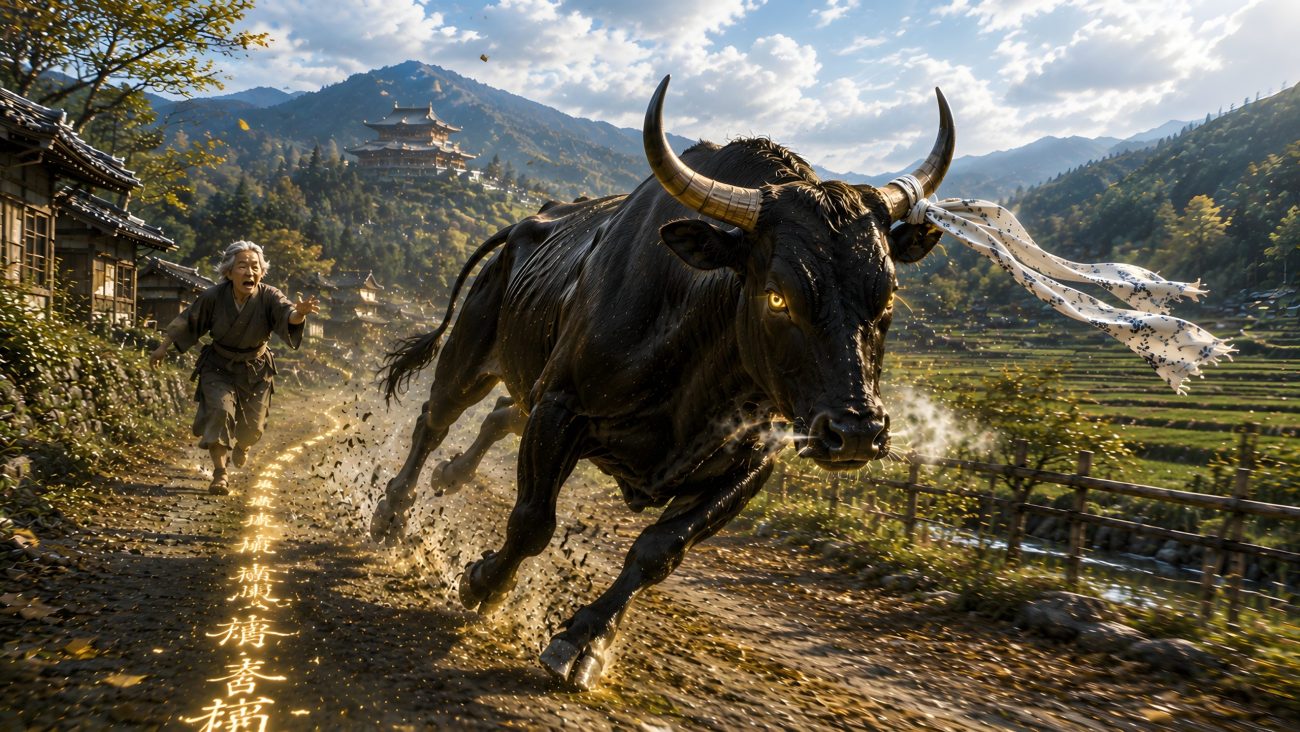
Tradition: Japanese Mythology
Alternative names: Nunohiki-ushi
Category: Cow
The Myth
Long ago, in Shinano Province, there lived a wicked and unfaithful old woman in Chiisagata District.
One day, while she was drying a hand towel beneath the eaves of her house, a mysterious cow suddenly appeared. The animal caught the towel upon its horns and immediately ran away.
The old woman chased after it, determined to retrieve her towel. However, the cow continued running until she eventually found herself at the dining hall of Zenkoji Temple. By the time she arrived, the sun had set and darkness had fallen. The mysterious cow had disappeared.
Then something miraculous happened.
The Buddha of Zenkoji Temple suddenly emitted a radiant light, illuminating the trail of drool that the cow had left behind. When the old woman looked closely, she saw that the shining trail formed words. The message told her not to think of the incident as merely the work of a cow, but to understand that her own heart had guided her toward the path.
The old woman was deeply moved by the revelation. She immediately became devoted to Buddhism and spent the night before the Buddha chanting sutras.
When she returned home the following day, she visited a nearby Kannon hall. There, beside the statue of Kannon, she discovered the hand towel that the mysterious cow had taken.
She realized that the cow had actually been an incarnation of Kannon.
Her faith in the Buddha of Zenkoji consequently became even stronger, and she eventually attained rebirth in paradise.
According to the tradition, the Kannon who appeared in the form of the cow was the Nunobiki Kannon, whose statue is preserved at Nunobikiyama Shakusonji Temple in Komoro.
The story became the origin of the Japanese expression meaning to be “led to Zenkoji Temple by a cow”—being unexpectedly guided toward something good by an event whose purpose was not initially understood.
From the Edo period through the Meiji period, prints depicting the miraculous cow leading the old woman to Zenkoji Temple were repeatedly produced and sold around the temple.
Sources
Takahashi, Toshihiro. “布引牛 (Nunohikiushi).” 新版TYZ 妖怪図鑑 (New TYZ Yokai Encyclopedia). June 27, 2021. Accessed August 29, 2026. https://tyz-yokai.blog.jp/archives/1078437882.html