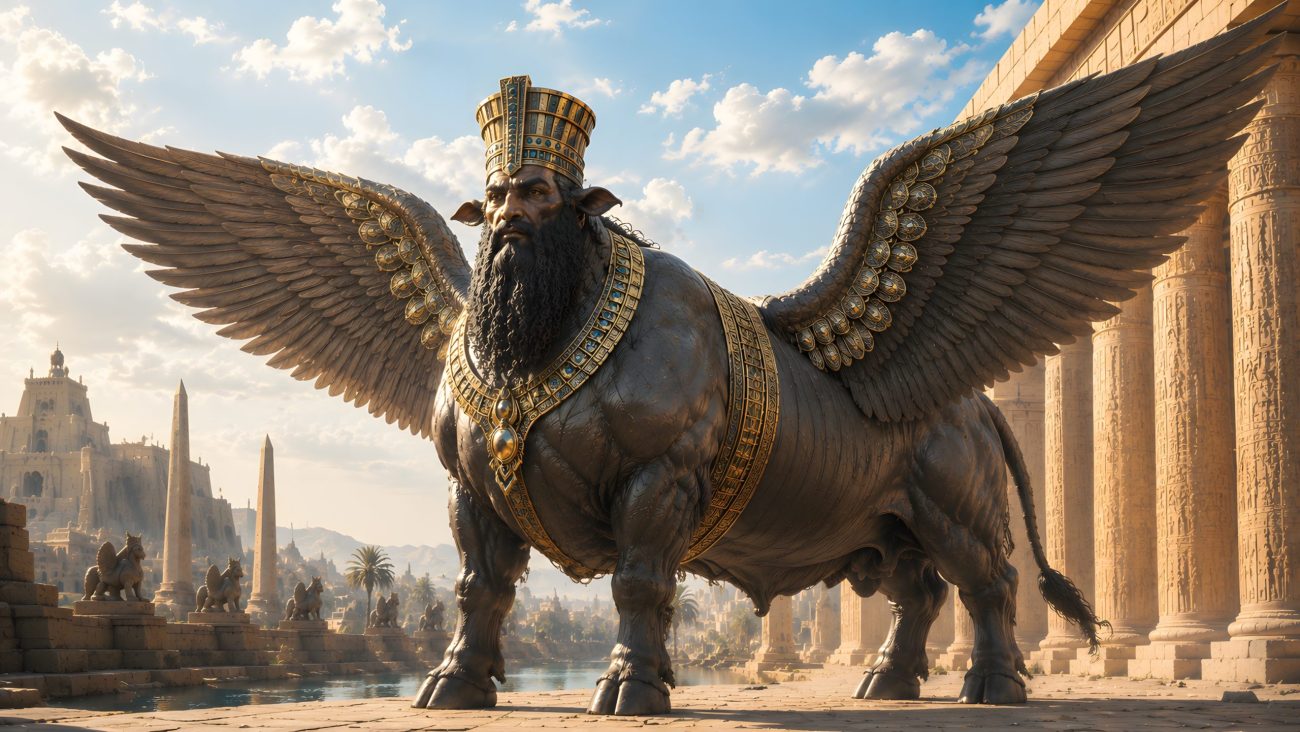
Tradition: Mesopotamian mythology, Iraqi Mythology
Alternative names: Lamma, Lam(m)a, Aladlammu, Shedu
Category: Cow
The Myth
The Lamassu is a powerful protective deity of ancient Mesopotamia. In its earliest Sumerian form, Lamma was a goddess who acted as a mediator, presenting worshippers before the gods. Later, particularly in Assyrian tradition, the figure developed into the famous hybrid guardian.
The Lamassu possessed a human head, the body of a bull or lion, and enormous bird wings. Its human head represented intelligence, the bull represented strength, and the wings represented freedom. It could also possess the horns and ears of a bull.
Lamassu served as guardians against evil spirits and malevolent intruders. Protective representations could be buried beneath the thresholds of ordinary houses, while enormous stone Lamassu were placed in pairs at the entrances of palaces, cities, and other important buildings.
Their monumental presence was deliberately intimidating. A person approaching an Assyrian palace would encounter these enormous hybrid beings standing watch over the entrance, symbolically declaring that the building was under divine protection.
The Lamassu also had a celestial dimension, being associated with stars, constellations, and the zodiac. Thus the creature combined the qualities of several realms: human intelligence, animal strength, divine protection, and celestial power.
The male counterpart was known as the Shedu, while the Lamassu itself could retain its older feminine association with the goddess Lamma.
Sources
“Lamassu.” Wikipedia: The Free Encyclopedia. Wikimedia Foundation. Accessed August 21, 2026. https://en.wikipedia.org/wiki/Lamassu