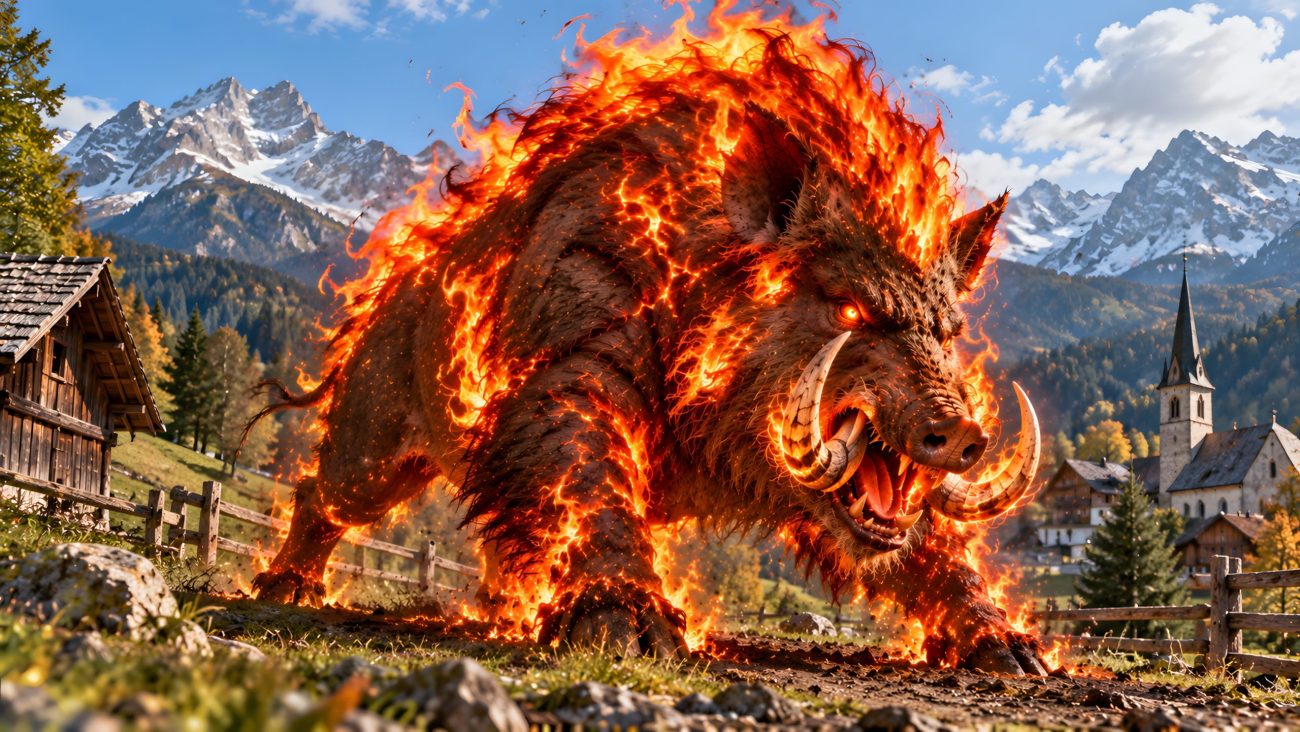
Tradition: Austrian Mythology
Alternative Names: Fiery Wild Boar of Kohlerstadl, Burning Boar of Broat-Wiese
Category: Pig
The Myth
Near the road between Mutters and Götzens in Tyrol, Austria, stands an old wooden hay shed known as the Kohlerstadl, situated in a meadow called the Broat-Wiese. Beside it is a small chapel commemorating a traveller who froze to death there in 1815. The surrounding landscape, with its deep valleys and dense fir forest filled with croaking ravens, has long been associated with fear and supernatural apparitions. The place is especially dreaded after nightfall, and travellers passing through the area have reportedly turned back rather than risk continuing. Even the call of the cuckoo inspires unease, as Tyrolean tradition associates the bird’s voice with the Devil and his phantoms.
The most feared apparition at Kohlerstadl is a fiery wild boar that has reportedly been seen wandering across the meadow. Some believe it is the same monstrous being associated with the Unholdenhof in another local legend, which appears in the form of a burning boar. Others regard the creature as a demonic phantom. One account tells of Klaus Sinnis, a wealthy farmer from Natters, who was travelling with his hay cart toward the meadows of Götzens-Lufens. As darkness fell, the fiery boar suddenly rushed in front of his horses. The terrified animals reared and kicked, refusing to move any farther, forcing Sinnis to return home with his cart empty.
A herdsman driving cattle home from Mutters also encountered the apparition near the dreaded shed. The boar raced wildly in circles, terrifying the cows so badly that they scattered in panic. Many plunged down nearby precipices and were lost. Other witnesses reported seeing black dogs in the same area and hearing unnatural screams and howls. Together, these accounts established Kohlerstadl as a place haunted by frightening supernatural manifestations, with the fiery boar serving as its most notorious apparition.
Sources
Von Günther, Amalia, Countess. Tales and Legends of the Tyrol. London: Chapman and Hall, 1874.