Tradition: Austrian Mythology
Alternative Names: Howangoas, Habergoaß
Category: Sheep
The Myth
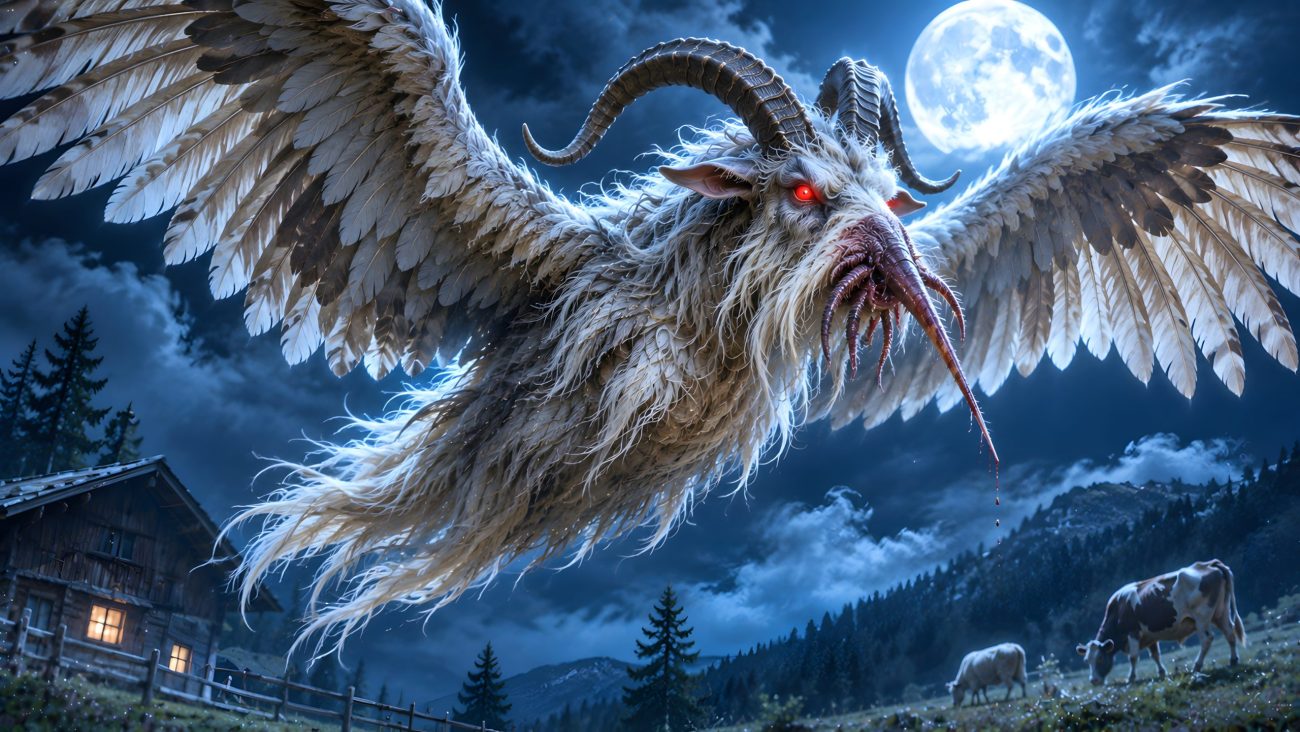
The Hobangoas is a supernatural creature from Alpine folklore, particularly associated with traditional customs in Austria. It is a complex figure that can represent a vegetation demon, an elemental spirit, a ghost, or a frightening legendary beast. Its name derives from Hoban, a regional word meaning “buck,” related to the Old Norse word hafr, meaning “goat.” The creature was therefore originally understood as a hybrid of a buck and a goat. It may once have been associated with fertility, although its role changed over time.
In folklore, the Hobangoas is often described as a three-legged billy goat with glowing eyes and a long beard. Other accounts portray it as a hybrid of a goat and a bird, without legs but with wings. Its dreadful bleating inspires fear, and some traditions describe it as a bloodsucker that attacks farmers and livestock.
The Hobangoas traditionally appears alongside Niglo on the fifth or sixth of December. It carries a Zistl, a basket resembling those once used by farmers. Children were told that the creature would use it to carry away naughty children.
The Hobangoas also accompanies the frightening Schiachperchtn figures. In these customs, it may be more than two metres tall. During May tree celebrations, it sometimes attacks spectators or tears hats from their heads.
The creature has many different roles in Alpine tradition. It may appear as a frightening beast associated with the Wild Hunt, a ghost of the Rauhnächte, a witch or bogeyman, a bringer of misfortune, a bird associated with bad weather, a figure in carnival processions, an assistant of the Devil, a children’s bogeyman, or a character in May tree customs. Its varied appearances and functions make it an especially complex figure in regional folklore.
Sources
Boarische Wikipedia contributors. (n.d.). Hobangoas. https://bar.wikipedia.org/wiki/Hobangoas