Tradition: Finnish Mythology
Alternative Names: Hiidet (plural), Hiiden eukko (Hiisi Queen)
Category: Goblin
The Myth
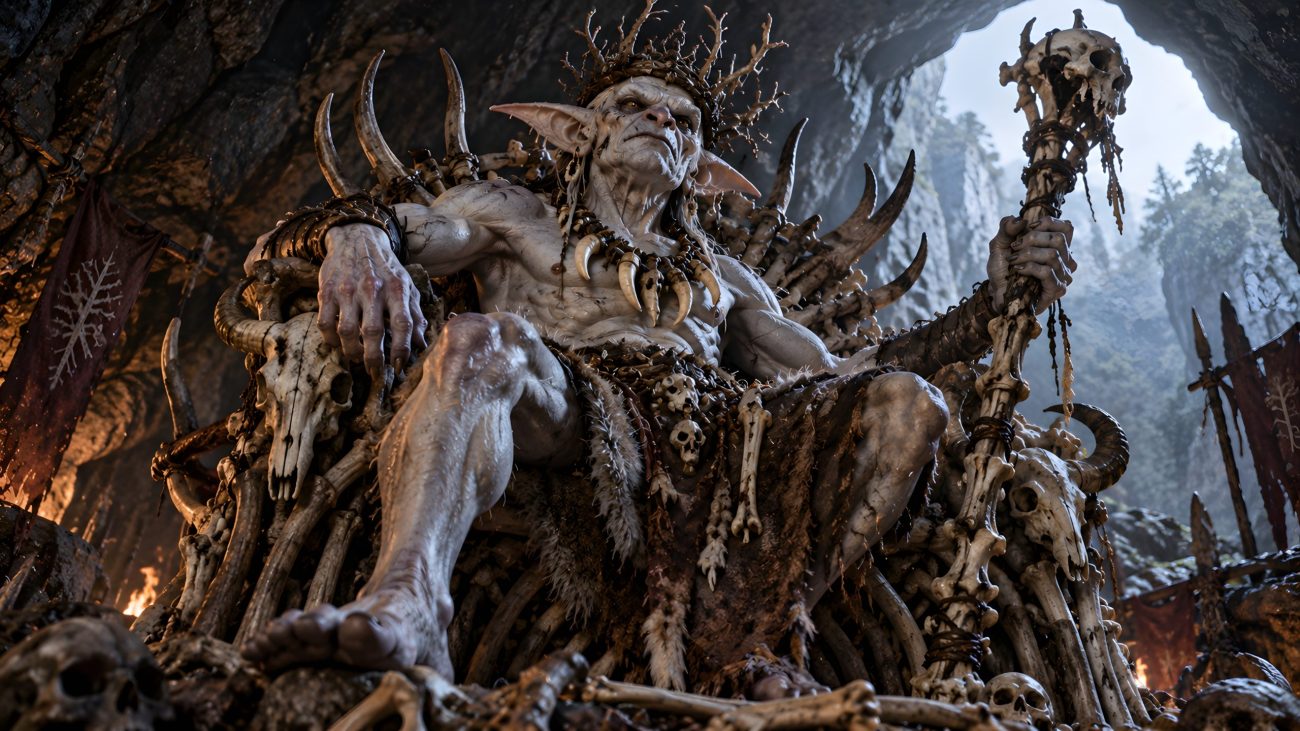
The Hiisi are supernatural beings associated with Finland’s deep forests, mountains, caves, crevices, and waters. Their forms vary considerably: some accounts describe them as small, goblin-like creatures living in rocky places, while others portray them as giants capable of moving enormous boulders into remarkable formations. They are also regarded as powerful ancient nature gods. The giant’s kettles found in Finnish landscapes are traditionally called hiidenkirnu, meaning Hiisi’s churn, reflecting the beings’ association with extraordinary rock formations.
The Hiisi inhabit wild places known as their own lands. Mountains are called Hiisi’s Castles, and forests are considered their territory. In Finnish tradition, different kinds of Hiisi are associated with particular environments, including the forest Hiisi, water Hiisi, mountain Hiisi, and earth Hiisi. Their presence was treated with caution, and people entering their domains were advised to protect themselves with magical iron equipment. Traditional Finnish magical songs describe iron caps, coats, helmets, gloves, and boots worn by those venturing into Hiisi’s lands.
The Hiisi are sometimes portrayed as a supernatural household consisting of Hiisi himself, the Hiisi Queen, their daughters and sons, servants, and animals. The mountains serve as their castles, and human men may travel there seeking brides among the Hiisi daughters. Upon arriving, they are received by the Hiisi Queen, who assigns them tasks. The Hiisi thus inhabit a distinct otherworldly society, complete with family relationships, servants, dwellings, and skilled craftspeople.
In older Finnish religious tradition, Hiisi was associated with the forest and the success of hunters. Bishop Mikael Agricola included Hiisi in his list of ancient Finnish gods in 1551, describing him as a forest god who helped hunters obtain prey. The name also referred to sacred places in forests where people made sacrifices to the gods. Over time, however, the Hiisi increasingly acquired darker characteristics and became associated with devils and malevolent supernatural forces.
In their more dangerous aspect, the Hiisi attack humans and animals, cause accidents, and inflict mysterious pain. Together with their companion Lempo, they are said to shoot invisible arrows into living creatures. In the Kalevala, the Finnish shaman Väinämöinen suffers a severe injury when Hiisi and Lempo interfere with his axe, causing it to strike rock and send fragments into his knee. Yet the Hiisi retain their older status as formidable nature powers, and their aid can still be invoked in difficult circumstances.
Finnish healers and shamans call upon the Hiisi to help stop bleeding and overcome harmful supernatural influences. Invocations summon the mountain Hiisi, the Water Goblin, or the entire Hiisi household and nation, calling upon their power to consume or destroy the source of an affliction. They may also be summoned to punish evildoers. In traditional spells, Hiisi’s bloody cloak or gory covering is invoked against people who use the evil eye, curse others, or attempt to cause harm through malicious observation.
The Hiisi are also renowned as master blacksmiths who forge weapons inside mountain smithies. Their supernatural craftsmanship extends to the creation of extraordinary animals. According to Finnish magical songs, they fashioned a horse from iron and steel, with a stone head and rocky hooves. They also created the Hiisi elk, Hiiden hirvi, into which they breathed an evil spirit before sending it into the world to spread chaos. Through these traditions, the Hiisi emerge as ambiguous powers: ancient guardians of the wild, skilled creators, and dangerous spirits whose influence can bring either assistance or destruction.
Sources
“Goblins: Bloody Cloth.” Finnish Mythology, June 23, 2018. https://finnmyth.wordpress.com/2018/06/23/goblins-bloody-cloth/