Tradition: Greek Mythology
Alternative Names: Erymanthian Wild Boar, Erymanthian Boar (ὁ Ἐρυμάνθιος κάπρος), Aper Erymanthius
Category: Pig
The Myth
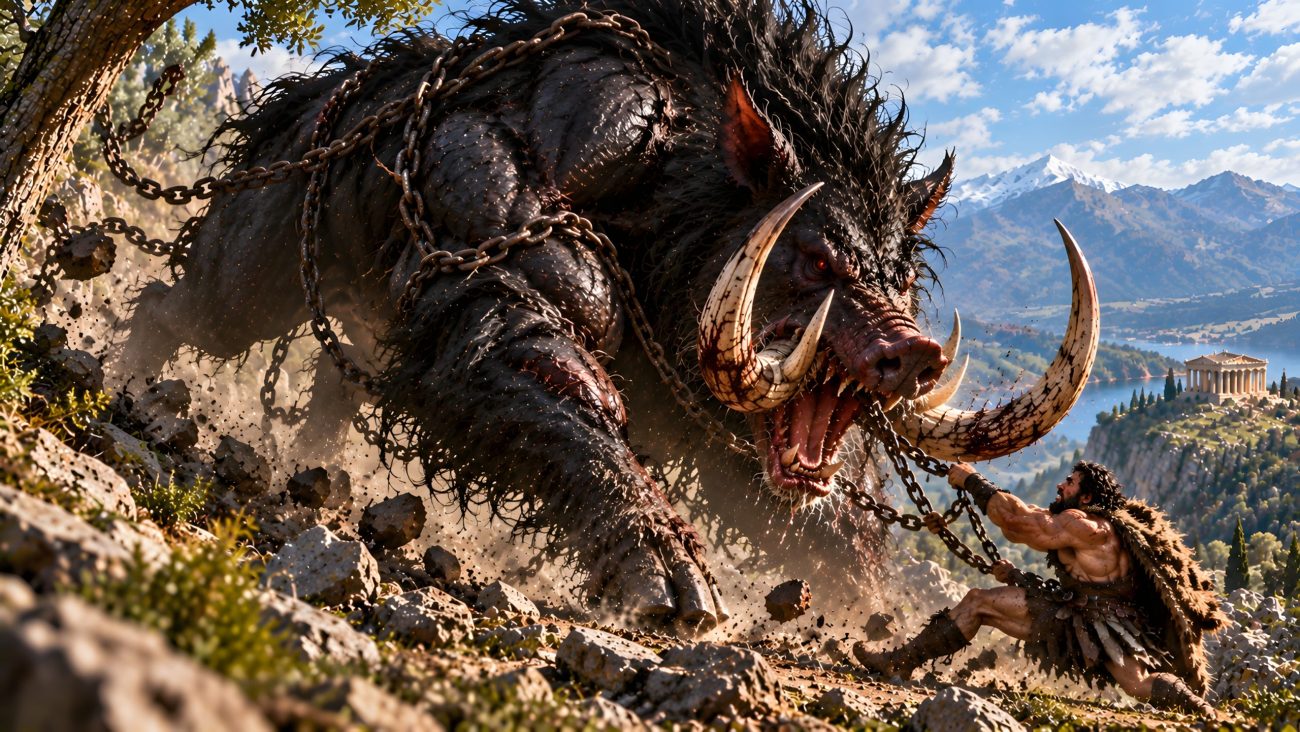
The Erymanthian Boar was a gigantic, savage beast in Greek mythology, described as shaggy, untamable, enormously heavy, and foaming at the jaws. It inhabited the mountainous wilderness of Arcadia, particularly the wooded heights of Mount Erymanthus and the surrounding valleys and marshes. From its forest refuge, the boar would descend to ravage the groves of Arcadia and devastate the countryside around Psophis, threatening farmers and their lands. Its habitat was also associated with Mount Erymanthus, a region connected with Artemis, the goddess of the hunt and wild animals.
The capture of the Erymanthian Boar was the fourth labour of Heracles, who was ordered by King Eurystheus to bring the animal back alive to Mycenae. Heracles pursued the beast through the wilderness, driving it from its hiding place with loud shouts before forcing it into deep snow. Exhausted and trapped by the snow, the boar could no longer escape. Heracles bound it in chains and carried it on his shoulder to Mycenae, completing his task despite the animal’s size and strength. When Eurystheus saw the hero approaching with the enormous boar, he was so terrified that he hid inside a bronze vessel.
According to one tradition, the inhabitants of Cumae claimed that the tusks preserved in the sanctuary of Apollo there belonged to the Erymanthian Boar, although this identification was regarded as highly improbable. The creature also reflects the danger that wild boars represented in ancient Greek traditions. When Artemis was angered, she could send a devastating boar to ravage a region, as in the story of Meleager and the Calydonian Boar. The Erymanthian Boar thus embodied the destructive power of the untamed wilderness and the challenge faced by heroes who sought to master it.
Sources
“Beast of Dean.” Wikipedia: The Free Encyclopedia. Wikimedia Foundation. Accessed October 27, 2026.