Tradition: Spanish Mythology, Portuguese Mythology
Alternative Names: Coca, Cucuy, Cuco, Cuca, Cucu, Cucuí, El Cucuy, El Cucuí
Category: House dweller
The Myth
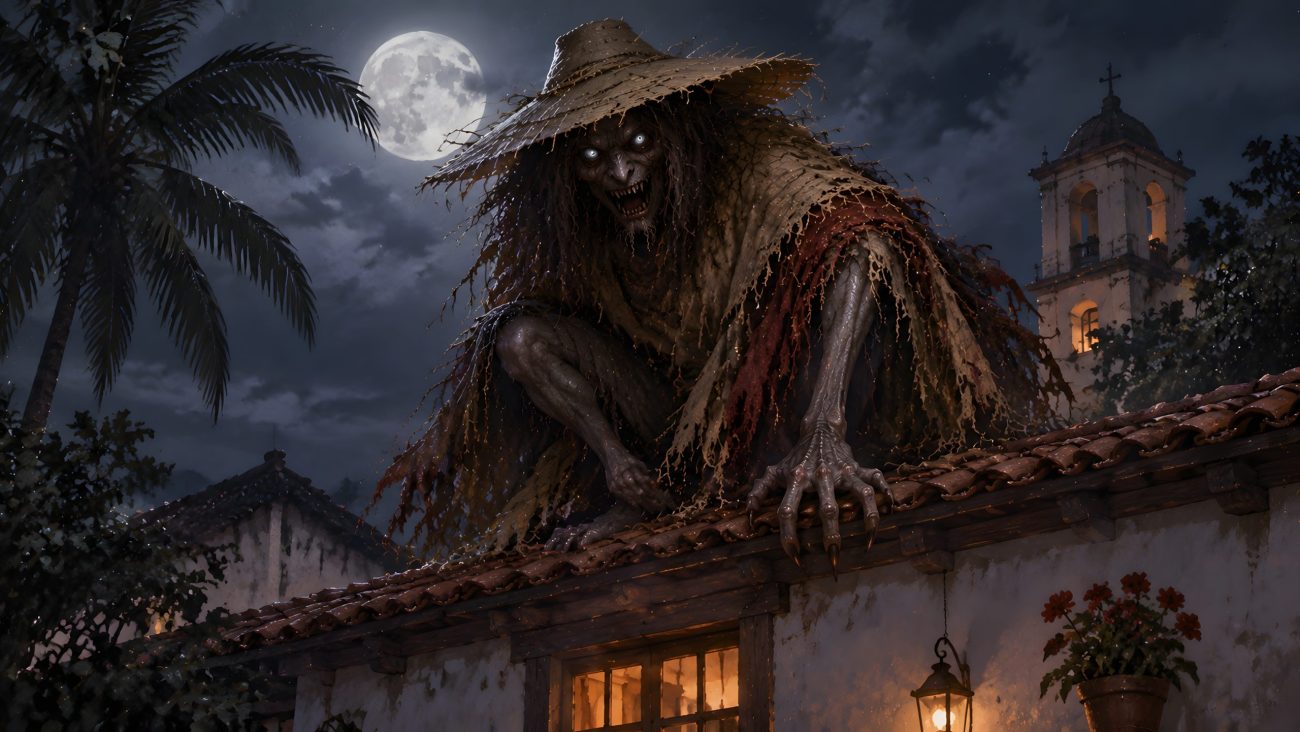
Coco is a frightening, ghost-like monster from Portuguese and Spanish folklore, known for abducting or devouring disobedient children. The creature is also widespread in Hispanic and Lusophone communities across Latin America, where its name and characteristics vary between regions. Rather than having one fixed appearance, Coco is often imagined as a shapeless shadow, a hairy monster, or a terrifying figure hiding in closets, beneath beds, or on rooftops. Its defining feature is not how it looks, but what it does: it comes for children who refuse to obey their parents, especially those who will not go to sleep.
Coco is traditionally invoked by parents as a threat to frighten children into behaving. It is said to watch from rooftops and lurk in dark corners, waiting for an opportunity to seize its victims. When it finds a disobedient child, it may eat them completely, leaving no trace, or carry them away to a place from which they will never return. In this way, Coco functions as a supernatural enforcer of parental authority, representing the danger supposedly awaiting children who misbehave or wander outside when they should remain at home.
The creature is particularly prominent in lullabies and children’s rhymes. One of the oldest known Spanish verses about Coco appears in a seventeenth-century religious play by Juan Caxés. A familiar version warns:
Duérmete niño, duérmete ya…
Que viene el Coco y te comerá.
This means, “Sleep, child, sleep now, or Coco will come and eat you.” Portuguese lullabies similarly tell Coca to leave the house and climb onto the roof, allowing the child to sleep peacefully. These songs turn the monster into a threatening presence that can be driven away, at least temporarily, so that children may rest.
Coco has several regional forms. In Spanish-speaking communities, the masculine Coco or Cucuy is commonly distinguished from Cuca, its female counterpart. In Brazil, Cuca is often represented as a female humanoid alligator with blond hair and clawed fingers. This distinctive appearance became especially familiar through adaptations of children’s literature and television, although older descriptions of the character were less specific. Portuguese traditions also feature Coca as a dragon-like creature, and some regional versions of the bogeyman resemble a mysterious old man carrying a bag or a bird of prey perched on a rooftop.
The names associated with Coco have been connected with words meaning the head or skull in Portuguese, Spanish, and Galician. Related forms occur in other Celtic languages, although the precise development of the name is not fully established by the accounts presented here. Across its different forms, the name evokes a frightening figure associated with the human head and the fear of being seized or devoured.
Coco is often compared to the devil or understood as the opposite of a guardian angel. Some interpretations also associate the creature with the dead of the local community, suggesting that its frightening presence may reflect fears surrounding death and the unknown. Whatever its precise form, Coco represents a threat that watches unseen and punishes children who violate the rules imposed by adults.
The tradition spread throughout Latin America during Spanish and Portuguese colonization, becoming established in countries including Mexico, Argentina, Uruguay, and Chile. Its many regional variations demonstrate the adaptability of the bogeyman: the name, appearance, and details of the threat change, but the central warning remains remarkably consistent. Coco is the monster waiting in the darkness, ready to take the child who refuses to listen.
Sources
“Coco (folklore).” Wikipedia: The Free Encyclopedia. Wikimedia Foundation. Accessed October 18, 2026. https://en.wikipedia.org/wiki/Coco_%28folklore%29