Tradition: Greek mythology
Alternative Names: Cerynitian Hind, Ceryneian Hind, Elaphos Khrysokeros, Elaphus Chrysocerus, Golden-Horned Deer
Category: Deer
The Myth
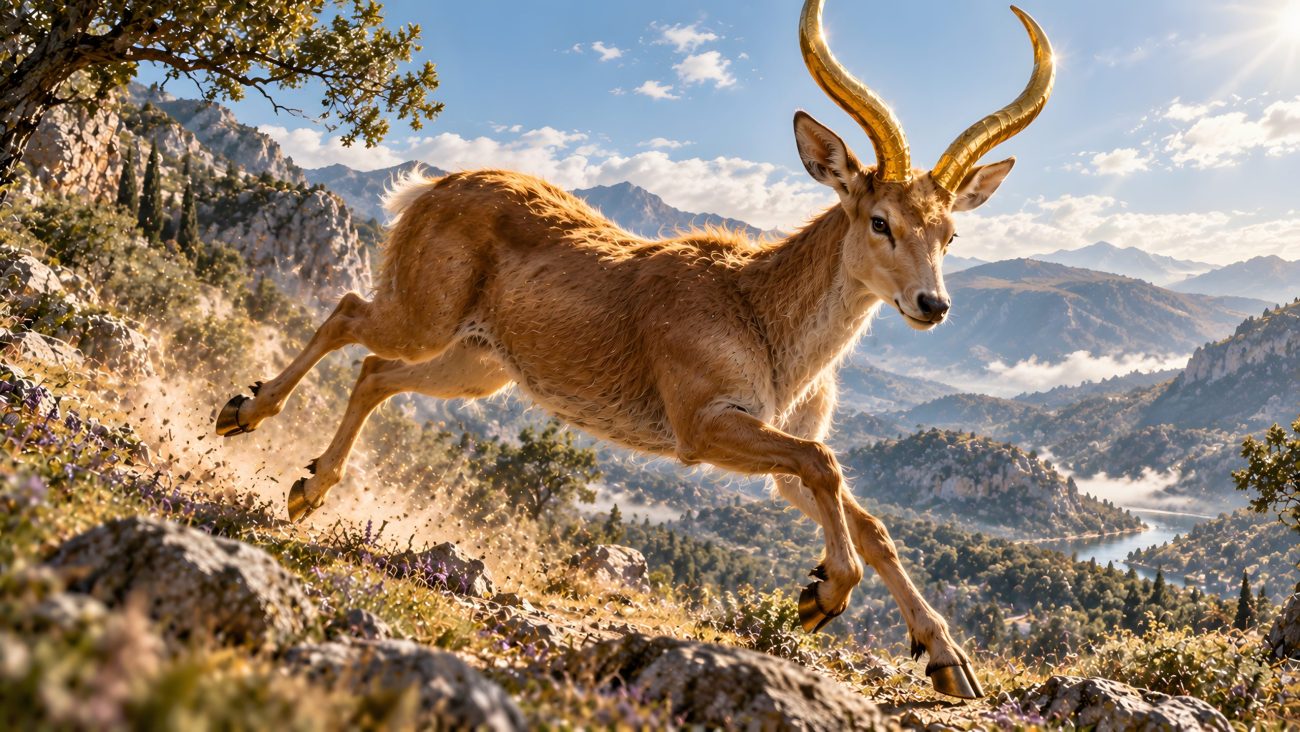
The Cerynitian Hind was a magnificent golden-horned deer sacred to the goddess Artemis. It was renowned for its extraordinary speed and possessed golden antlers and, according to some accounts, brazen feet. The deer lived in the region of Ceryneia in Arcadia and was considered a sacred animal of Artemis.
According to Callimachus, Artemis once discovered five enormous deer near the foot of the Parrhasian hill. They were larger than bulls, and gold shone from their horns. Artemis was amazed by them and wished to capture them for herself. She caught four of the deer through her extraordinary speed and harnessed them to her golden chariot. The fifth escaped, through the designs of Hera, and the Ceryneian hill became its refuge. This surviving deer was later destined to become one of the labours of Heracles.
Another tradition says that the five golden-horned deer had been given to Artemis by the nymph Taygete. Taygete had been saved by Artemis from the pursuit of Zeus and dedicated the deer to the goddess in gratitude. Four of them became the animals that drew Artemis’s chariot, while the fifth remained free.
Heracles was ordered by Eurystheus to capture the Cerynitian Hind alive and bring it back to Mycenae. Because the deer was sacred to Artemis, Heracles was determined not to kill or seriously wound it. He pursued it for an entire year as it fled across the wilderness.
The hind eventually fled from Oenoë toward Mount Artemision in Argolis and then continued toward the river Ladon in Arcadia. Heracles finally caught it while it was crossing the river, shooting it with an arrow in one account before capturing it. He then lifted the deer onto his shoulders and began carrying it toward Mycenae.
While Heracles was still in Arcadia, Artemis and Apollo encountered him. They were furious that he had seized an animal sacred to Artemis and accused him of attempting to kill it. Heracles explained that he had been ordered by Eurystheus to complete the labour and that Eurystheus was responsible for what had happened. He managed to calm the gods’ anger and continued his journey with the hind still alive.
Different ancient writers give different accounts of how Heracles captured the animal. Some say that he used nets, others that he found and mastered it while it was asleep, while another tradition says that he simply exhausted it through pursuit. Diodorus Siculus emphasizes that Heracles succeeded through intelligence rather than force, avoiding unnecessary danger and violence.
Some later traditions say that Heracles ultimately killed the deer, while others maintain that he successfully brought it alive to Mycenae as ordered.
The Cerynitian Hind remained closely associated with Artemis because of its golden horns and divine origin. Its extraordinary beauty, speed, and sacred status made its capture one of the most unusual of Heracles’ labours.
Sources
Atsma, Aaron J. “Elaphos Kerynitis (Cerynitian Hind).” Theoi Greek Mythology. Accessed September 5, 2026. https://www.theoi.com/Ther/ElaphosKerynitis.html