Badnjak — A Christian Ascetic Deep Dive

Christian ascetic theology interprets hearth-spirits absorbed into Christian festivals as residual ritual personifications, tolerated only insofar as they are emptied of agency and subordinated to Christological time. Badnjak is not a benign household spirit; it is a pre-Christian domestic power undergoing liturgical neutralization, allowed to survive only as fuel, not as will.

What happens when an old spirit is permitted to remain only by being consumed?


Lens Effect

Under this lens, Badnjak appears as:
a domesticated remnant of pagan immanence, stripped of autonomy through ritual combustion.

Primary effect on humans:
It teaches transference of trust—from hearth-power to Christ-centered temporality—by destruction rather than appeasement.


1. The Log Burned at Christmas — Annihilation through Incarnation-Time

The Badnjak log embodies localized immanent power, once revered as a dwelling spirit of fertility and household fortune. Christian ascetic logic does not negotiate with such beings; it absorbs and exhausts them.

By burning the Badnjak on Christmas Eve, the log is subjected to Incarnation-time (καιρὸς ἐνανθρωπήσεως). Fire here is not hospitality but judgmental consumption. The spirit is not welcomed—it is converted into warmth, ash, and light, its agency reduced to usefulness.

The bearded old man imagery echoes the archetype of the pagan household elder, now rendered powerless, visiting only symbolically and only to be spent entirely. What once guarded the home is allowed to remain only by ceasing to exist.


Final Reading

Under a Christian ascetic lens, Badnjak is a spirit permitted to survive only by dying each year, a ritualized surrender of old immanent power into the fire of Christ’s advent.


Lesson for the Reader

Do not preserve old powers by renaming them. What belongs to a former order must be offered up, not accommodated. True protection does not come from the hearth, the fire, or the past—but from allowing all lesser guardians to be consumed by the Light that enters the world.


“What once warmed the house must now burn before the Child.”
Vette (Vættir) — A Christian Ascetic Deep Dive

Christian ascetic theology approaches place-spirits not as benign folklore remnants, but as pre-Christian spiritual residues, intelligences bound to created matter without submission to the Creator. Vættir are not neutral guardians; they are local powers (δυνάμεις τοπικαί) that remained operative after the Fall, inhabiting land, graves, and dwellings where human order and spiritual vigilance weakened.

What inhabits creation when worship is withdrawn but presence remains?


Lens Effect

Under this lens, the vette appears as:
a territorial spirit of immanence, exercising authority without obedience to divine hierarchy.

Primary effect on humans:
It normalizes spiritual compromise, replacing prayer and stewardship with appeasement and familiarity.


1. Spirits of Land and Burial Mounds — Immanent Powers without Ascent

Land-vættir and Vaette-houer dwell in soil, mounds, and waterfalls—places associated with death, transition, and elemental force. In Christian ascetic understanding, spirits bound to such locations are unliberated intelligences, neither angels nor human souls at rest.

Their fear of ship figureheads reveals their vulnerability: they are disturbed by assertive form, by signs of intentional presence. They prefer quiet continuity, not proclamation. This marks them as spirits of the old order, displaced by Christ’s dominion but not annihilated—allowed to persist where faith is absent or diluted.


2. Household Help and Mischief — Familiar Spirits and Spiritual Sloth

The helpful vette who feeds animals and tends homes embodies outsourced order. Ascetically, this is dangerous: labor performed without prayer becomes mechanical stability without sanctification.

Their mischief—confusion, irritation, humiliation—functions as pedagogical punishment, disciplining households that treat spirits as partners rather than temptations. The refusal of clothing openly mirrors demonic pride: acceptance only when unseen, never under blessing or gratitude.

Christian ascetics would name such beings familiar spirits, tolerated until they erode discernment and replace reliance on God with negotiated coexistence.


3. Refusal of Open Gifts — Pride without Confession

The vette’s aversion to receiving clothing openly reflects ἀκαταγνωσία (akatanōsia)—the refusal to be known, named, or judged. In Christian ascetic theology, holy beings accept gifts only within blessing and thanksgiving. Spirits that require secrecy reveal pride without repentance.

Clothing signifies re-ordering and covering under authority. To reject it publicly is to reject incorporation into moral hierarchy. The vette accepts gifts only when hidden because it cannot tolerate acknowledged dependence. This marks a spirit that desires benefit without submission.

Such beings do not want generosity; they want concealed transaction, which is the currency of demonic familiarity.


4. Multiplicity of Forms — Ontological Ambiguity as Strategy

The term vættir expanding to include elves, dwarves, giants, and even gods indicates taxonomic collapse. Ascetically, this reflects πλάνη (planē)—confusion deliberately sustained to prevent discernment.

Christian thought insists on clear spiritual taxonomy: angels serve, demons rebel, souls await judgment. Vættir resist classification because ambiguity itself is protective camouflage. What cannot be named cannot be exorcised.

Thus the vette persists not through power, but through semantic fog, remaining “neighbor,” “helper,” or “tradition” rather than spirit requiring renunciation.

Under a Christian ascetic lens, vettir are unsubmitted local powers, spirits that fill the vacuum left when land, home, and labor are no longer consecrated. They offer help without holiness and order without salvation.


Lesson for the Reader

Do not make peace with what has not bowed to God. What assists you without prayer will eventually rule you through habit. Consecrate your home, your land, and your labor—or unseen neighbors will claim them as their own.


“Where Christ is not enthroned, something else quietly takes His seat.”

The Rabbit Mystery

Tradition / Region: Japan (Amami Ōshima — Yamato Village)
Alternate Names:
Category: Rabbit / shapeshifter


The Myth

In Yamato Village on Amami Ōshima, there is a legend of a strange and terrifying occurrence that once plagued the island. Every night, an unknown visitor would appear, stealing a set of rice cakes and kidnapping one person. As night after night passed, fear spread through the village and the number of inhabitants steadily decreased.

At last, two courageous villagers decided to uncover the truth. They prepared rice cakes and carried them in a basket, intending to follow the visitor and discover its true form. As they walked, they suddenly saw many white rabbits appear around them. The rabbits gathered together, chanting softly and repeatedly bowing toward the east, as if praying to something unseen.

The two men sought help from an old woman and borrowed her dog. When the dog was brought among the rabbits, it attacked them, killing and devouring them one by one as they ate the rice cakes and continued bowing toward the east.

Afterward, it was revealed that until that time, the rabbit had been transforming into the shape of a monk. In that form, it had been stealing rice cakes and kidnapping people from the village. With the rabbits destroyed by the old woman’s dog, the nightly disappearances ended, and the villagers were finally able to live in peace again.

Thus the rabbit came to be remembered not only as an animal, but as a dangerous shapeshifter whose true nature had long been hidden beneath a human disguise.


Interpretive Lenses

Religious Readings
Philosophical Readings
Psychological Readings
Esoteric Deep Dive
  • Hermetic Deep Dive
Political / Social Readings
Other

The Rabbit Mystery — A Christian Ascetic Deep Dive

Christian ascetic theology approaches deceptive spirits not as neutral shapeshifters, but as energies of prelest—forces that imitate holiness in order to dislocate discernment (διάκρισις). The Rabbit Mystery is not about animals masquerading as monks; it is about false ascetic appearance divorced from obedience, humility, and truth. What appears pious here is, in fact, predatory simulation.

What kind of evil bows, prays, and wears the form of holiness?


Lens Effect

Under this lens, the rabbit appears as:
a demonic agent of prelest, cloaking predation in ritualized piety.

Primary effect on humans:
It corrupts discernment, teaching fear through counterfeit holiness rather than open violence.


1. The Monk-Form and Nocturnal Theft — Prelest through False Ascetic Masking

In Christian ascetic thought, the monk’s form signifies kenosis, obedience, and self-emptying under God. The rabbit’s transformation into a monk represents sacrilegious inversion: holiness reduced to external form without inner repentance.

The nightly theft of rice cakes and abduction of villagers parallels spiritual parasitism—a demon feeding on community vitality while wearing the symbols of sanctity. This is prelest in its most dangerous mode: evil that presents itself as spiritual authority, lulling the faithful into compliance through reverence rather than fear.


2. Bowing Rabbits Facing East — Ritual without Logos

The rabbits’ collective bowing toward the east imitates liturgical orientation—the east as the direction of resurrection and Christ’s return. Yet this posture is empty of Logos, prayer reduced to choreography without truth.

In ascetic theology, such ritualism is dead form (τύπος νεκρός)—external devotion unmoored from obedience to God. The dog’s destruction of the rabbits signifies unadorned discernment, instinctive and unsentimental, cutting through deception where intellectual piety fails.

The dog does not pray; it recognizes corruption immediately.


Final Reading

Under a Christian ascetic lens, the Rabbit Mystery is a warning against holy disguise without holiness, a narrative of prelest where ritual, prayer, and clerical form are weaponized to consume the innocent. Peace returns only when deception is exposed and destroyed, not negotiated with.


Lesson for the Reader

Do not trust holiness that demands nothing of the heart. True sanctity bears humility, obedience, and self-sacrifice. What bows beautifully but steals life by night is not holy—it is a devourer in vestments. Discernment, not reverence alone, guards the soul.


“Not all who face the East walk toward the Light.”

Utixo’s Rabbit (Tiqua) — A Hermeticism Deep Dive

Hermeticism treats divine messengers not as neutral carriers, but as operative intermediaries, beings whose capacity to translate Logos into temporality determines whether cosmic decree survives incarnation. Utixo’s Rabbit is not a simple fool—it is a failed psychopompic vector, where transmission collapses and metaphysical law mutates through error.

What happens when Logos fractures in transit?


Lens Effect

Under this lens, Utixo’s Rabbit appears as:
a compromised noetic courier, whose mnemonic failure converts reversibility into finality.

Primary effect on humans:
It locks mortality into linear irreversibility, sealing death as a one-way ontological condition.


1. Divine Message — Logos Destined for Temporal Implantation

Utixo’s declaration that death is not eternal constitutes eschatological elasticity, a Hermetic condition where dissolution is followed by re-coagulation. The message is not comfort—it is cosmic protocol, intended to regulate how human consciousness relates to finitude.

The rabbit’s role is to serve as semantic vessel, carrying Logos downward across planes. Hermetically, this requires mnemonic integrity—the ability to preserve meaning under descent.


2. Forgetting and Inversion — Noetic Entropy and Semantic Reversal

The rabbit’s confusion represents noetic entropy, the degradation of intelligible form during transmission. Hermetically, this is Logos inversion, where meaning does not vanish but flips polarity.

Immortality does not disappear—it becomes its opposite. Reversibility collapses into irreversible linear time, and death hardens into terminal condition. The error is small in speech, absolute in consequence.


3. Permanent Death — Ontological Sealing of the Human Circuit

Once spoken, the inverted message binds reality, because utterance functions as performative inscription. Hermetically, speech at the mythic level is world-setting, not description.

Thus death becomes fixed not by divine will, but by miscommunicated decree, embedding finitude into the human condition as a structural limit rather than a phase.


Final Reading

Under a Hermetic lens, Utixo’s Rabbit is the moment Logos failed to survive descent, transforming a reversible cosmos into a closed mortal loop through semantic error.


Lesson for the Reader

Be careful what you carry between worlds—ideas, words, intentions. Meaning degrades under pressure, and even small distortions can harden into law. Not all fate is imposed; some is misdelivered.


“When Logos is misremembered, eternity breaks into time.”

Penanggalan

Tradition / Region: Malay folklore (Malaysia and wider Southeast Asia)
Alternate Names: Penanggal
Category: Vampire / witch


The Myth

The Penanggalan is a nocturnal vampiric being from Malay folklore. By day, it appears as an ordinary human woman, but at night it separates its head from its body. The head flies freely through the darkness, trailing its internal organs and entrails from the neck. From a distance, it is said to glow or flicker like a small ball of fire, resembling a will-o’-the-wisp.

The name penanggalan comes from the Malay word tanggal, meaning “to remove” or “to take off,” referring to the creature’s ability to detach its head. The Penanggalan is not an undead corpse but a living woman who has gained this ability through black magic. According to tradition, a woman becomes a Penanggalan by performing a ritual bath in vinegar, meditating while her body is submerged except for her head. Through this practice, she learns how to separate herself from her body at night.

When active, the Penanggalan soaks its dangling organs in vinegar to shrink them, making it easier to reattach to its body before dawn. Because of this, the creature is always associated with a strong smell of vinegar, which is said to betray its true nature even during the daytime.

At night, the Penanggalan hunts for blood. Its preferred victims are pregnant women, women who have recently given birth, and young children. Traditional Malay houses were built on stilts, and the Penanggalan was believed to hide beneath them, extending its long tongue upward to feed on the blood of new mothers. Those it feeds upon are said to suffer a wasting illness that is often fatal. Even being brushed by the dripping entrails of the creature could cause painful, festering sores that would not heal without the help of a bomoh.

The Penanggalan is closely related to similar beings across Southeast Asia, all sharing the same basic form of a flying female head with trailing organs. These include the Ahp in Cambodia, the Kasu in Laos, the Krasue in Thailand, the Ma lai in Vietnam, the Kuyang and Leyak in Indonesia, and the Manananggal in the Philippines.

Protection against the Penanggalan involves physical barriers. Thorny leaves of the mengkuang plant are scattered around houses or hung near windows to snag and injure the exposed organs. Shards of glass fixed to the tops of walls serve the same purpose. Pregnant women are said to keep scissors or betel nut cutters under their pillows, as the Penanggalan fears sharp metal.

A Penanggalan may be destroyed if its abandoned body is found. Filling the neck cavity with broken glass will tear its organs apart when it tries to reattach. The body may also be sanctified and burned, or otherwise prevented from reuniting with the head before sunrise. In some accounts, turning the body upside down causes the head to reattach incorrectly, exposing the creature’s identity to everyone.

In Malay tradition, the Penanggalan remains a feared figure of the night—born of witchcraft, moving unseen above villages, and preying upon the most vulnerable while hiding in plain sight by day.


Interpretive Lenses

Religious Readings
Philosophical Readings
Psychological Readings
Esoteric Deep Dive
Political / Social Readings
Other

Penanggalan — A Hermeticism Deep Dive

Hermeticism understands vampiric witches not as undead aberrations, but as intentional fractures of the human compound, beings who survive by disassembling the natural concord between body, soul, and pneuma. The Penanggalan is not possessed—it is self-dissected, a practitioner who has learned to separate components of being without achieving transcendence. What remains is functional monstrosity.

What happens when separation is mastered without ascent?


Lens Effect

Under this lens, the Penanggalan appears as:
a consciously disarticulated human vessel, sustained by inverted circulation and nocturnal extraction.

Primary effect on humans:
It weaponizes vulnerability, feeding on moments when life-force is most exposed and unsealed.


1. Detachable Head — Violent Anthropological Severance

The removal of the head enacts radical disjunction between intellect (nous) and embodied order. Hermetically, the head represents directive consciousness; its flight signals cognition liberated without ethical integration.

Unlike mystical ascent, this separation leaves the body behind as inert residue, not transmuted matter. The result is mobility without wholeness.


2. Trailing Organs — Externalized Interior Economy

The exposed entrails signify failed interiorization. Hermetically, organs are meant to circulate vitality internally; when externalized, they become parasitic conduits, demanding replenishment from outside sources.

The glowing appearance in flight reflects leaking pneuma, life-force escaping containment and visible as erratic light.


3. Vinegar Immersion — Corrosive Stabilization

Vinegar functions as alchemical astringent, shrinking and preserving flesh while preventing decay. Hermetically, this is artificial cohesion, a chemical stand-in for spiritual integration.

The smell of vinegar betrays the Penanggalan because false unity always leaves residue. What is held together by corrosion announces itself.


4. Black Magic Bath — Submersion without Rebirth

The ritual bath mimics initiation immersion but inverts its aim. Hermetically, water dissolves form to allow rebirth through recombination. Here, dissolution is practiced without recomposition, producing a being that can separate but not rejoin fully.

Meditation without prayer or alignment produces technique divorced from ascent.


5. Targeting Birth and Pregnancy — Extraction at the Threshold of Incarnation

Pregnancy and childbirth mark ontological openings, moments when new life has not yet sealed its boundaries. Hermetically, these are points of maximum pneumatological flux.

The Penanggalan feeds here not out of cruelty, but because life-force is least defended. This is vampirism as theft of incarnation, draining vitality before it fully anchors.


6. Stilts, Tongue, and Under-House Lurking — Inverted Verticality

Traditional houses on stilts establish a vertical hierarchy: earth below, life above. The Penanggalan inverts this order, attacking from beneath, extending its tongue upward like an anti-axis mundi.

Hermetically, this is subversion of ascent, life pulled downward into dissolution rather than rising into form.


7. Destruction through Obstruction — Forced Misalignment

Glass, thorns, and metal do not kill through purity but through structural interference. Hermetically, the Penanggalan survives only if reattachment occurs correctly. Preventing reunion enforces irreversible incoherence.

Filling the neck cavity with glass destroys the possibility of recombination, turning technique against itself.


Final Reading

Under a Hermetic lens, the Penanggalan is human separation perfected without wisdom, a being who mastered disassembly but failed at reintegration. She exists as a warning that power over structure does not equal transcendence—and that fragmentation without ascent leads only to hunger.


Lesson for the Reader

Do not seek mastery over yourself by cutting pieces away. What you separate without understanding will return as appetite. True transformation recombines at a higher order; false transformation survives by feeding on what it cannot become.


“What ascends whole becomes light; what ascends in pieces must feed.”

Waterwolf — A Hermeticism Deep Dive

Hermeticism does not interpret hybrid water-beasts as corrupted fauna, but as elemental transmutations, beings formed when an element internalizes the operative logic of another plane. The Waterwolf is not a wolf that entered water; it is aquatic substance that has assimilated predatory νοῦς (nous). Where circulation acquires intention, element becomes executor.

What emerges when an element learns to hunt?


Lens Effect

Under this lens, the Waterwolf appears as:
an elemental egregore of submerged predation, water coagulated into sentient enforcement.

Primary effect on humans:
It reasserts liminal law, annihilating those who violate elemental jurisdiction through ignorance or familiarity.


1. Scaled Body, Algae, Fins — Elemental Re-Coagulation

The Waterwolf’s scales signify hermetic sealing, a body closed against air and solar exchange. Fur belongs to the realm of aerial respiration and warmth circulation; scales indicate total aqueous saturation, a vessel permanently submerged in passive matter.

Algae and moss mark chronic immersion, the accumulation of slow life upon slow life. Hermetically, this is putrefactive adhesion stabilized into form, not decay but persistent sub-solar vitality.

Fins replace legs to enable frictionless translation through the undifferentiated medium. This is motion without wake, predation without announcement, an executor designed to act before perception can orient.


2. Wolf Form — Transferred Predatory Logos

The wolf shape introduces terrestrial hunting intelligence into the aqueous realm. Hermetically, this is cross-elemental contamination of logos, where water adopts the strategic cognition of land-based carnivory.

The Waterwolf does not merely exist in water; it thinks like a land predator while moving as liquid. This fusion creates a being whose threat lies in conceptual mismatch: humans expect water to flow, not to stalk.

Here, water ceases to be medium and becomes jawed intention.


3. Silent Ambush and Drowning — Boundary Enforcement through Dissolution

Dragging victims beneath the surface is not consumption but elemental repossession. Hermetically, drowning is forced reversion to undifferentiated matter, the collapse of breath, voice, and verticality.

The Waterwolf does not kill to feed. It eliminates boundary transgression, reclaiming bodies that linger too long at the interface between dry and wet. This is not moral punishment, but jurisdictional correction.

Children are targeted because they embody incomplete boundary inscription—beings not yet fully encoded with spatial caution. Their disappearance reinforces the non-negotiability of elemental borders.


Final Reading

Under a Hermetic lens, the Waterwolf is water that has learned discrimination, an elemental intelligence enforcing separation between realms. It is not evil, but regulatory—a living theorem that water is not empty space but sovereign domain.


Lesson for the Reader

Never mistake familiarity for permission. Elements tolerate proximity only until they are required to remember their authority. What moves silently beneath calm surfaces is not absence, but latent enforcement.


“When an element acquires intention, ignorance becomes fatal.”

Cikavac

Tradition / Region: Serbian Mythology
Alternate Names:
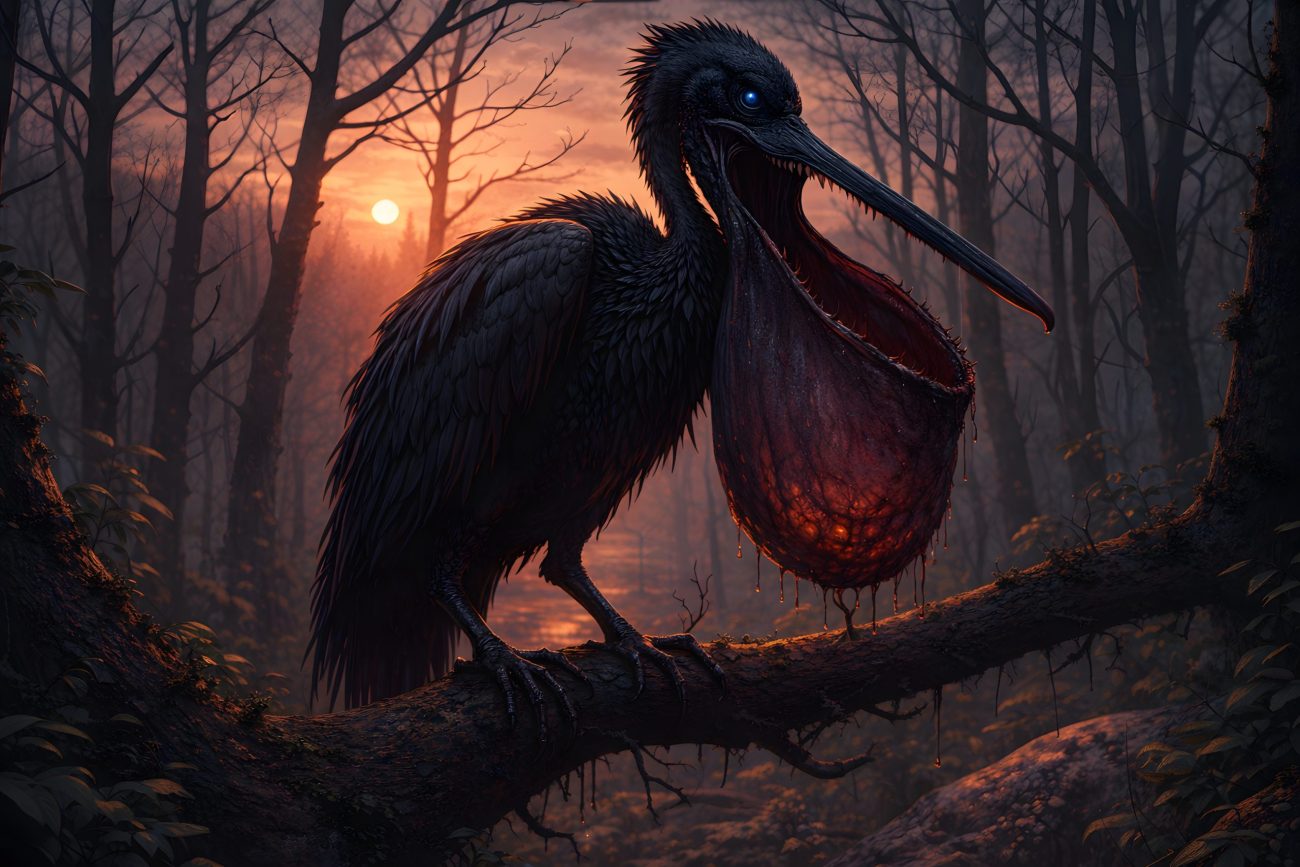
Category: Bird / Pelican


The Myth

The Cikavac is a creature of Serbian folklore, described as a strange winged being that is neither fully bird nor beast. It is said to resemble a bird with a long beak and a pouch like that of a pelican. The Cikavac does not appear naturally in the world but must be deliberately created through a secret ritual.

To obtain a Cikavac, a person must take an egg laid by a black hen. The egg is then carried under the armpit of a woman for forty days. During this time, strict rules must be followed. The caretaker must not confess sins, must not pray, must not wash her face, cut her nails, or speak of what she is doing. If these conditions are kept, the egg hatches, and the Cikavac is born.

Once created, the Cikavac becomes bound to its owner. At night, it flies out to perform tasks on their behalf. It is said to steal honey from neighboring beehives and milk from other people’s cattle, bringing these goods back to its master. Despite this, the beehives and animals it visits are often described as remaining unharmed.

The Cikavac is also believed to grant its owner the ability to understand the language of animals. Through this power, humans gain insight into the hidden world of beasts and birds, learning things normally beyond human hearing.

The Cikavac remains close to the household that created it, acting as a secret helper and bringer of prosperity. Its existence depends on secrecy and careful observance of the ritual that brought it into the world. If the rules are broken, the creature is said to fail to form or to disappear.

In Serbian tradition, the Cikavac is remembered as a liminal being—born through human action, moving between forest, farm, and home, and serving as a hidden companion that operates under cover of night.


Cikavac — A Hermeticism Deep Dive

Hermeticism reads familiars not as “helpers,” but as artificially condensed intermediaries, beings produced when human will interrupts natural generation and reroutes vitality into service. The Cikavac is not summoned from elsewhere; it is manufactured liminality, a creature born where taboo, secrecy, and deprivation suspend ordinary moral and ritual circuits.

What kind of being forms when creation is achieved by subtraction rather than invocation?


Lens Effect

Under this lens, the Cikavac appears as:
a deliberately incubated intermediary intelligence, sustained by ritual silence and moral suspension.

Primary effect on humans:
It externalizes agency, allowing desire and acquisition to act without direct human motion.


1. The Black Hen’s Egg — Inverted Generation

The egg of a black hen marks chthonic fertility, life sourced from obscured, non-solar origin. Hermetically, this is counter-natural genesis, where birth is initiated outside sanctioned reproductive order.

The egg is not fertilized in the ordinary sense; it is potential awaiting coercion.


2. Forty Days Under the Armpit — Incubatio per Deprivation

The armpit is a liminal bodily zone—neither sexual nor nutritive. Hermetically, incubating the egg there enacts parasitic gestation, life warmed by withheld circulation rather than nurtured exchange.

The forty days signal ritual completeness, but inverted: a full cycle of denial, not blessing.


3. Prohibitions and Silence — Ethical Suspension Field

The bans on prayer, confession, washing, and speech create a moral vacuum, a field where ordinary correspondences are deliberately severed. Hermetically, this is ritual disconnection, allowing something to form unobserved by higher order.

The Cikavac can only exist where no witness claims authority.


4. Night Flight and Theft — Indirect Acquisition

The Cikavac steals honey and milk—symbols of refined nourishment—yet leaves sources unharmed. Hermetically, this is subtle siphoning, extraction without depletion.

Prosperity here is gained through rerouted abundance, not destruction, but it remains ethically unanchored.


5. Animal Speech — Borrowed Gnosis

Granting understanding of animal language reflects horizontal gnosis, knowledge gained by proxy rather than initiation. Hermetically, this is mediated perception, insight without transformation.

The human does not become wiser; they become informed through a tool.


6. Binding to the Household — Localized Dependency

The Cikavac cannot roam freely; it is domesticated liminality, tethered to the site of its illicit birth. Hermetically, all artificially generated intermediaries require continuous secrecy to persist.

Exposure dissolves them.


Final Reading

Under a Hermetic lens, the Cikavac is desire given wings, an intermediary born from silence, denial, and withheld conscience. It serves efficiently, but only because it was never permitted to belong fully to any order—natural, moral, or divine.


Lesson for the Reader

Be wary of power gained without transformation. What serves you without changing you will eventually replace your agency, acting where you no longer can. Every shortcut creates a companion that must be fed with secrecy.


“What is born without blessing survives only in the dark.”