Shisa

Tradition / Region: Ryukyu Islands (Okinawa, Japan)
Alternate Names:
Category: Guardian beast / talisman


The Myth

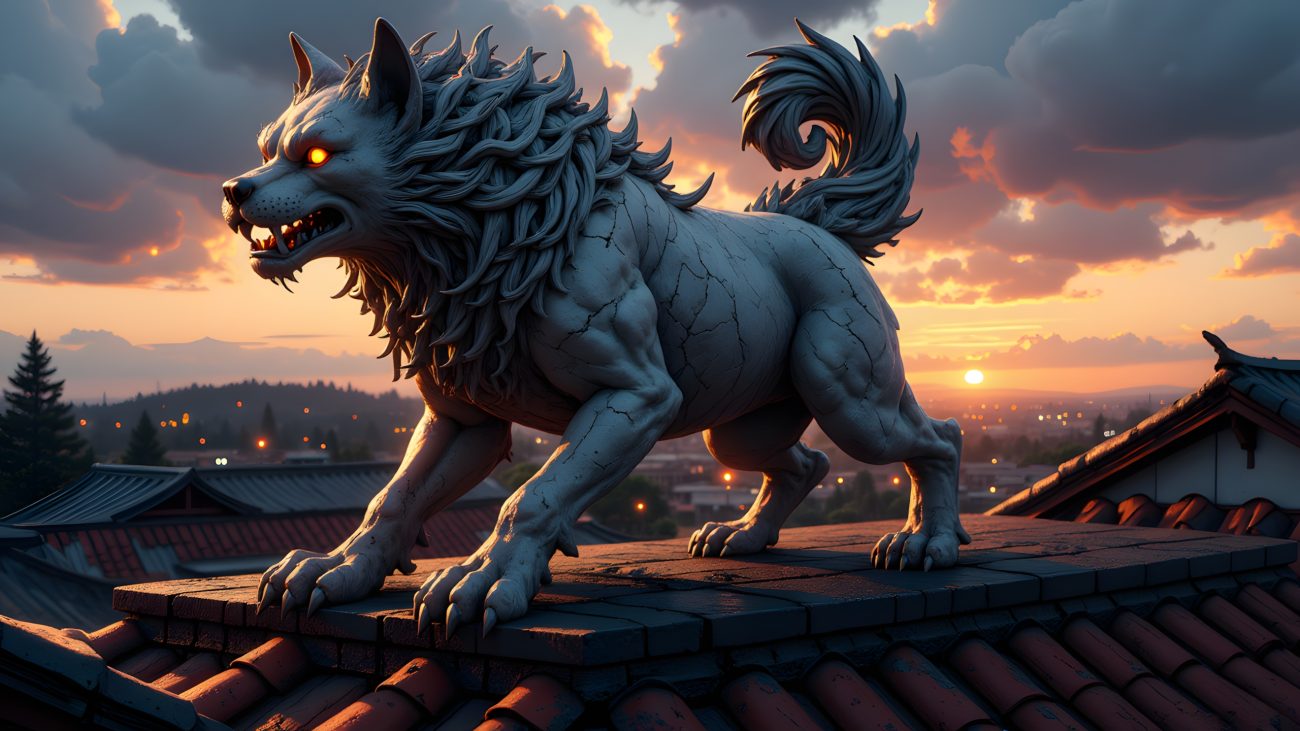
Shisa are guardian figures found throughout the Ryukyu Islands, especially in Okinawa. Their name comes from the local pronunciation of the word “lion,” and they are believed to descend from lion figures that spread from the ancient Orient through China and into Japan. Though commonly seen as statues, Shisa are understood as living protectors in spirit.

Shisa are most often placed on rooftops, gates, and walls of houses. There they stand watch over homes and villages, guarding against fire, misfortune, and evil spirits. They are typically made of stone, ceramic, or plaster. In many cases, Shisa appear as a pair: one with an open mouth and one with a closed mouth. One is said to ward off evil, while the other is said to invite good fortune and prosperity.

According to Ryukyuan tradition recorded in the Kyuyo, the national history of the Ryukyu Kingdom, the origin of the Shisa is linked to a time when fires repeatedly broke out in a village. A feng shui master advised that a lion statue be placed facing a particular direction—toward Yaese Takashi—to suppress the destructive force. After the statue was set in place, the fires ceased. The oldest Shisa connected to this account is said to still exist in Yaese.

Over time, Shisa became widespread across Okinawa. Each household placed them according to local custom, believing that the guardian beasts watched constantly, standing between the human world and unseen dangers. Though unmoving in form, Shisa are remembered as ever-vigilant protectors whose presence alone was enough to keep disaster at bay.


Interpretive Lenses

Religious Readings
Philosophical Readings
Psychological Readings
Esoteric Deep Dive
Political / Social Readings
Other

Shisa — A Hermeticism Deep Dive

Hermeticism approaches guardian beasts not as symbolic decorations, but as fixed operators of spatial order, entities whose function is to stabilize thresholds by continuous presence. Shisa do not react to danger; they preempt it. They are not activated by crisis, but by placement. Their power lies in being correctly stationed.

What kind of protector works simply by standing where it must?


Lens Effect

Under this lens, Shisa appear as:
stationary apotropaic intelligences, anchoring protection through correct orientation.

Primary effect on humans:
They externalize vigilance, allowing households to rest while guardians remain awake.


1. Rooftops and Gates — Threshold Sovereignty

Shisa occupy liminal architecture: roofs, walls, entrances. Hermetically, these are zones of exchange, where inside meets outside and vulnerability peaks.

By standing at thresholds, Shisa intercept influence before it enters circulation. Protection occurs not within the home, but before intrusion becomes interaction.


2. Open and Closed Mouths — Respiratory Polarity

The paired mouths enact energetic respiration. One expels malefic influence; the other retains benefic force. Hermetically, this is controlled circulation, ensuring flow without leakage.

Protection here is not blockage, but regulated breathing of space.


3. Orientation Toward Fire — Directional Binding

The Kyuyo account reveals geomantic correction. Fire is treated as directional excess, not random catastrophe. The Shisa does not fight fire—it binds its vector.

Hermetically, this is spatial counterweighting, where force is neutralized by aligned presence rather than opposition.


4. Statue as Living Function — Ensouled Fixity

Though immobile, Shisa are understood as alive in operation. Hermetically, this reflects ensouled form, where vitality does not require motion.

Their stillness is strength: permanence that resists entropy through unchanging watchfulness.


Final Reading

Under a Hermetic lens, Shisa are guardians of placement, beings whose power derives from correct position, orientation, and pairing. They prove that protection does not always act—it often stands correctly and refuses to move.


Lesson for the Reader

Not all defense requires action. Sometimes the most effective protection is knowing where to stand and staying there. Align your boundaries well, and many threats will never need to be confronted at all.


“What is properly placed does not need to pursue danger—it prevents it from arriving.”

Olde Marolde

Tradition / Region: Netherlands (Achterhoek; Drenthe)
Alternate Names: Marolde
Category: Witch / night spirit


The Myth

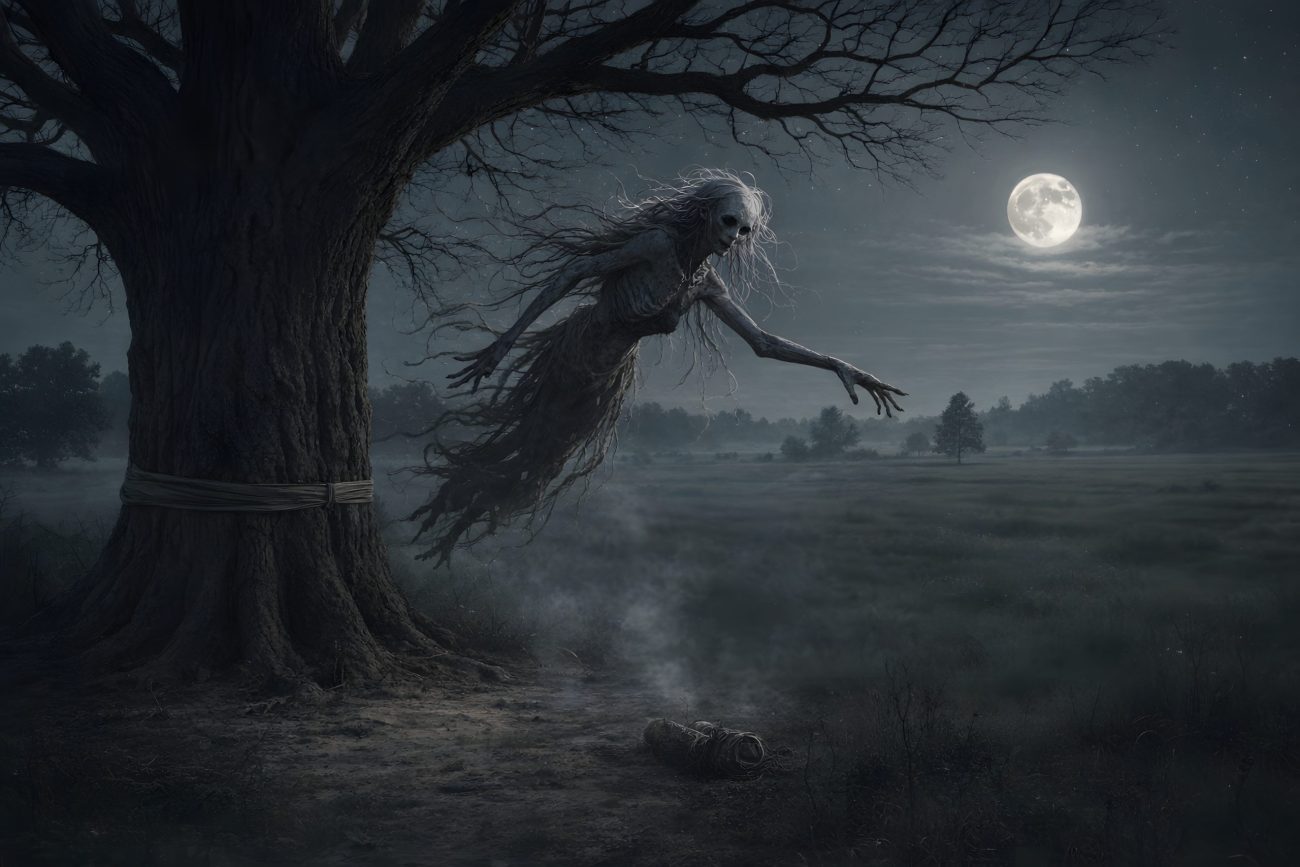
Olde Marolde is a figure from folk belief in the eastern Netherlands, remembered in a Drents poem as a witch who flies naked through the night sky. She is said to move unseen through the air, traveling great distances as darkness falls.

According to tradition, Olde Marolde steals children from their cradles and carries them away to the witches’ sabbath. Her presence was feared, especially at night, when illness, restlessness, or misfortune struck a household.

Despite her danger, people believed there was a way to protect themselves from her influence. A spoken rhyme could be used to transfer illness—especially fever—to Olde Marolde herself. To perform this act, one had to walk three times around an old oak tree or bind a garter around its trunk, and then recite:

“Olde Marolde,
Ik hebbe de kolde,
Ik hebbe ze now,
Ik gève ze ow,
Ik bind em hier neer,
Ik krieg em neet weer.”

Through this ritual, the sickness was believed to be passed on to Olde Marolde and bound to the tree, never to return.

In these stories, Olde Marolde appears as a flying witch of the night, a child-stealer and bearer of illness, yet also a being whose power could be resisted through ritual words and actions rooted in the landscape itself.


Interpretive Lenses

Religious Readings
Philosophical Readings
Psychological Readings
Esoteric Deep Dive
Political / Social Readings
Other

Olde Marolde — A Hermeticism Deep Dive

Hermeticism reads night-witch figures not as random malefactors, but as mobile carriers of excess astral residue, beings who move where unresolved vitality detaches from bodies and seeks circulation. Olde Marolde is not simply a child-stealer or illness-bringer; she is nocturnal conveyance, the personification of what travels when boundaries loosen after dusk.

What kind of being exists to transport what cannot remain where it was born?


Lens Effect

Under this lens, Olde Marolde appears as:
an astral vector, redistributing illness, fear, and vulnerable life across night-space.

Primary effect on humans:
She externalizes internal disorder, allowing sickness and misfortune to be relocated rather than endured.


1. Night Flight and Nakedness — Astral Exteriorization

Olde Marolde’s naked flight signifies total astral exposure. Hermetically, clothing marks social and bodily containment; nakedness in flight indicates release from corporeal bindings.

Her movement through the night sky reflects free astral circulation, where distance, gravity, and enclosure lose authority. She does not walk into houses—she passes through their psychic permeability.


2. Child Theft — Pre-Form Vital Capture

Infants represent unsealed vitality, life not yet fully integrated into personal destiny. Hermetically, this makes them susceptible to astral siphoning.

Olde Marolde does not steal children to consume them; she transports excess potential, drawing unanchored life toward liminal gatherings where identity has not yet crystallized.


3. Illness Transfer — Ritualized Displacement

The spoken rhyme and oak-tree ritual enact deliberate transference, a core Hermetic operation. Illness is treated not as internal malfunction but as circulating substance capable of reassignment.

Binding the sickness to the oak performs telluric grounding, anchoring volatile astral matter into deep vegetal stability. Olde Marolde becomes the carrier, not the source.


4. The Oak Tree — Axis of Fixation

The oak functions as vertical stabilizer, linking sky, human realm, and earth. Hermetically, walking thrice around it establishes triadic sealing, closing the circuit through repetition.

What is bound there cannot return, because it has been reassigned to deeper order, outside personal circulation.


Final Reading

Under a Hermetic lens, Olde Marolde is the night’s courier, a being who moves disorder so that humans may survive it. She is feared not because she causes illness, but because she reveals that illness can move—and must be guided carefully.


Lesson for the Reader

Do not cling to what harms you. Some burdens are meant to be transferred, not endured. Learn the difference between what must be healed within and what must be ritually released outward, or the night will decide for you.


“What cannot remain in the body will travel—either by will, or by witch.”

Bardha — A Hermeticism Deep Dive

Hermeticism understands fate-spirits not as arbiters who impose destiny, but as gradients of probability, subtle intelligences that bias outcomes through alignment rather than force. Bardha is not the cause of good fortune; she is the condition under which favorable outcomes are permitted to emerge. She does not act loudly—she lightens the field.

What kind of being improves fate simply by being present?


Lens Effect

Under this lens, Bardha appears as:
a benevolent harmonizer, reducing friction between human life and unseen order.

Primary effect on humans:
She tilts circumstance toward coherence, allowing effort to resolve cleanly rather than collapse.


1. The White One — Albedo Without Conflict

Bardha’s whiteness signifies albedo, the Hermetic phase of clarification following dissolution. Unlike destructive purification, this whiteness does not burn away—it softens opacity, making paths visible without coercion.

She represents purity without negation, fortune that arrives not through struggle but through reduced resistance.


2. One of the Three Ora — Tripartite Fate Modulation

The triad of Bardha (white), Verdha (yellow), and Zeza (black) reflects fate distributed across polarity, not centralized decree. Hermetically, this is probabilistic governance, where outcomes arise from competing influences rather than single judgment.

Bardha does not cancel death or misfortune; she buffers them, delaying or redirecting their manifestation.


3. Subterranean and Nebulous — Quiet Immanence

Her indistinct, sometimes underground presence marks immanent operation. Hermetically, beings that work beneath visibility influence foundations rather than events.

Offerings of sugar and cakes are not bribes but reciprocal sweetness, aligning domestic life with the subtle currents she maintains.


Final Reading

Under a Hermetic lens, Bardha is fate eased, an intelligence that smooths transitions and allows life to proceed without unnecessary rupture. She governs not destiny itself, but how gently destiny unfolds.


Lesson for the Reader

Do not underestimate quiet forces. Not all protection arrives as intervention—some arrives as absence of obstruction. Cultivate clarity, sweetness, and restraint, and fortune may not need to announce itself to be real.


“The best fate is the one that never has to assert itself.”

Saratan — A Hermeticism Deep Dive

Hermeticism reads colossal sea-monsters not as beasts of appetite, but as misrecognized foundations, structures mistaken for stability because they exceed the scale of human perception. Saratan is not deceptive by intent; it is ontologically misleading, a being whose magnitude collapses the difference between ground and creature. It does not hunt—it allows error.

What happens when the world you trust turns out to be alive?


Lens Effect

Under this lens, Saratan appears as:
a false substrate, living matter mistaken for reliable ground.

Primary effect on humans:
It punishes epistemic complacency, destroying those who settle without verification.


1. Island-Body — Macrocosmic Misidentification

Saratan’s shell bearing soil, plants, and trees marks scale-induced illusion. Hermetically, this is macrocosmic camouflage, where magnitude itself defeats discernment.

What appears as land is merely paused motion. Stability is assumed because movement lies beyond human time-sense.


2. Fire as Catalyst — Ignition of Hidden Life

The lighting of fires introduces active heat into a dormant system. Hermetically, fire reveals what water conceals, activating latent circulation within inert appearance.

Saratan moves not from malice, but because life responds to ignition. Human action completes the error.


3. Withdrawal into the Sea — Submergent Correction

When Saratan dives, it performs ontological correction, removing the false ground entirely. Hermetically, this is reabsorption into the undifferentiated, where mistaken distinctions are erased.

Those who survive do so by abandoning certainty quickly.


Final Reading

Under a Hermetic lens, Saratan is ground that was never ground, a reminder that not all foundations are inert, and that some stability exists only until tested.


Lesson for the Reader

Do not settle too quickly on what feels solid. Some supports hold only because they have not yet been warmed by attention or action. Always test the ground beneath you—especially when it appears too vast, too quiet, or too complete.


“What seems like land may only be patience waiting to move.”

Bolotnik — A Hermeticism Deep Dive

Hermeticism understands swamps not as empty terrain but as zones of arrested circulation, places where elemental processes fail to resolve into clarity. Where water does not flow and earth does not harden, corruption becomes stable. Bolotnik is not merely a demon inhabiting the swamp; he is the swamp’s operative intelligence, a being born where putrefaction becomes governance.

What kind of spirit rules where transformation never completes?


Lens Effect

Under this lens, Bolotnik appears as:
a lord of stalled alchemy, embodying matter caught between dissolution and form.

Primary effect on humans:
He punishes misrecognition, destroying those who mistake stagnation for stability.


1. Swamp as Habitat — Alchemical Putrefactio

Bolotnik dwells in bogs and marshes because these are regions of endless putrefactio—decay without rebirth. Hermetically, putrefaction is meant to precede transformation; in swamps, it never resolves.

Bolotnik is thus failed alchemy personified, ruling matter that dissolves but does not ascend.


2. Mud-Covered Body — Coagulated Filth

His body layered with algae, scales, and sludge marks impure coagulation, where matter thickens without purification. Hermetically, this is coagula without solve, solidity achieved through corruption rather than refinement.

He is not shapeless—he is wrongly formed.


3. Imitated Sounds — False Correspondence

Bolotnik’s mimicry of animals and humans is counterfeit resonance. Hermetically, this is anti-correspondence, where familiar signals lead not to communion but to dissolution.

The swamp answers when called—but answers falsely.


4. Illusions of Hospitality — Phantom Multiplicity

The feasts, music, and beautiful rooms signify illusory projection, an astral mirage generated by stagnant pneuma. Hermetically, this is spectral multiplicity, where appearances multiply but substance collapses.

When illusion fades, only refuse remains—the true state of the matter.


5. Many Forms, Many Names — Demonic Indistinction

Bolotnik’s confusion with other spirits reflects ontological bleed, where boundaries dissolve. Hermetically, this is identity erosion, a hallmark of stagnant zones where categories fail.

In swamps, names lose precision, just as footing does.


6. Immunity to Lightning — Elemental Short-Circuit

Thunder loses force in swamp water because fire cannot assert dominance over saturated matter. Hermetically, this indicates elemental cancellation—active force neutralized by excess passivity.

Bolotnik survives because nothing penetrates stagnation.


7. Death by Drainage or Frost — Forced Resolution

Bolotnik perishes when swamps are drained or frozen because circulation resumes or matter crystallizes. Hermetically, both acts restore determinacy: flow or fixity.

Stagnation cannot survive decision.


Final Reading

Under a Hermetic lens, Bolotnik is stagnation crowned, the consciousness of matter that refuses to transform. He governs not through speed or violence, but through delay, imitation, and exhaustion, ensuring that those who linger lose coherence before they ever realize they are sinking.


Lesson for the Reader

Do not linger where nothing moves forward. What feels quiet, soft, and yielding may be the most dangerous terrain of all. Stagnation does not attack—it waits. Learn to recognize places, habits, and thoughts that never resolve, because what cannot transform will eventually drag you down with it.


“Where nothing flows and nothing hardens, something watches.”
Couzzietti — A Hermeticism Deep Dive

Hermeticism treats forest dwarfs not as petty tricksters, but as localized agents of material misalignment, beings that emerge where human order temporarily thins. Washing places are zones of transition—dirty to clean, raw to ordered—and such thresholds invite minor chthonic interference. Couzzietti is not a thief of cloth; he is entropy given voice, reclaiming matter at the instant it becomes orderly.

What kind of being feeds not on wealth, but on moments of completion?


Lens Effect

Under this lens, Couzzietti appears as:
a parasitic threshold-dweller, exploiting moments when material order is newly achieved.

Primary effect on humans:
He disrupts confidence in completion, reminding that order declared too early invites reversal.


1. Washing Places and Shouting — Acoustic Claiming of Thresholds

Couzzietti haunts streams and washing sites because these are zones of liminal stabilization, where matter passes from disorder to use. Hermetically, such moments attract retrograde correction, small forces that test whether order can hold.

His loud cries are not warnings but territorial inscriptions—sound used to mark jurisdiction. By announcing himself, Couzzietti ensures that loss is not mysterious but instructional: what is cleansed must still be guarded until fully reintegrated.


Final Reading

Under a Hermetic lens, Couzzietti is minor entropy personified, a dwarf who steals not out of malice but out of function—ensuring that no act of ordering is mistaken for permanence.


Lesson for the Reader

Do not celebrate order too soon. What has just been cleaned, finished, or resolved is still vulnerable. Guard transitions carefully, because small forces specialize in undoing what you assume is already secure.


“What is newly ordered still belongs half to disorder.”

Atua — A Hermeticism Deep Dive

Hermeticism does not read atua as a class of beings but as ontological operators, presences that arise where mana concentrates into agency. An atua is not defined by form, morality, or hierarchy; it is force that has crossed the threshold into intention. Where influence becomes will, and will becomes environmental fact, an atua is already present.

What kind of being exists wherever power finishes condensing?


Lens Effect

Under this lens, Atua appear as:
mana-coagulated intelligences, forces stabilized into situational sovereignty.

Primary effect on humans:
They collapse the boundary between action and consequence, making environment responsive to alignment or violation.


1. Ever-Present Supernatural Beings — Immanent Sovereignty

Atua do not descend from elsewhere; they inhere. Hermetically, this is immanent theurgy, where divinity is not remote but situationally activated. An atua manifests when conditions—place, conduct, timing—reach correspondential saturation.

They are feared and revered because they are inescapable. One does not encounter an atua; one enters its jurisdiction.


Final Reading

Under a Hermetic lens, atua are power that has learned where it belongs, supernatural not because they transcend the world, but because they perfectly occupy it.


Lesson for the Reader

Do not assume neutrality where power gathers. Where influence thickens long enough, it begins to decide. Act as if presence is already watching—not from above, but from within the conditions you are shaping.


“When force settles into place, it no longer needs a face to rule.”

Octopus Girl

Tradition / Region: Japan (late Edo period)
Alternate Names:
Category: Yōkai


The Myth

Octopus Girl is a monster depicted in Yoshimori’s Shinban Bakemono Tsukushi, created at the end of the Edo period. She appears as a female yōkai distinguished by her gigantic head, which dominates her form.

Beyond her appearance, little is recorded about her behavior or origin. She is remembered primarily through illustration, existing as one of the many strange beings cataloged in late Edo yōkai imagery.


Interpretive Lenses

Religious Readings
Philosophical Readings
Psychological Readings
Esoteric Deep Dive
Political / Social Readings
Other