Wildenburg Castle Ghosts

Tradition: Swiss Mythology
Alternative Names: The Battle of Egelsee
Category: Ghost


The Myth

The lord of Wildenburg Castle was a quarrelsome knight who once became embroiled in a fierce dispute with the neighboring Baron of Wädenswil. Seeking to confront his rival, the knight led his men into the Winzwilerholz forest, where they established a camp. However, the cunning baron had discovered their position and maneuvered around them, bypassing the Wildenburg forces and threatening their castle. Realizing that they had been outwitted, the knight and his men hurried home to defend their stronghold.

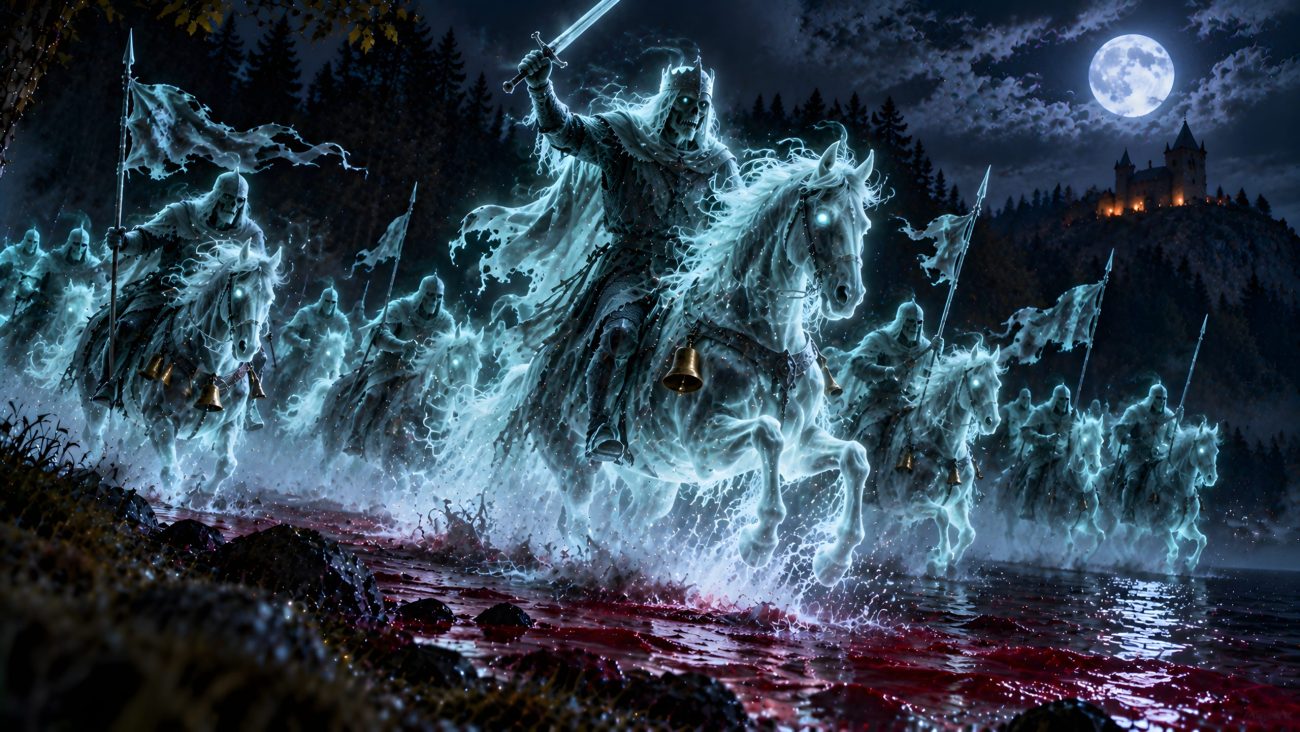
Their retreat led to a vicious battle beside a stream near Egelsee. The Wildenburg warriors were fiercely attacked, and many were thrown into the nearby lake. So much blood flowed into the stream that its waters turned red, earning it the name of the Red Stream. The battle ended in terrible slaughter, leaving many of the Wildenburg knight’s men dead in the surrounding wilderness.

Afterward, the area around Egelsee became haunted by strange and frightening sounds heard during the night. Ghostly warriors mounted on wild horses were seen riding through the air, accompanied by the dreadful noise of cowbells. These spectral riders were believed to be the fallen men of Wildenburg, returning as restless spirits to reenact their violent fate. Their phantom battle preserved the memory of the bloody conflict, haunting the lake and its surroundings long after the warriors had perished.


Sources

“Die Geisterschlacht.” SAGEN.at – Traditionelle Sagen aus der Schweiz (Zug). Reproduced by SAGEN.at. https://www.sagen.at/texte/sagen/schweiz/zug/geisterschlacht.html
Lake Urdensee Ghost

Tradition: Swiss Mythology
Alternative Names: Lake Urden
Category: Ghost


The Myth

In a narrow, rugged valley descending from the Rothorn toward the Plessur River in Graubünden, Switzerland, lies Lake Urdensee. The lake was not always there. Once, the place was occupied by a beautiful alpine meadow surrounding a dairy hut, where a herdsman lived with his large red cow. The herdsman was wicked and refused to offer refreshments to poor travelers who passed through his pasture. One day, an elderly woman arrived after a long journey, exhausted and desperately thirsty. She begged him for a little milk, explaining that her knees were failing and her tongue burned with thirst. The herdsman insulted her and slammed the door in her face.

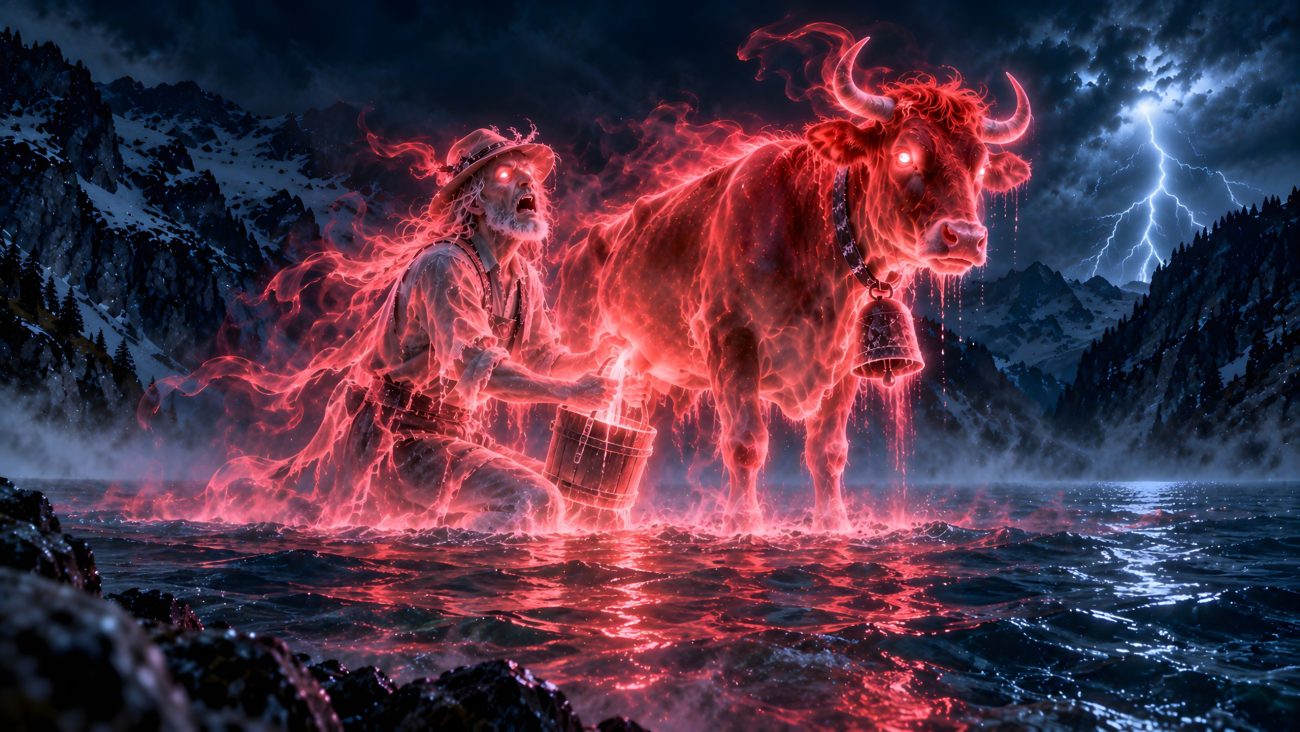
When he found the old woman still sitting outside, the herdsman mockingly promised to give her milk so that she could quench her thirst. He milked his red cow and handed her a drink, but secretly he had mixed rennet into the milk. The woman drank gratefully and blessed him, unaware of his cruelty. She had barely continued along the path when terrible pains seized her body. As she collapsed, dying, she cursed the herdsman and his alpine pasture. At that moment, thunder roared across the mountains and lightning struck the dairy hut. The hut, the herdsman, and the red cow sank into the earth, while water surged up to form a lake in their place.

The lake still bears signs of the vanished alpine pasture. The old path leading to the hut can supposedly be seen disappearing beneath the water and reappearing on the opposite shore, where it continues over the mountains toward Obervaz. A dark spot in the middle of the lake marks the place where the dairy hut sank. Once every seven years, during terrible thunderstorms, the cursed herdsman rises from the lake with his red cow. Above the storm-tossed waves, he milks the cow before sinking back beneath the water with a dreadful howl, wringing his hands in despair. Thus, the legend explains the origin of Lake Urdensee and preserves the memory of the herdsman’s cruelty toward a helpless traveler.


Sources

“Der Urdensee.” In Theodor Vernaleken, Kinder- und Hausmärchen in den Alpenländern. Vienna, 1863. Reproduced by SAGEN.at. https://www.sagen.at/texte/sagen/vernaleken/urdensee.html


Elegant Milanese Woman

Tradition: Swiss Mythology
Alternative Names: The Beautiful Milanese Woman
Category: Ghost


The Myth

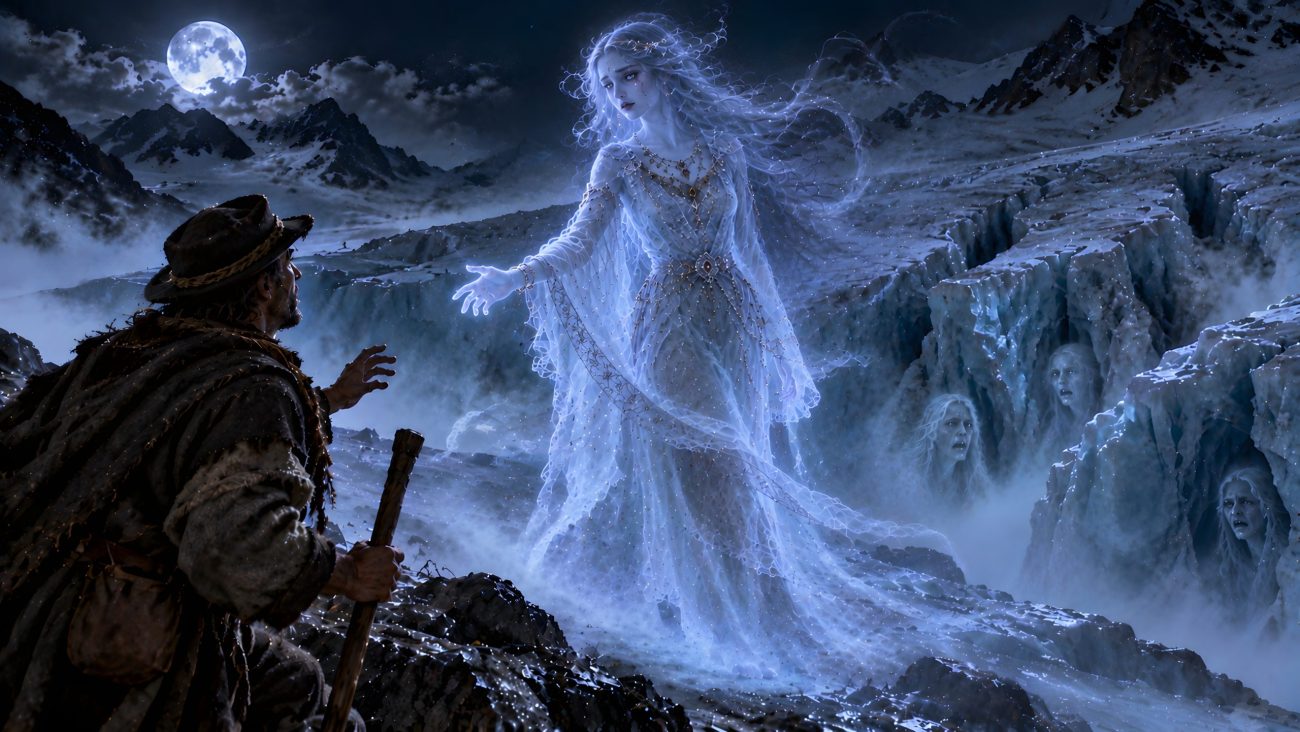
In the mountains of Valais, the dead are said to wander among the peaks, while the distant sound of a death drum echoes across the valleys. The mighty Aletsch Glacier is considered especially eerie, and a pious priest once claimed to have seen countless heads of suffering souls emerging from its crevasses. It was in this desolate mountain wilderness, near the Törbjeralp and the Grimsel Pass, that a solitary shepherd encountered a mysterious woman while searching for a lost cow. Beneath a gloomy sky, amid jagged rocks and deep glacier crevasses, he saw a beautiful young woman walking slowly toward the ice. She moved with noble grace despite being barefoot and bareheaded in the cold, rainy weather. Her long black hair shone with a bluish sheen, and she wore a necklace of gold and precious stones, golden bracelets, a jeweled belt, and diamonds on her small hands. Her face was pale and streaked with tears, and heavy sighs escaped her lips.

The shepherd approached her, astonished that someone so elegantly dressed could be wandering alone through such a dangerous place. He asked whether she had lost her way or been separated from her servants and horses. The woman answered that she was neither lost nor accompanied by anyone. She had come from a great city and a magnificent palace, and her body still lay warm upon its deathbed in Milan, where her grieving parents mourned their only daughter. God had condemned her to atone upon the glacier for the pampered life she had led. In life, she had rarely touched the bare ground, always traveled by carriage, and been sheltered from rain, cold winds, and physical hardship. She had denied herself no pleasure and avoided every exertion. Now, after death, she was forced to walk barefoot through the freezing wilderness, enduring the harsh weather as penance for her former luxury.

As the woman spoke, a thick black fog rolled over the glacier, and her graceful figure disappeared. When the mist lifted moments later, she was nowhere to be seen. The shepherd suddenly realized that he might have been given an opportunity to help redeem her soul, but he had failed to offer his assistance while she was still before him. Desperate to learn how he could free her, he cried out into the mountains, asking the beautiful woman to tell him what he must do. Only the faint echo of his voice answered. The streams murmured, the glacier thundered and crashed, and pale, misty figures rose and fell among its crevasses. Deeply saddened, the shepherd returned home, but he repeatedly climbed back into the wilderness to search for her. Each time, he called out asking whether he could release her from her punishment. Black mists swept across the ice, strange shapes appeared in the crevasses, and the glacier roared, yet the elegant Milanese woman never appeared again.


Sources

“Die Mailänderin.” SAGEN.at – Traditionelle Sagen aus der Schweiz. Reproduced by SAGEN.at. https://www.sagen.at/texte/sagen/schweiz/allgemein/mailaenderin.html


Zofingen Ghost

Tradition: Swiss Mythology
Alternative Names: The Gold Coals
Category: Ghost


The Myth

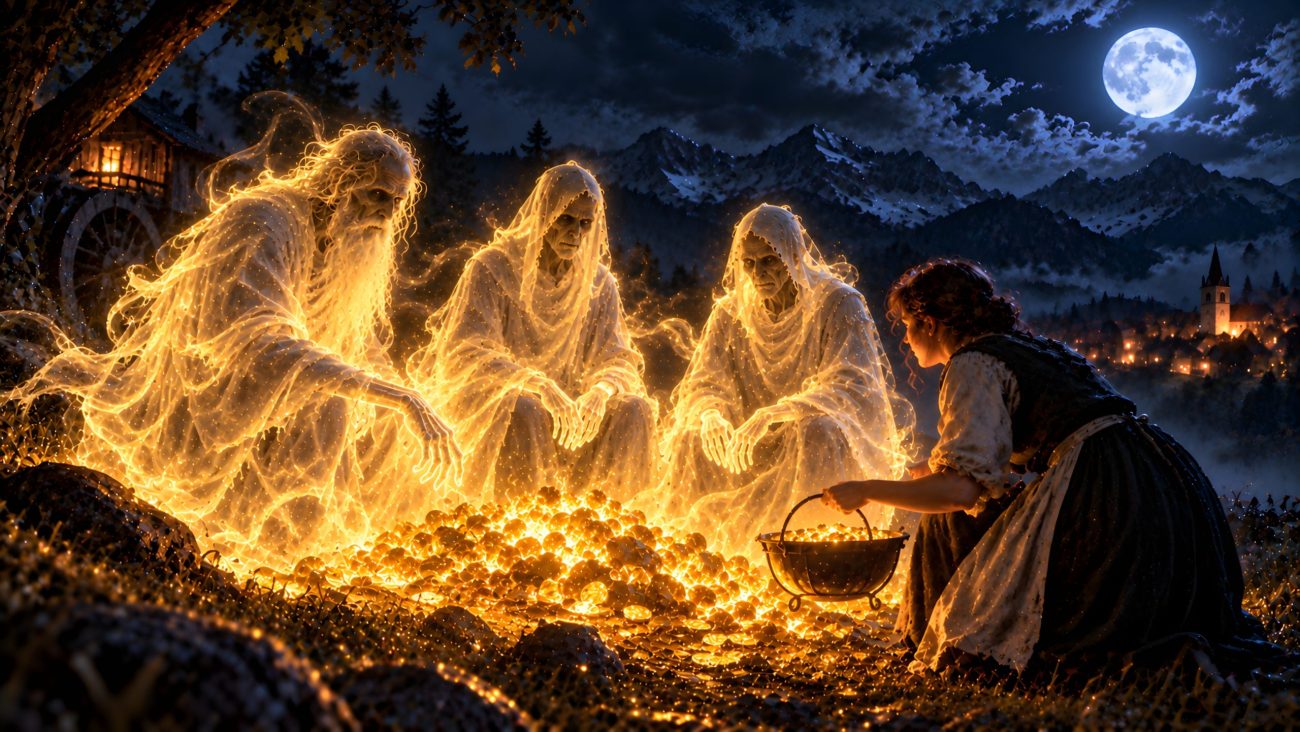
Near the small town of Zofingen in the Swiss canton of Aargau, a young maid named Kathrine served an old miller whose elderly aunt had recently died. One night, while preparing to rise early and make breakfast for her master, Kathrine awoke beneath the light of the full moon, mistaking its glow for dawn. Unable to light the kitchen fire because the tinder was damp, she looked outside and noticed a small fire burning on the meadow near the house. Hoping to find glowing embers for the hearth, she took a brazier and hurried out into the night. There she discovered three men wrapped in white cloths, sitting silently around the fire. Believing them to be travelers, she politely asked permission to take some coals. The men remained silent, staring into the embers, so she gathered a few and returned to the kitchen. Yet when she poured them onto the hearth, they had already gone out.

Thinking the coals might not have been hot enough, Kathrine returned to the strange men and collected another brazier full of embers. Again, the coals extinguished as soon as she brought them inside. Uneasy but still determined to prepare breakfast, she ventured out a third time. The three figures remained motionless, ignoring her greetings and questions. As she gathered the hottest coals, the eldest man finally raised his head. His face was deathly pale and sullen, and he warned her in a deep voice never to return. Terrified, Kathrine rushed back into the house with the brazier. Once more, the coals went out as soon as they touched the hearth. When she looked through the kitchen window, the nearby village clock struck midnight. A tremendous crash sounded around the house, and the mysterious fire and its three silent companions vanished without a trace. Kathrine realized that the moon was setting behind the wooded hills and fled to her bed, where she eventually fell asleep from exhaustion and fear.

The next morning, the miller came downstairs expecting his breakfast but found neither food nor Kathrine. When he inspected the kitchen hearth, he was astonished to discover it filled with glittering gold ducats arranged in three heaps. The mysterious coals had transformed into a treasure far greater than the inheritance he expected from his deceased aunt. Kathrine awoke late and hurried downstairs, where she explained her encounter with the three pale figures and their strange fire. The household listened in fearful amazement, realizing that the silent men had been supernatural visitors who had bestowed the treasure upon her. The miller honestly gave Kathrine the gold, and she became a wealthy woman who lived comfortably for the rest of her life.


Sources

“Die verschneite Alp.” SAGEN.at – Traditionelle Sagen aus der Schweiz. Reproduced by SAGEN.at. https://www.sagen.at/texte/sagen/schweiz/allgemein/verschneite_alp.html


Ghost of Neuheim

Tradition: Swiss Mythology
Alternative Names: The Lost Nunnery of Neuheim
Category: Ghost


The Myth

Long ago, a convent stood in Neuheim, in the Swiss canton of Zug, below the local church in a place known as the Unterhaus-Matte, or Lower House Meadow. The nunnery has long since disappeared, leaving no visible trace of its former existence. Yet the ground where it once stood remained strangely barren: despite repeated efforts and careful cultivation, nothing could be made to grow there. The abandoned site acquired an eerie reputation, as wandering lights were frequently seen flickering across it at night.

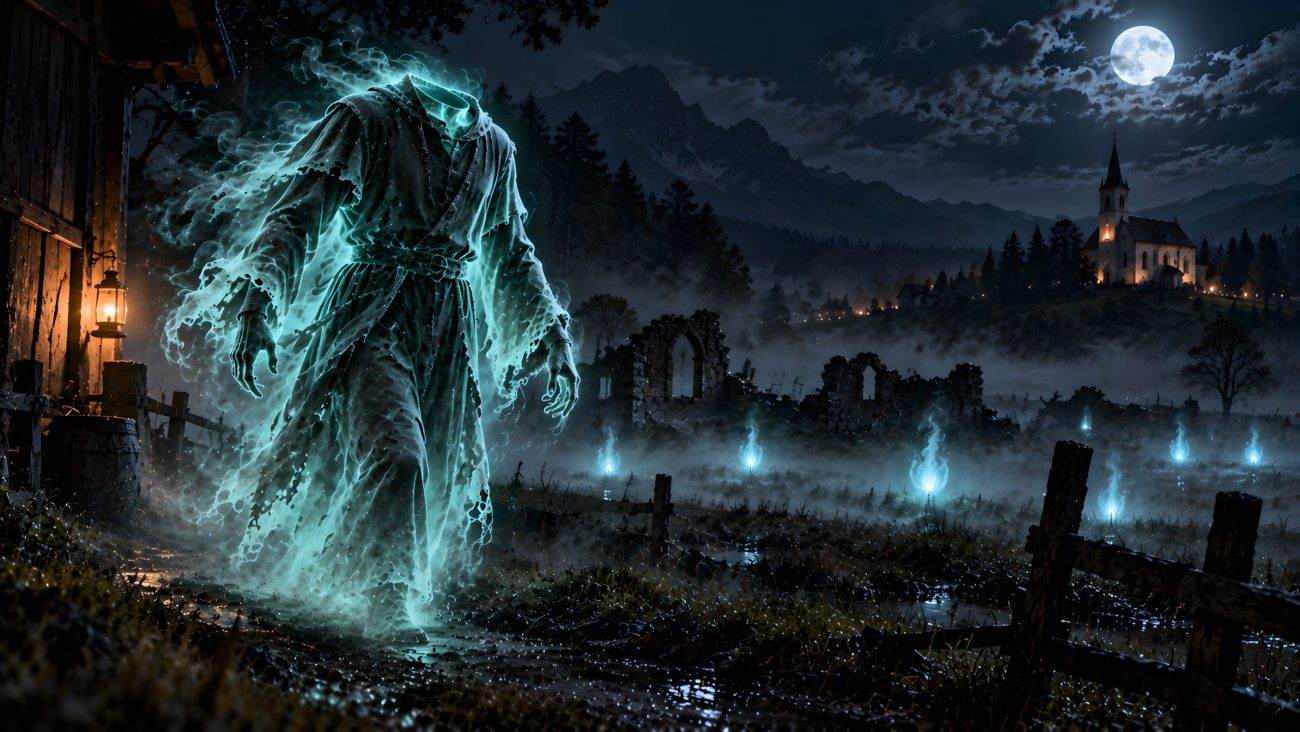
The supernatural disturbances were not limited to the former convent grounds. Near a nearby barn, a night watchman was reportedly confronted by a horrifying apparition: a headless man walking silently through the darkness. The legend offers no explanation for the identity of the figure or its connection to the vanished nunnery, leaving the barren meadow, wandering lights, and headless apparition as mysterious remnants of Neuheim’s haunted past.


Sources

“Das Kloster Neuheim.” SAGEN.at – Traditionelle Sagen aus der Schweiz (Zug). Reproduced by SAGEN.at. https://www.sagen.at/texte/sagen/schweiz/zug/kloster_neuheim.html


Beautiful Anneli of Berchtwil

Tradition: Swiss Mythology
Alternative Names: Schön-Anneli of Berchtwil, Anneli von Berchtwil
Category: Ghost


The Myth

Anneli von Berchtwil was a young woman of extraordinary beauty who lived near the Reuss River in the Swiss canton of Zug. The Baron of Rüßegg became consumed by desire for her after seeing her during his travels along the river. He showered her with courtship, promises, and enticements, but Anneli refused to return his affection. Unable to accept her rejection, the baron continued to long for her, determined to make her his own.

One day, while Anneli was gathering hazelnuts along the banks of the Reuss, the baron’s men ambushed her. A fisherman waited nearby with a large boat beneath the overhanging branches, ready to help the warriors seize their intended prize. Anneli fought desperately against her captors, but the strong men eventually forced her to her knees. Trapped and terrified, she saw no way to escape their grasp except through death. Near Meisterschwil, she leaped from the boat into the swollen waters of the Reuss and disappeared beneath the waves. The Baron of Rüßegg waited in vain for her return, while his men and the fisherman came back to the castle empty-handed. The river spirits never returned Anneli’s lifeless body.

After her death, fishermen at the place where she had vanished sometimes saw a pale female figure hovering above the waters of the Reuss. The ghost cried out desperately for help, as though still seeking rescue from her terrible fate. From the dense thickets along the riverbank came answering whimpers and groans. According to the legend, the lustful Baron of Rüßegg and his accomplices were imprisoned among these thickets, where they were forced to atone for the crime that had driven beautiful Anneli to her death. Thus, the river became the setting for the restless apparition of the maiden and the supernatural punishment of those who had persecuted her.


Sources

“Berchtwil.” SAGEN.at – Traditionelle Sagen aus der Schweiz (Zug). Reproduced by SAGEN.at. https://www.sagen.at/texte/sagen/schweiz/zug/berchtwil.html


Snowed Woman

Tradition: Swiss Mythology
Alternative Names: The Snow-Covered Woman, The Cursed Mountain of Frau
Category: Ghost


The Myth

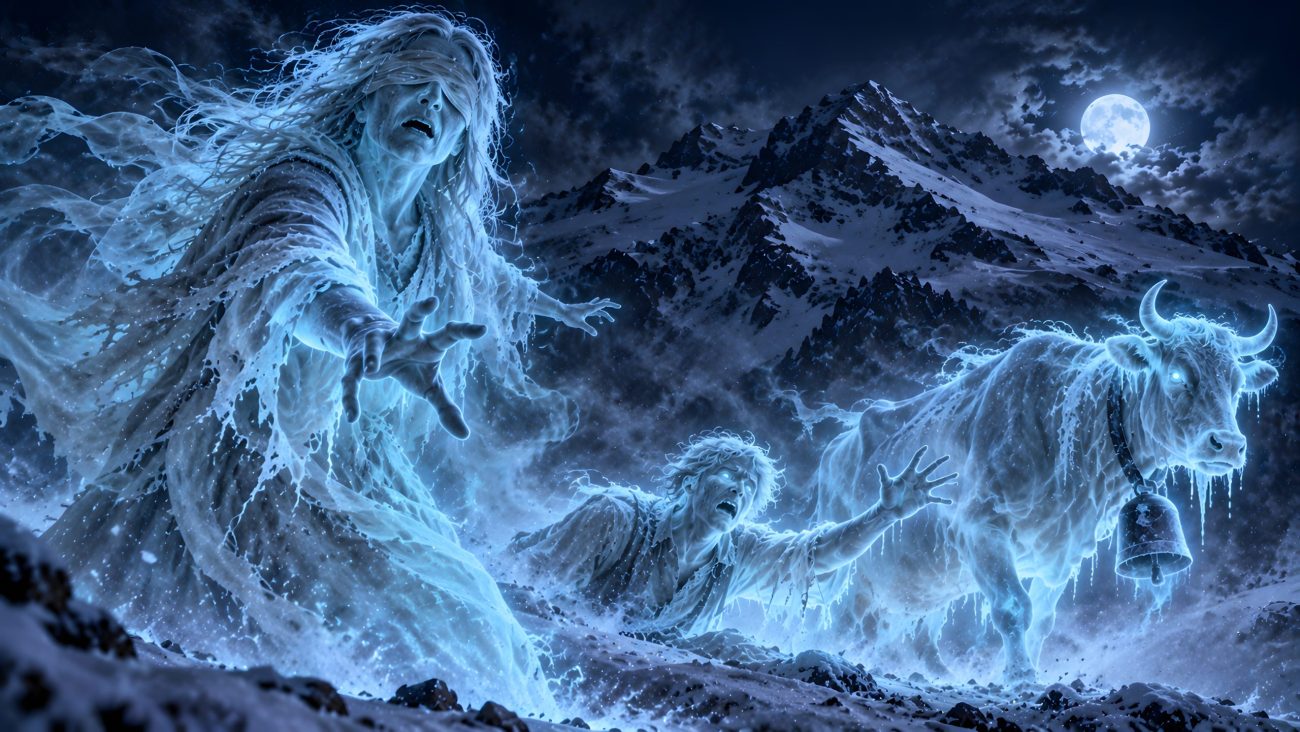
The Snowed Woman is a legendary mountain in the Frutigen valley of the Bernese Oberland, Switzerland, whose peaks rise more than 11,000 feet and remain covered in eternal snow. According to local tradition, the mountain was once a lush alpine pasture filled with excellent grasses and herbs, including a plant known as Mutern, described as resembling carrot tops. The vegetation was so abundant that the cattle grazing there had to be milked three times a day. The mountain belonged to a blind woman who, every spring, brought her son, servants, and herd of cattle up to the high pasture.

The woman’s son lived a life of excess and engaged in a forbidden relationship with a maiden. He ignored his mother’s warnings and treated her cruelly, despite her blindness. Grieved and angered by her son’s behavior, the mother finally pronounced a curse: the mountain would be covered in ice, and both her son and the finest cow in the herd would be banished there forever. Her curse came to pass, transforming the fertile pasture into a frozen, desolate mountain. The son and the cow were condemned to remain there, and their presence can still be sensed through the cow’s bellowing and the son’s mournful cries, which are said to echo across the mountain.

The curse can supposedly be broken if someone manages to milk the cow on Good Friday before sunrise. If the task is completed in time, the mountain will regain its former beauty and fertility. However, no one has ever succeeded, because the sun invariably rises before the milking is finished. Those who attempt the dangerous task and fail are said to fall victim to a monster. The legend thus explains the mountain’s perpetual snow as the consequence of a mother’s curse and preserves the hope that its lost alpine abundance might one day be restored.


Sources

“Die beschneite Frau.” SAGEN.at – Sagen aus Vernaleken. Reproduced by SAGEN.at. https://www.sagen.at/texte/sagen/vernaleken/beschneite_frau.html


Priest’s Cellar Woman

Tradition: Swiss Mythology
Alternative Names: Pfaffenkellerin, The Priest’s Cellar Woman of Zug
Category: Ghost


The Myth

The Priest’s Cellar Woman, known in German as the Pfaffenkellerin, is a restless female spirit said to haunt parts of central Switzerland, particularly the Lucerne region, the canton of Schwyz, and the canton of Zug. During her lifetime, she was believed to have served as the housekeeper of a clergyman. When an illegitimate child was born in the parish, she was chosen to be its godmother. However, the housekeeper was extremely vain and spent so long attending to her appearance and arranging her hair that she arrived too late for the baptism. The child consequently died without being baptized. Soon afterward, the housekeeper herself died suddenly and unexpectedly.

Her death did not bring her peace. Condemned to wander through pitch-black nights, she became a miserable, moaning apparition whose uncombed hair fluttered wildly in the wind. Her lamentations could be heard in lonely places after dark, and her appearance was regarded as a frightening reminder of the consequences of vanity and neglecting one’s religious duties.

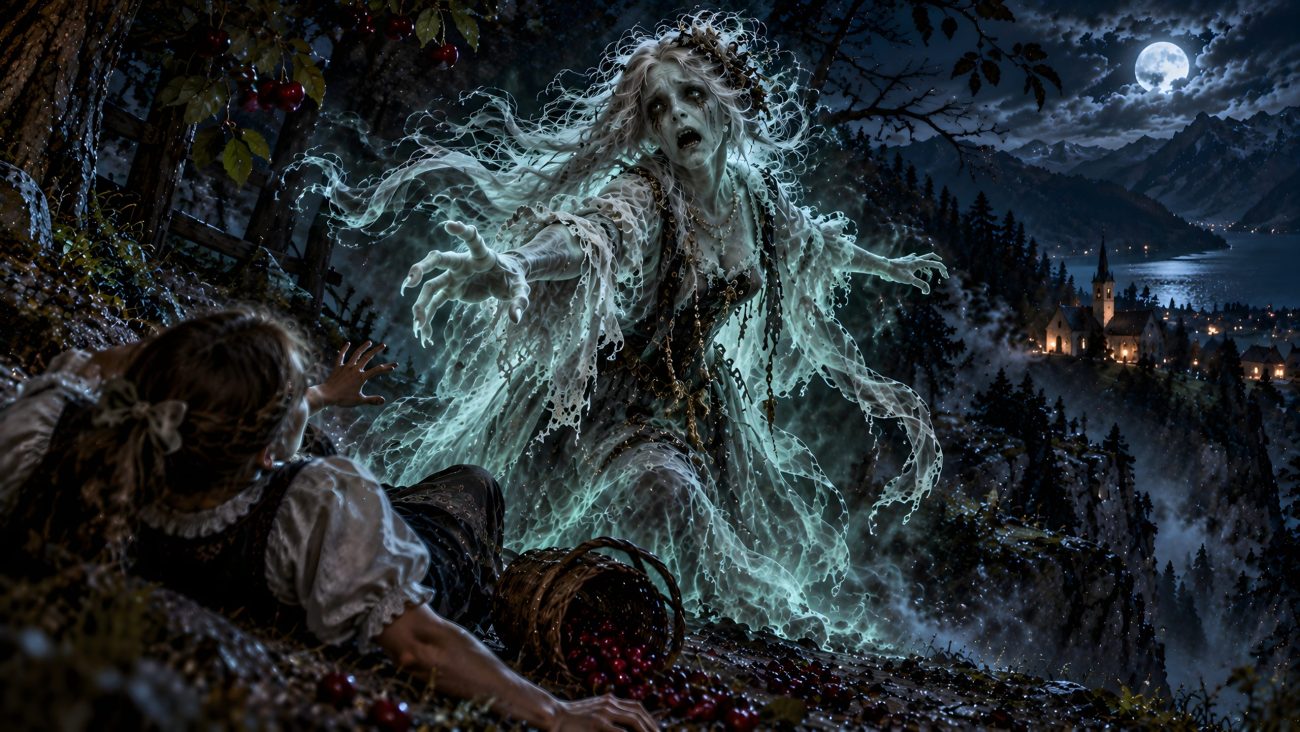
The Priest’s Cellar Woman was especially feared around Roßweidli on the Zugerberg. Three hardworking young women from Walchwil regularly helped local farmers with difficult agricultural tasks and were well liked for their strength and willingness to work. One Saturday evening, they were gathering cherries at Roßweidli. As darkness approached, two of the women decided to return home, but the eldest remained behind, determined to fill her basket with more fruit. Despite warnings that the Pfaffenkellerin wandered the area at night, she continued picking cherries alone.

A short time later, a terrified cry rang out, and the young woman rushed into the farmhouse. Her face was deathly pale, and she trembled so violently that she could scarcely speak. When she finally recovered enough to explain what had happened, she described how the dreadful Priest’s Cellar Woman had suddenly appeared and tried with all her strength to drag her down into a nearby ravine. The encounter confirmed the danger of remaining outdoors after dark in places haunted by the restless spirit.


Sources

“Die Pfaffenkellnerin.” SAGEN.at – Zuger Sagen. Reproduced by SAGEN.at. https://www.sagen.at/texte/sagen/schweiz/zug/pfaffenkellnerin.html


Krummau Monk

Tradition: Czech Mythology
Alternative Names: The Head That Sought Confession
Category: Ghost


The Myth

A monk from the monastery in Krummau once set out on a pilgrimage to the Virgin Mary at Gojau. He intended to arrive at the Church of Our Lady and confess something that troubled his conscience. Before nightfall, however, he had to pass through a dangerous forest known for its robbers. As he made his way along the path, a band of robbers suddenly sprang from the thicket and attacked him. One of them struck him so fiercely with a sword that his head was severed from his neck.

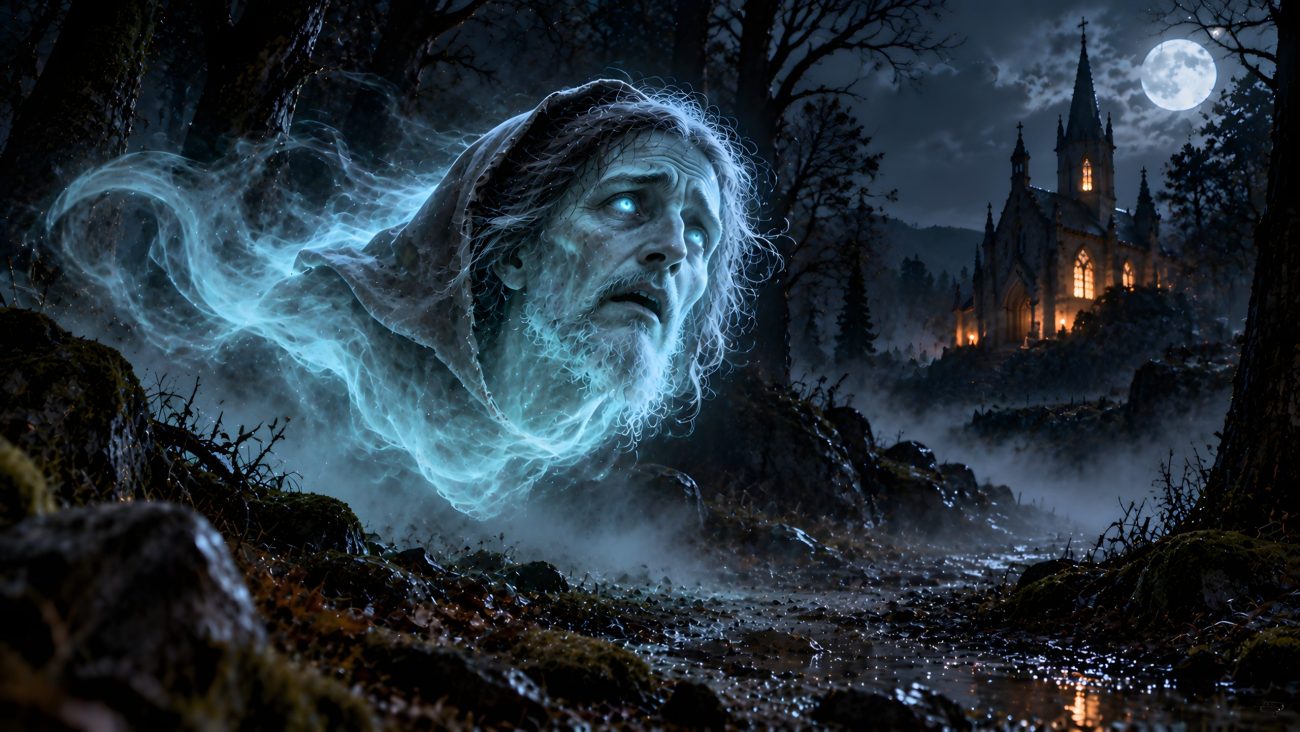
Although the monk’s body lay dead, his bloody head continued to live. It rolled along the forest paths, tumbling both uphill and downhill, and even floated through streams. Wherever it went, it uttered the same desperate plea: “Confess! Confess!” Unable to find peace, the severed head continued its strange pilgrimage toward the holy church.

At last, the head reached the Church of Our Lady in Gojau. There, a priest heard its confession and granted absolution. Only after the monk’s sins had been forgiven did the bloody head finally die, ending its terrible journey. The legend tells of a soul so burdened by its conscience that even death could not prevent it from seeking forgiveness.


Sources

Watzlik, Hans. “Die wilde Wallfahrt.” In Böhmerwald-Sagen. Budweis: Böhmerwalder Dorfbücher, 1921, Heft 5. Reproduced by SAGEN.at. https://www.sagen.at/texte/sagen/tschechien/watzlik/wildewallfahrt.html


Sträggeln and the Wild Türst

Tradition: Swiss Mythology
Alternative Names: Sträggeln, Türst
Category: Ghost


The Myth

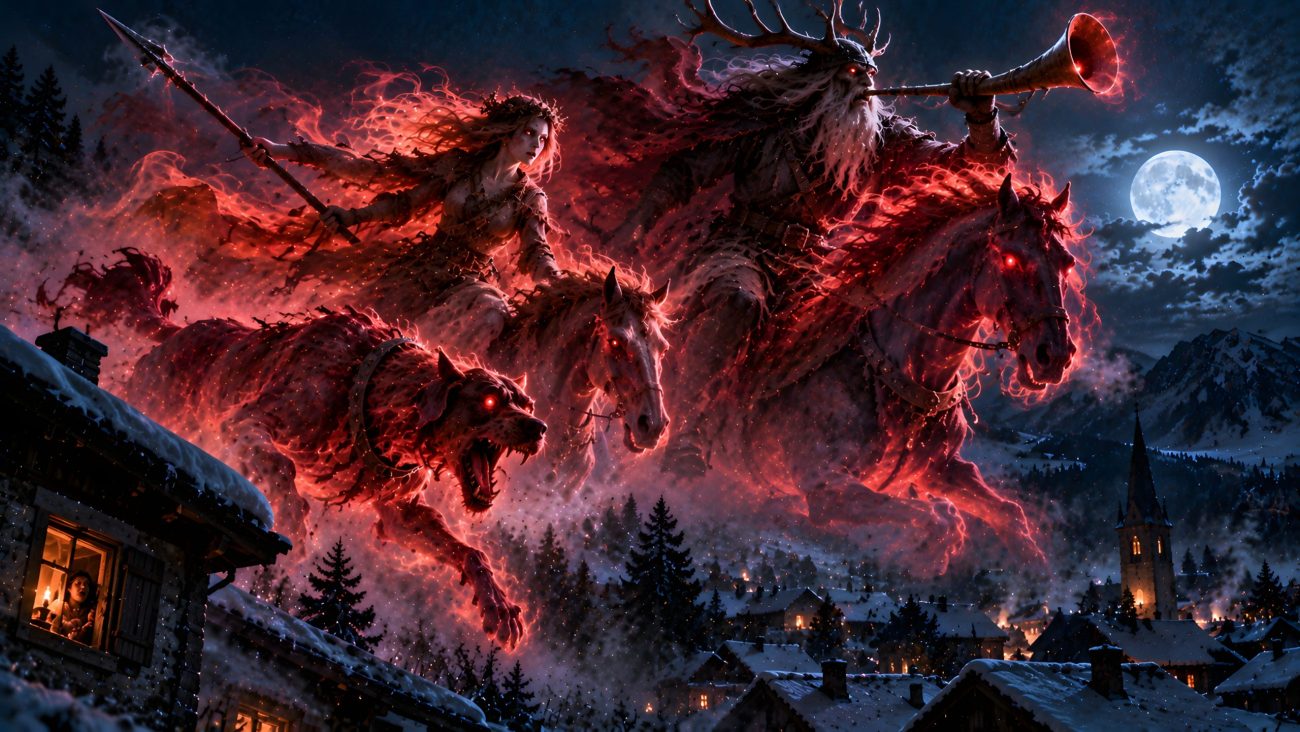
Sträggeln was a beautiful and wealthy maiden from Entlebuch in the Lucerne hinterland, but her wild and unruly ways made her unpopular among the people. Rather than tending to the household or attending church, she spent her days hunting in the mountain forests with her spear, horn, bow, and barking hound. She pursued stags and wolves with such enthusiasm that the animals fled before her, and she showed no respect for Sunday rest or religious observances. The people warned that her behavior would bring misfortune upon her, fearing that the devil would eventually claim her when he rode through the land in the storm winds.

On Christmas Eve, a slender young knight arrived at her family home and asked for lodging. He declared that he wished to join Sträggeln on a hunt the following morning, and the maiden was delighted to find such a handsome companion who shared her passion. Yet the stranger refused to reveal where he came from. When Christmas morning arrived and the church bells summoned the people to celebrate the holy day, the knight urged Sträggeln to ignore them and go hunting instead. Laughing, the pair rode into the forest with their weapons and her great hound, while the churchgoers watched them pass with apprehension.

Deep in the mountain woods, Sträggeln raised her spear to strike a doe and her fawns. The knight seized her arm and revealed his true identity: he was the wild Türst, a fearsome supernatural hunter who had come to claim her as his prey. He declared that because she had ignored her conscience and sinned against God, she would become like him and terrorize humankind. The knight grew into a towering giant, rising above the fir trees, while Sträggeln and her hound also grew into monstrous figures. An invisible force compelled the maiden to follow Türst as he charged across hills and valleys, with the enormous hound barking at his heels. Their passage swept through the land like a whirlwind, terrifying the wild animals and the people who witnessed them.

At the first crowing of the cock, the giant figures rushed toward Gadenmatt, where a flaming abyss opened and swallowed them without a trace. Sträggeln never returned home, and people came to believe that Türst had taken her into his Wild Hunt, condemning her to ride with him through the night until Judgment Day. Long afterward, on clear winter nights when fierce winds howled around houses, people claimed to see the gigantic hunter, the cursed maiden, and their monstrous hound charging over the rooftops. Whenever church bells rang, Sträggeln’s mournful cries could be heard, while Türst blew his horn ever more wildly. Terrified by the spectacle, those who heard them hid beneath their bedcovers.


Sources

“Der Türst.” SAGEN.at – Traditionelle Sagen aus der Schweiz. Reproduced by SAGEN.at. https://www.sagen.at/texte/sagen/schweiz/allgemein/tuerst.html