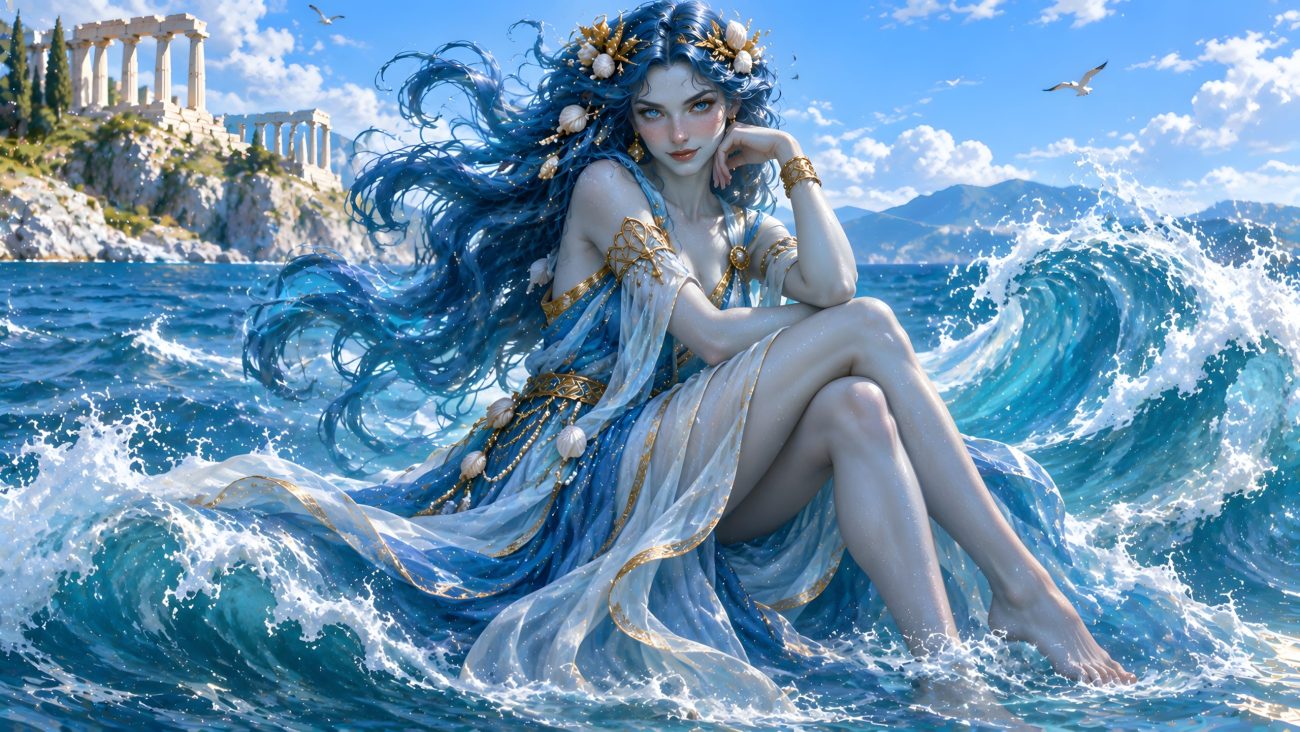
Tradition: Greek mythology
Alternative Names: Oceanides, Ōkeanídes (Ὠκεανίδες); singular: Oceanid, Ōkeanís (Ὠκεανίς)
Category: Nymph
The Myth
The Oceanids were three thousand nymphs in Greek mythology, the daughters of the Titans Oceanus and Tethys. Their number was understood to mean that they were innumerable. Their father was the great primordial river that encircled the world, while their mother was a sea goddess. Their brothers, also numbering three thousand, were river gods who personified the world’s great rivers.
The Oceanids were primarily associated with water, particularly springs and freshwater sources. According to Hesiod, they were scattered throughout the world, serving both the earth and the deep waters. In the Argonautica of Apollonius of Rhodes, the Argonauts became stranded in the Libyan desert and prayed to the sacred nymphs of Oceanus to reveal a spring or a stream emerging from the earth.
The Oceanids were not restricted to a single role, however, and some had little apparent connection to water. Certain Oceanids became important goddesses in their own right. Metis, the personification of intelligence and wisdom, was Zeus’s first wife and the mother of Athena. Zeus swallowed Metis while she was pregnant, after which Athena emerged from his head. Doris, another Oceanid, was an important sea goddess and became the wife of Nereus and mother of the fifty Nereids. Styx, described by Hesiod as the eldest and most important Oceanid, personified the underworld river of the same name.
Other Oceanids became wives or lovers of gods and Titans, establishing important divine lineages. Eurynome, one of Zeus’s wives, became the mother of the Charites, or Graces. Clymene married the Titan Iapetus and bore Atlas, Menoetius, Prometheus and Epimetheus. Electra became the wife of the sea god Thaumas and the mother of Iris and the Harpies. Perseis married the sun god Helios and became the mother of Circe and Aeetes, the king of Colchis. Idyia married Aeetes and became the mother of Medea, while Callirhoe married Chrysaor and became the mother of Geryon. Other Oceanids, including Europa and Asia, were associated with geographical regions rather than bodies of water.
The Oceanids also had an important role in protecting and watching over the young. Hesiod describes them as a sacred company of daughters appointed by Zeus to care for youths alongside Apollo and the river gods. Their duties extended beyond the natural world, making them attendants and guardians within the divine order.
Sailors regularly honoured the Oceanids through prayers, libations and sacrifices, seeking their protection against storms and other dangers at sea. Before beginning their voyage to Colchis in search of the Golden Fleece, the Argonauts offered flour, honey and sea water to the ocean deities, sacrificed bulls and prayed for protection during their dangerous journey. The Oceanids were also described as companions of Persephone at the time of her abduction by Hades.
The Oceanids could serve particular goddesses as well. Artemis requested sixty Oceanids, each nine years old, to form her personal choir and serve as her attendants. They were expected to remain virgins and accompany the goddess in her service.
Through their many forms and responsibilities, the Oceanids represented far more than springs and streams. They were connected to the world’s waters, the care of the young, divine families, sacred places and the protection of travellers. Their vast number reflected their widespread presence throughout the mythological world.
Sources
Wikipedia contributors. (n.d.). Oceanids. In Wikipedia, from https://en.wikipedia.org/wiki/Oceanids