Tradition: Japanese Mythology
Alternative Names: 鼠の化物, Rat Monster, Mouse Monster
Category: Rat
The Myth
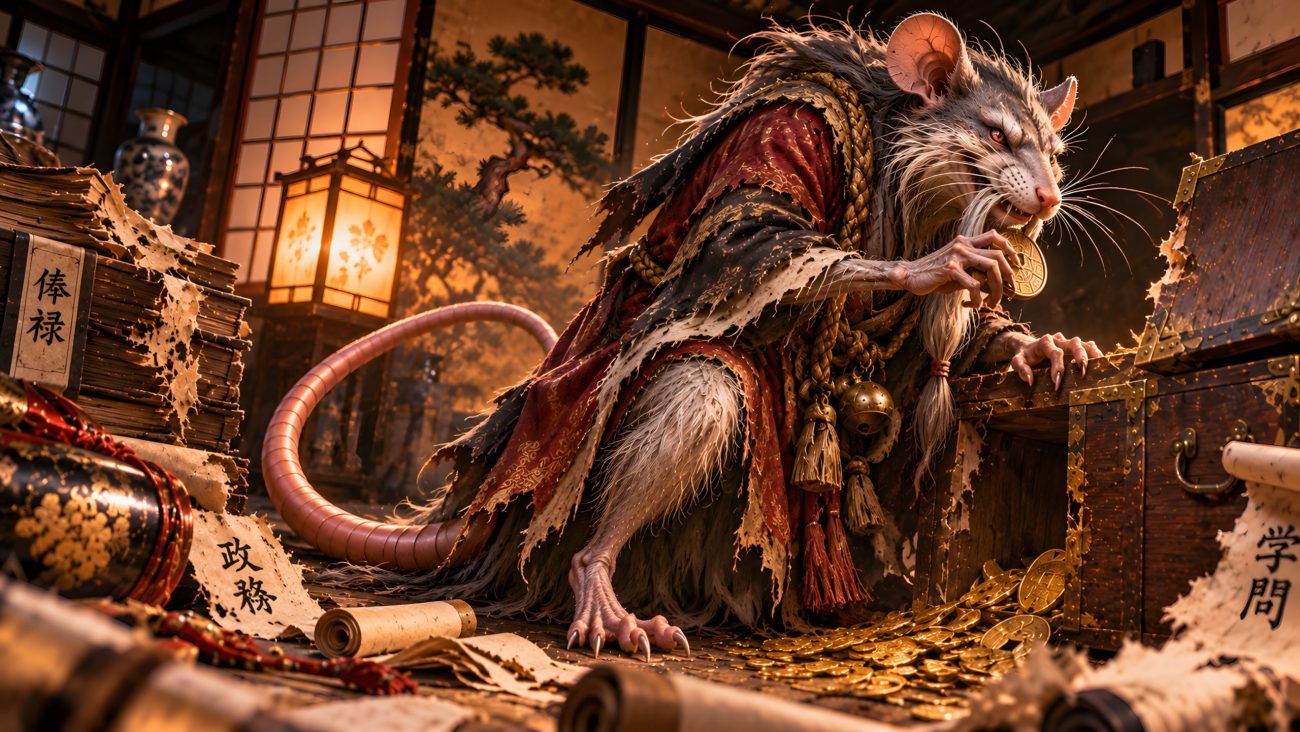
Nezumi no Bakemono is a satirical yokai described in Ōmachi Keigetsu’s Eiri Kunwa, published in 1916, in a section titled Hyakki Hirugyō. It is listed as the thirty-eighth of forty-one monsters and depicts a rat standing upright on two legs in a comical pose.
According to the account, an outbreak of plague led authorities to purchase rats for five sen each. Alarmed by this development, the rats transformed into monsters. Yet even after changing their forms, they retained their natural habits of gnawing and stealing. Their sharpness of tooth varied: those with poor teeth gnawed at their parents’ shins, while those with somewhat sharper teeth gnawed at their masters’ households.
The satire extends beyond ordinary theft. Some of these creatures gnaw away at government salaries and positions, the wealth and livelihoods of the people, and even learning, religion, and morality. However, they consume these things without understanding their true value. The author laments that the world has become overwhelmed by such monsters, using the rat’s habit of gnawing as a metaphor for people who exploit others, misuse their positions, or take only fragments of knowledge for personal gain.
Sources
“Nezumi-bakemono.” 新版TYZ 妖怪図鑑 (New TYZ Yokai Encyclopedia). https://tyz-yokai.blog.jp/archives/1077096665.html