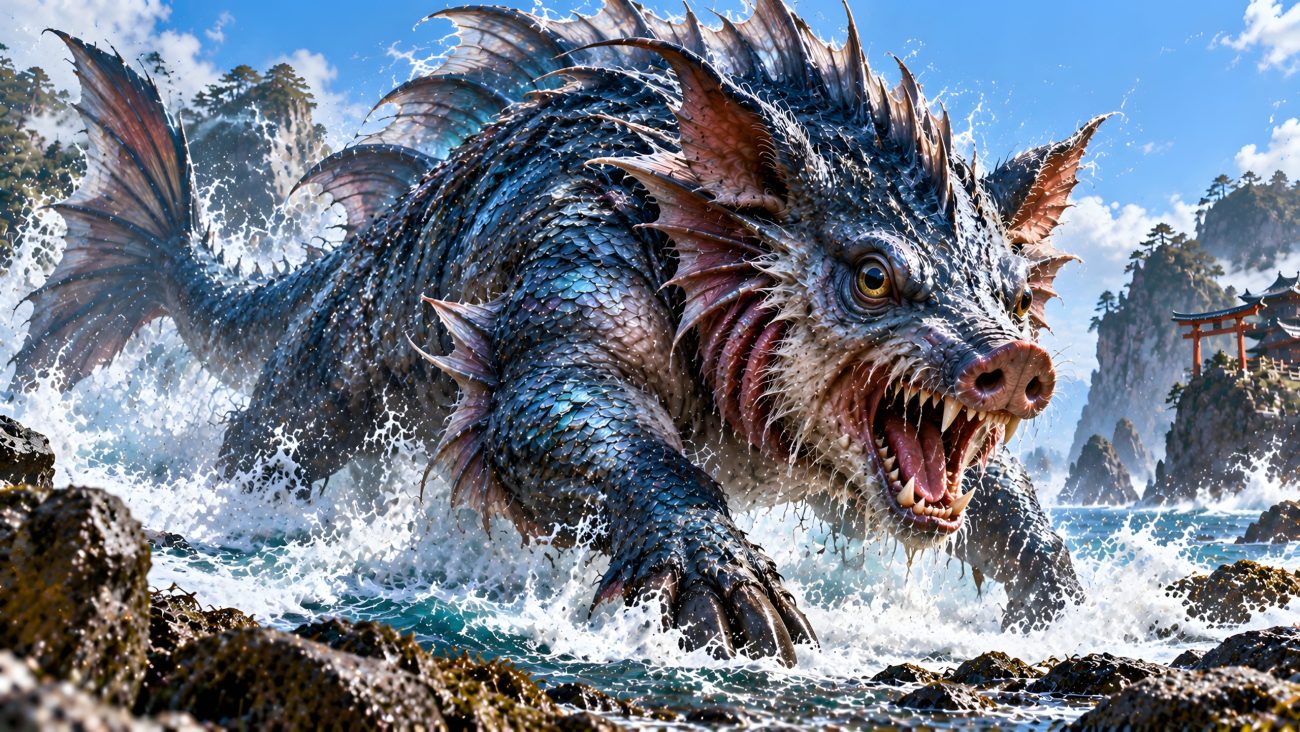
Tradition: Japanese Mythology
Alternative Names: 海の猪, Sea Boar, Wild Boar of the Sea
Category: Pig
The Myth
Umi no Inoshishi, meaning “Sea Boar,” appears in a traditional tale from Tanegashima, an island in southern Japan. According to the story, whales once lived on land while wild boars inhabited the sea. Both creatures struggled in their original environments, eventually prompting the gods of the mountains and the sea to arrange an exchange of habitats.
The whale originally roamed through fields and mountains in search of prey. Its enormous body knocked down trees and damaged embankments, causing floods. When it failed to catch even a rabbit, it became furious and stamped about violently. The mountain god, troubled by the destruction and feeling pity for the whale, consulted the sea god. The sea god proposed exchanging the habitats of the whale and the wild boar. At the time, the boar lived in the sea but struggled because it was a poor swimmer, and the sea god also felt sorry for it.
After moving onto land, the boar found that its familiar food was limited to small crabs called shiratagan i. Unable to satisfy its hunger, it begged the mountain god for better food. When the god learned that the boar had previously eaten erabu eels, a type of sea snake, he allowed it to eat a similar land animal: the venomous snake known as shirakuchi, or mamushi. The boar enjoyed this food so much that it began circling each snake seven times in excitement before eating it.
Meanwhile, the whale delighted in its new home in the sea, where it could swim freely and chase fish. However, its vigorous hunting disturbed the ocean, so the sea god forbade it from eating fish larger than squid and declared that breaking this rule would result in its being driven back onto land. The god told the whale that kibinago, a small fish, was its most suitable food. Still hungry, the whale sometimes disobeyed and ate larger fish. Whenever it did, a fearsome creature called the shachi attacked, cutting the whale’s body with deep, cross-shaped wounds. The whale fled toward the shore and became stranded on the beach or rocks, fulfilling the sea god’s punishment.
Sources
“Umi-inoshishi.” 新版TYZ 妖怪図鑑 (New TYZ Yokai Encyclopedia). https://tyz-yokai.blog.jp/archives/1073501646.html?utm_source=chatgpt.com