Tradition: Japanese Mythology
Alternative Names: 重い葛籠の化物, 重い葛籠の大入道, Omo Tsuzura no Bakemono, Monster of the Heavy Trunk, Giant of the Heavy Trunk
Category: Object
The Myth
The Monster of the Heavy Wicker Trunk appears in the Japanese folktale Shita-kiri Suzume, or The Tongue-Cut Sparrow. In the story, a kind old man befriends a sparrow, but the bird eats paste prepared by his wife. Enraged, the old woman cuts out the sparrow’s tongue, forcing it to flee. When the old man discovers what happened, he searches the mountains for the bird and eventually reaches the sparrows’ home, where he receives a warm welcome.
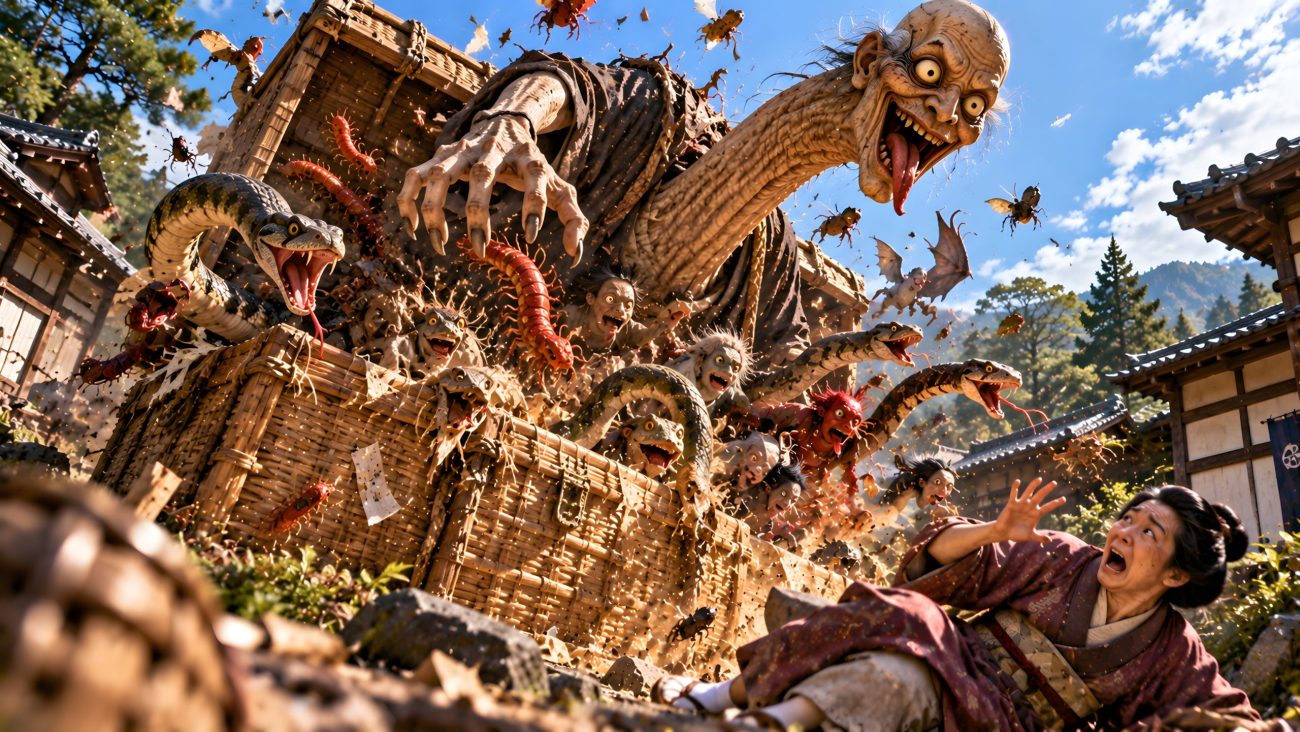
Before he leaves, the sparrows offer him a choice between two wicker trunks as a gift: a small, light trunk and a large, heavy one. The old man chooses the smaller trunk and returns home to discover that it contains gold, silver, and other treasures. His greedy wife then visits the sparrows, hoping to obtain an even greater reward. She insists on taking the heavy trunk, but when she opens it on the way home, a multitude of monsters, snakes, and poisonous insects burst out. Terrified, she collapses in fright. This is the basic form of the tale, which became widely popular during the Edo period through illustrated children’s books and other printed stories.
The scene of the greedy woman opening the heavy trunk and confronting the monsters became a popular subject in Japanese yokai art. Artists including Tsukioka Yoshitoshi depicted it in supernatural-themed print series such as One Hundred Tales of China and Japan and New Forms of Thirty-Six Ghosts. Yoshitoshi’s teacher, Utagawa Kuniyoshi, also created a painting titled The Tongue-Cut Sparrow. In a satirical illustrated version published by Utagawa Yoshimori in 1864, the monsters emerging from the trunk were used to represent the forces involved in the Kinmon Incident, a battle near Kyoto’s Hamaguri Gate. The creature also appears frequently in yokai-themed playing cards and sugoroku board games, where it is often represented by a giant monk-like figure with an exceptionally long neck.
Sources
“Omo-tsuzura-bakemono.” 新版TYZ 妖怪図鑑 (New TYZ Yokai Encyclopedia). https://tyz-yokai.blog.jp/archives/1010654282.html