Tradition: Māori Mythology, New Zealand Mythology
Alternative Names: —
Category: Goblin
The Myth
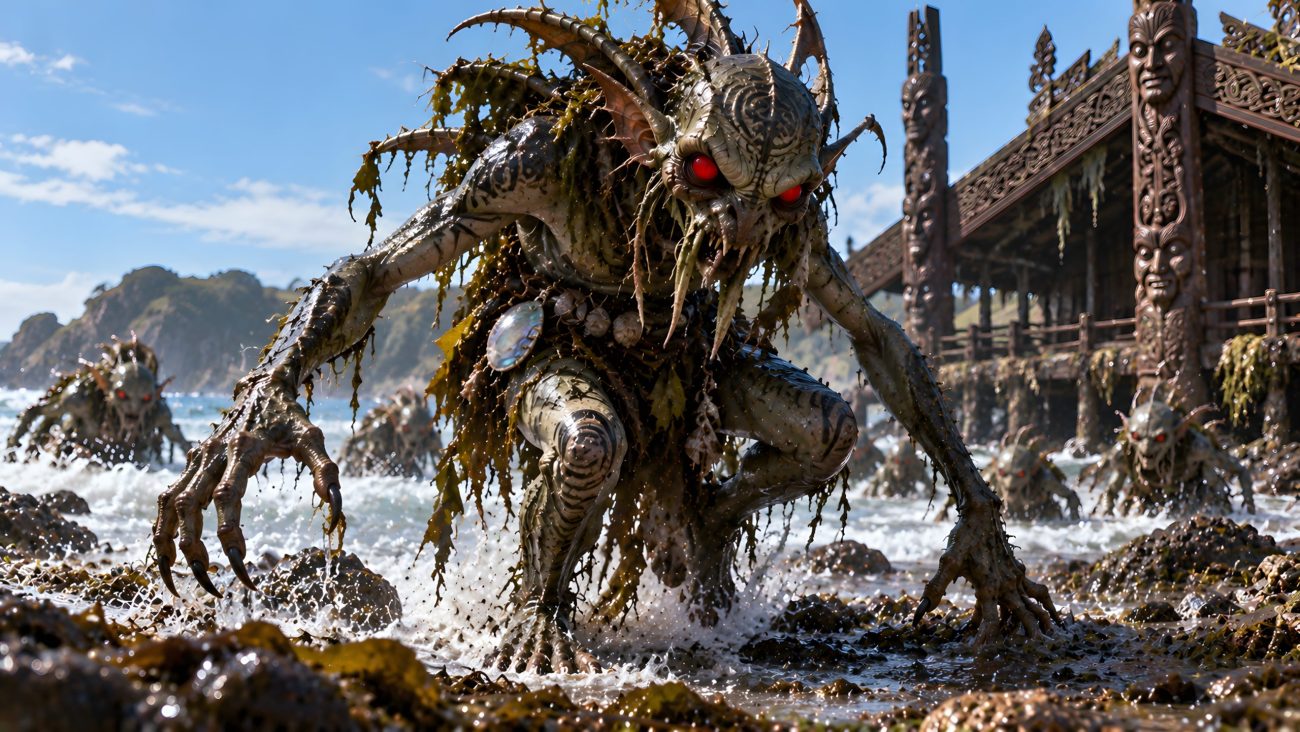
The Ponaturi are hostile, goblin-like creatures who dwell beneath the sea during the day and return to shore each evening to sleep in their house, Manawa-Tāne. They dread daylight, which is fatal to them. This weakness plays a central role in the stories of the Māori heroes Tāwhaki and Rātā, whose families suffer at the hands of these dangerous beings.
In the story of Tāwhaki, the Ponaturi kill his father, Hemā, and carry away his body. They also capture his mother, Urutonga, forcing her to serve as the doorkeeper of Manawa-Tāne. Seeking revenge, Tāwhaki and Urutonga block every opening in the house, making the Ponaturi believe that night still surrounds them. They then suddenly allow the sunlight to enter. Deceived by the false darkness, the creatures are caught by the fatal rays of the sun and destroyed.
The Ponaturi also appear in the story of Rātā, who seeks to recover his father’s bones after the creatures carry them away. The Ponaturi use the bones to keep time while practising their magical arts. Rātā hides himself, learns their incantations, and masters a more powerful spell called Titikura. He then attacks the creatures, kills their priests, and recovers the bones. The surviving Ponaturi regroup and pursue him, but Rātā and his warriors use their strength and powerful incantations to defeat them, killing a thousand of their number.
In another version of the Tāwhaki story, the grey mullet, known as the kanae, accompanies the Ponaturi when they emerge from the sea and enter Manawa-Tāne. Tāwhaki and his companion Karihi kill the creatures to avenge Hemā, but the mullet escapes by repeatedly leaping until it reaches the sea again.
A related tale concerns Ruapupuke, whose young son is drowned and taken by Tangaroa, the sea deity, to the bottom of the ocean. There, the child is transformed into a carved figure placed above the doorway of Tangaroa’s house. Ruapupuke descends into the sea to find him and encounters Hinematikotai, who explains that the inhabitants return at sunset and that daylight will kill them. Ruapupuke waits for their return before allowing the light to enter, destroying the inhabitants and burning their house. He takes some of its carvings back to the human world to serve as models for human carvers. Although this account does not explicitly call the inhabitants Ponaturi, it presents a similar pattern of sea-dwelling beings destroyed by exposure to daylight.
Sources
“Ponaturi.” Wikipedia: The Free Encyclopedia. Wikimedia Foundation. Accessed October 17, 2026. https://en.wikipedia.org/wiki/Ponaturi