Tradition: Navajo Mythology, American Mythology
Alternative Names: Yéʼiitsoh, Big Monster
Category: Giant
The Myth
Yeitso, whose name means “Big Monster,” was the largest, most powerful, and most feared of the Anaye, the hostile beings known as the “Alien Gods” in Navajo mythology. He was a terrifying giant whose immense size and supernatural abilities made him a formidable enemy of the Navajo people. According to different traditions, Yeitso was either the eldest son of the Sun God, Tsohanoai, or the offspring of a Navajo woman who, frustrated by unnatural practices, conceived a child with a stone. He lived near Tsoodzil, identified with Mount Taylor in New Mexico, and was regarded as the leader of the Anaye.
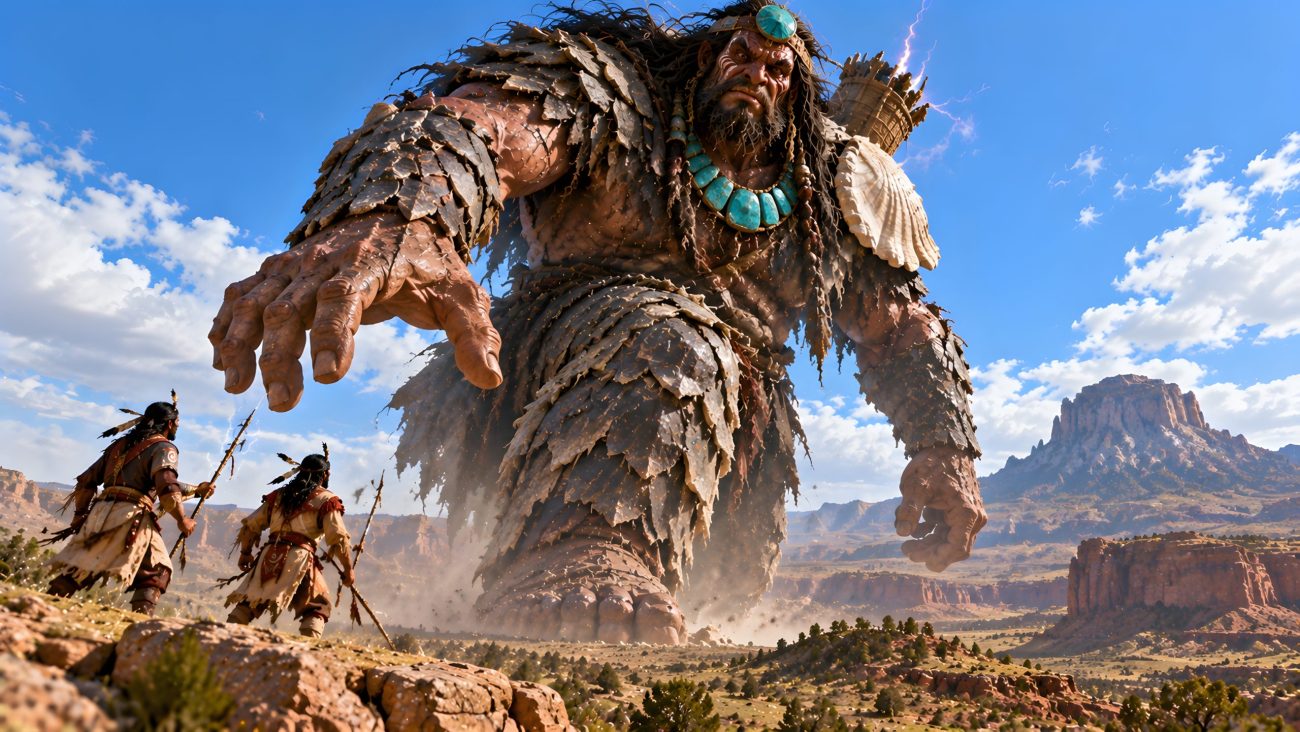
Yeitso’s enormous size was his most distinctive characteristic. His stride extended as far as an ordinary man could walk between sunrise and noon. His body was protected by overlapping scales of flint as sharp and hard as stone knives. He wore a perfect agate disc on his head, a perfect turquoise around his neck, and a perfect white shell over his shoulder. His face was marked with intimidating stripes, and he carried a basket that served as a quiver for his lightning bolts. Coyote acted as his messenger, connecting the monstrous giant with the wider world of supernatural beings.
When the hero twins Nayenezgani and To’badzistsini were still infants, Yeitso came close to discovering and devouring them. Their mothers, Yolkai’Estsan and Estsanatlehi, saved them through quick thinking. Yolkai’Estsan concealed the boys beneath piles of sticks while Estsanatlehi confronted the giant. When Yeitso noticed footprints and demanded to know whose they were, she courageously claimed they were her own. She explained that loneliness had driven her to make footprints so that she could pretend she had company. To convince him, she demonstrated how she had made the tiny prints with her hand. Fooled by her explanation, Yeitso left without discovering the children.
When the twins reached adulthood, they consulted their father, Tsohanoai, and set out to confront Yeitso at Tsoodzil. They heard the giant’s tremendous footsteps before seeing his head rise above an eastern hill. As he approached, his head and chest appeared above a southern hill, followed by his body above the waist over a western hill, before he finally came into view near Tsoodzil. Yeitso then descended to a lake and drank from it four times, visibly lowering the water level until the lake was almost dry. Only then did he notice the reflections of the two heroes in the water.
Delighted by the prospect of finding new prey, Yeitso called out to the twins and challenged them. The giant and the heroes exchanged taunts four times before Yeitso hurled four lightning bolts at them. Riding upon a rainbow, the twins evaded the attacks with ease. Their father, Tsohanoai, then struck Yeitso with lightning, and the twins followed with four bolts of chain lightning. The combined assault shattered the giant’s protective flint scales. Yeitso collapsed and attempted to rise, but fell forward onto his face and lay motionless.
After defeating the giant, the twins scalped him and threw his head toward the east, where it became Cabezon Peak in present-day New Mexico. Yeitso’s blood remained dangerous because, if it reached the other Anaye, it could revive him. Nayenezgani therefore used his knife to dig trenches that redirected the flowing blood and prevented it from reaching the other monsters. The resulting trenches were said to account for the ridges and cliffs of volcanic rock around Cabezon Peak. Yeitso’s shattered flint scales, meanwhile, became a valuable resource for the Navajo, who used the stone to make armor, knives, and arrowheads.
Yeitso’s death marked the defeat of one of the most formidable enemies faced by the Navajo hero twins. His enormous stature, flint armor, and mastery of lightning made him nearly invincible, but the combined power of the twins and their father brought him down. His story explains the mythological origins of a striking landscape feature and connects the defeat of a monstrous adversary with the acquisition of materials used for protection and warfare.
Sources
“Yeitso.” A Book of Creatures, February 10, 2017. https://abookofcreatures.com/2017/02/10/yeitso/