Tradition: Greek Mythology
Alternative Names: Hundred-Handers, Hundred-Handed Ones, Centimanes, Centimani, Hekatóncheires
Category: Giant
The Myth
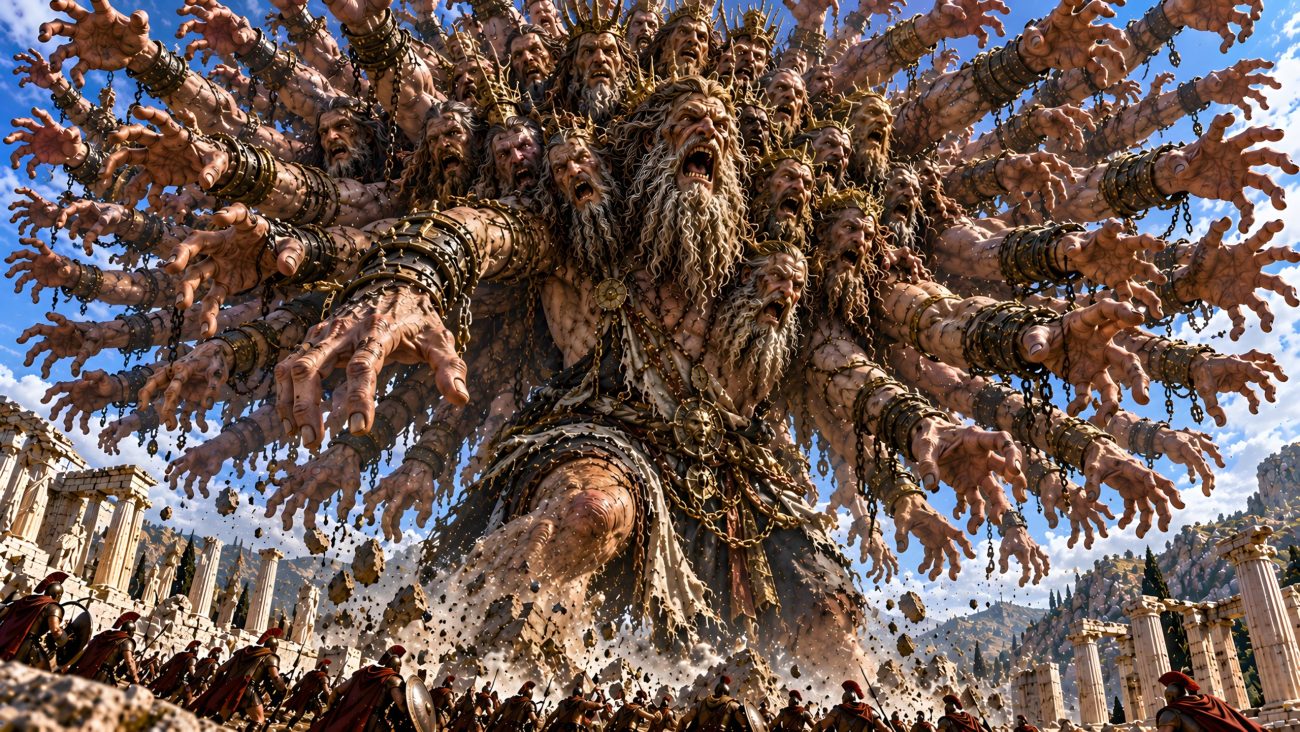
The Hecatoncheires, whose name means “Hundred-Handed Ones” in Ancient Greek, are three monstrous giants of extraordinary size and strength. Each possesses fifty heads and one hundred arms, making them among the most formidable beings in Greek mythology. Their individual names are Cottus, Briareus, and Gyges, also known as Gyes. Briareus is sometimes called Aegaeon, a name particularly associated with his role in traditions concerning the sea. In the standard account, the three are children of Uranus, the Sky, and Gaia, the Earth, and belong to the earliest generations of divine beings.
The Hecatoncheires play an important role in the struggle for control of the cosmos. Their father, Uranus, imprisons them along with their brothers, the Cyclopes, because of their monstrous appearance and power. Gaia eventually persuades her son Cronus to overthrow Uranus. Cronus seizes power but later becomes a tyrant himself, swallowing his children by his sister Rhea to prevent them from overthrowing him. Rhea saves their youngest child, Zeus, who eventually frees his siblings and begins a war against Cronus and the Titans known as the Titanomachy.
According to the best-known tradition, Gaia foretells that Zeus and the Olympian gods will prevail with the assistance of the Hecatoncheires. Zeus therefore releases the three giants from their imprisonment, and they join the Olympians in battle. Their extraordinary strength proves decisive in the conflict, helping secure the defeat of the Titans. After the war, the defeated Titans are imprisoned in Tartarus, the deep abyss beneath the underworld, and the Hecatoncheires become their guards. Their transformation from imprisoned beings into guardians of the defeated Titans marks their central place in the establishment of Zeus’s rule.
Briareus, the most prominent of the three, appears in several additional myths. In Hesiod’s Theogony, he is distinguished as a good and powerful ally of the gods, and Poseidon rewards him by giving him his daughter Cymopolea as his wife. In Homer’s Iliad, Briareus is also called Aegaeon. When Hera, Poseidon, and Athena conspire to bind Zeus during a revolt on Olympus, the sea goddess Thetis summons Briareus to the divine assembly. His formidable presence frightens the rebellious gods, preventing them from carrying out their plan and allowing Zeus to retain his authority.
Not every ancient account portrays Briareus as an ally of the Olympians. In a different tradition, preserved in references to the lost epic Titanomachy, Aegaeon is the son of Gaia and Pontus, the Sea, rather than Uranus and Gaia. He fights on the side of the Titans and is defeated by Poseidon. The poet Virgil likewise depicts Aegaeon as an enemy of the gods, describing him as wielding fifty shields and fifty swords. Ovid also associates Briareus with the defeated Titans. In one episode, Briareus attempts to restore their power by sacrificing a bull whose entrails are prophesied to grant victory over the gods. Before he can burn them, however, birds seize the entrails and are rewarded with a place among the stars.
An alternative, rationalized account by the mythographer Palaephatus presents Cottus and Briareus not as literal hundred-handed giants but as men known by a name associated with a city called Hecatoncheiria, meaning “Hundredarm.” In this version, they help the mortal inhabitants of Olympia drive away their enemies, the Titans. This interpretation differs from the supernatural accounts but preserves the central theme of powerful allies intervening in a struggle for supremacy.
The Hecatoncheires embody overwhelming physical power and the dangerous, unpredictable forces of the primordial world. Their role in the Titanomachy makes them essential to the victory of the Olympian gods, while their later service as guardians of Tartarus establishes them as defenders of the new cosmic order. The differing traditions surrounding Briareus and Aegaeon also reveal that these giants were not always assigned a single allegiance: depending on the account, they could be allies of Zeus or formidable opponents of the Olympian gods.
Sources
“Hecatoncheires.” Wikipedia: The Free Encyclopedia. Wikimedia Foundation. Accessed October 17, 2026. https://en.wikipedia.org/wiki/Hecatoncheires