Yeitso

Tradition: Navajo Mythology, American Mythology
Alternative Names: Yéʼiitsoh, Big Monster
Category: Giant


The Myth

Yeitso, whose name means “Big Monster,” was the largest, most powerful, and most feared of the Anaye, the hostile beings known as the “Alien Gods” in Navajo mythology. He was a terrifying giant whose immense size and supernatural abilities made him a formidable enemy of the Navajo people. According to different traditions, Yeitso was either the eldest son of the Sun God, Tsohanoai, or the offspring of a Navajo woman who, frustrated by unnatural practices, conceived a child with a stone. He lived near Tsoodzil, identified with Mount Taylor in New Mexico, and was regarded as the leader of the Anaye.

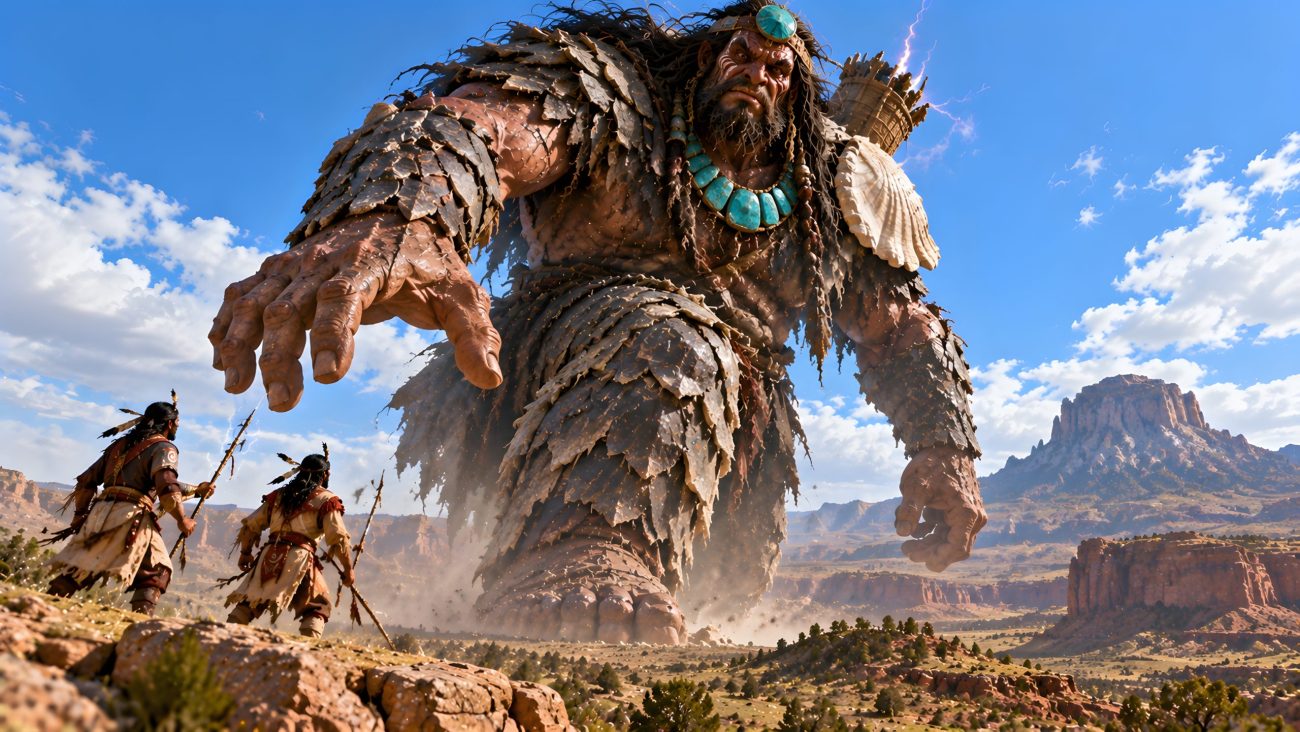
Yeitso’s enormous size was his most distinctive characteristic. His stride extended as far as an ordinary man could walk between sunrise and noon. His body was protected by overlapping scales of flint as sharp and hard as stone knives. He wore a perfect agate disc on his head, a perfect turquoise around his neck, and a perfect white shell over his shoulder. His face was marked with intimidating stripes, and he carried a basket that served as a quiver for his lightning bolts. Coyote acted as his messenger, connecting the monstrous giant with the wider world of supernatural beings.

When the hero twins Nayenezgani and To’badzistsini were still infants, Yeitso came close to discovering and devouring them. Their mothers, Yolkai’Estsan and Estsanatlehi, saved them through quick thinking. Yolkai’Estsan concealed the boys beneath piles of sticks while Estsanatlehi confronted the giant. When Yeitso noticed footprints and demanded to know whose they were, she courageously claimed they were her own. She explained that loneliness had driven her to make footprints so that she could pretend she had company. To convince him, she demonstrated how she had made the tiny prints with her hand. Fooled by her explanation, Yeitso left without discovering the children.

When the twins reached adulthood, they consulted their father, Tsohanoai, and set out to confront Yeitso at Tsoodzil. They heard the giant’s tremendous footsteps before seeing his head rise above an eastern hill. As he approached, his head and chest appeared above a southern hill, followed by his body above the waist over a western hill, before he finally came into view near Tsoodzil. Yeitso then descended to a lake and drank from it four times, visibly lowering the water level until the lake was almost dry. Only then did he notice the reflections of the two heroes in the water.

Delighted by the prospect of finding new prey, Yeitso called out to the twins and challenged them. The giant and the heroes exchanged taunts four times before Yeitso hurled four lightning bolts at them. Riding upon a rainbow, the twins evaded the attacks with ease. Their father, Tsohanoai, then struck Yeitso with lightning, and the twins followed with four bolts of chain lightning. The combined assault shattered the giant’s protective flint scales. Yeitso collapsed and attempted to rise, but fell forward onto his face and lay motionless.

After defeating the giant, the twins scalped him and threw his head toward the east, where it became Cabezon Peak in present-day New Mexico. Yeitso’s blood remained dangerous because, if it reached the other Anaye, it could revive him. Nayenezgani therefore used his knife to dig trenches that redirected the flowing blood and prevented it from reaching the other monsters. The resulting trenches were said to account for the ridges and cliffs of volcanic rock around Cabezon Peak. Yeitso’s shattered flint scales, meanwhile, became a valuable resource for the Navajo, who used the stone to make armor, knives, and arrowheads.

Yeitso’s death marked the defeat of one of the most formidable enemies faced by the Navajo hero twins. His enormous stature, flint armor, and mastery of lightning made him nearly invincible, but the combined power of the twins and their father brought him down. His story explains the mythological origins of a striking landscape feature and connects the defeat of a monstrous adversary with the acquisition of materials used for protection and warfare.


Sources

“Yeitso.” A Book of Creatures, February 10, 2017. https://abookofcreatures.com/2017/02/10/yeitso/
Wendigo

Tradition: Algonquian Mythology, American Mythology
Alternative Names: Windigo, Wiindigoo, Wīhtikōw, Whitego
Category: Giant


The Myth

The Wendigo is a malevolent supernatural being in the traditional beliefs of several Algonquian-speaking peoples, including the Ojibwe, Saulteaux, Cree, Naskapi, and Innu. Closely associated with winter, cold, famine, and starvation, it embodies the terrifying consequences of insatiable hunger and destructive greed. Depending on the tradition, the Wendigo appears as an evil spirit capable of possessing human beings or as a monstrous, cannibalistic creature with human-like characteristics.

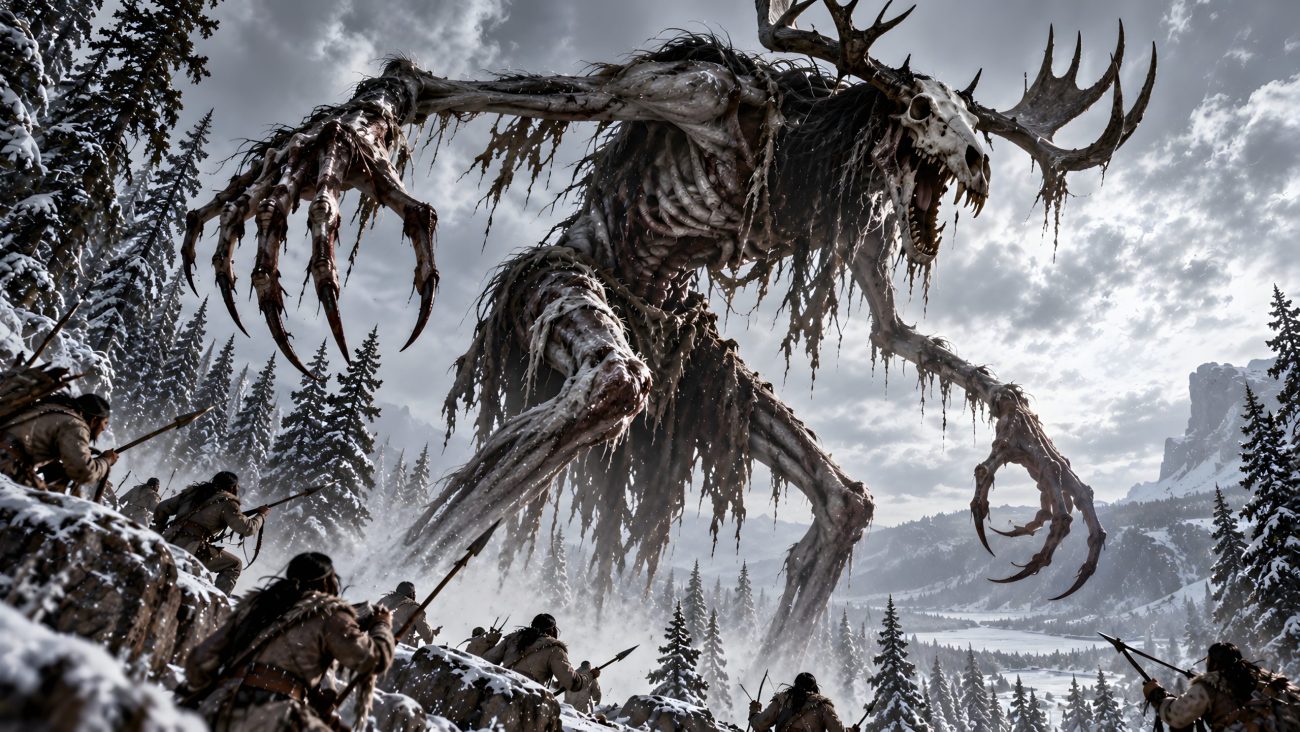
Descriptions of the Wendigo vary between communities. In some traditions, particularly among the Ojibwe, Eastern Cree, Westmain Swampy Cree, Naskapi, and Innu, it is depicted as a giant far larger than an ordinary human. One description portrays it as a horrifyingly emaciated figure, with desiccated skin stretched tightly over its bones, sunken eyes, an ashen complexion, and torn, bloody lips. Its decaying flesh gives off a foul stench associated with death and corruption. Other depictions emphasize its icy heart, while its approach may be heralded by an unnatural chill or a terrible odor.

The Wendigo’s defining characteristic is its endless hunger. According to some traditions, whenever it consumes a human being, it grows larger in proportion to the meal it has eaten. Despite its increasing size, it remains perpetually starved and can never be satisfied. This contradiction between enormous appetite and skeletal thinness makes the Wendigo an embodiment of gluttony, greed, and excess. It continually seeks new victims, killing and devouring people without ever reaching a state of fulfillment. Although monstrous, it does not necessarily lose its human ability to speak or reason. Some stories describe Wendigos communicating with their intended victims, threatening them, or attempting to deceive them.

One traditional story tells of a Wendigo that steals a boy but delays eating him because the child is too thin. The monster carries a knife and repeatedly cuts the boy’s hand to determine whether he has grown fat enough to eat. When they approach a human settlement, the Wendigo sends the boy to obtain food and orders him to return quickly. Instead, the boy warns the villagers of the monster’s presence and shows them his injured hand. The Wendigo calls after him, demanding that he stop telling lies, but the villagers recognize the danger and attack the creature. They cut off its legs, only to discover that it remains alive and consumes the marrow from its severed bones. When questioned about the fatness of its victims, the monster boasts that it has eaten many people. The villagers ultimately kill it and cut its body into pieces.

Wendigo traditions also describe how human beings can become associated with the monster. In some accounts, a person who resorts to cannibalism to survive may transform into a Wendigo. Other traditions connect transformation with overwhelming greed or prolonged contact with the creature. These beliefs reinforce the importance of moderation, cooperation, and respect for the community, especially during periods of famine when desperation might threaten established social obligations. Among the Assiniboine, Cree, and Ojibwe, a satirical ceremonial dance known as wiindigookaanzhimowin was sometimes performed during famine to emphasize the seriousness of the Wendigo taboo. Participants wore masks and danced backward around a drum.

The Wendigo remains one of the most recognizable figures in Algonquian folklore, representing the horrifying transformation of hunger into an uncontrollable desire to consume others. Its traditional meaning is closely tied to the dangers of starvation, selfishness, and the abandonment of communal responsibilities. Although modern literature and horror fiction have developed many additional versions of the creature, its traditional forms reflect a deeper fear: that the pursuit of survival or personal satisfaction can become a destructive hunger that no amount of consumption can ever appease.


Sources

“Wendigo.” Wikipedia: The Free Encyclopedia. Wikimedia Foundation. Accessed October 17, 2026. https://en.wikipedia.org/wiki/Wendigo


Alfred Bulltop Stormalong

Tradition: American Mythology
Alternative Names: Captain Stormalong, Old Stormy, Mister Stormalong, Stormalong John, Yankee John Stormalong
Category: Giant


The Myth

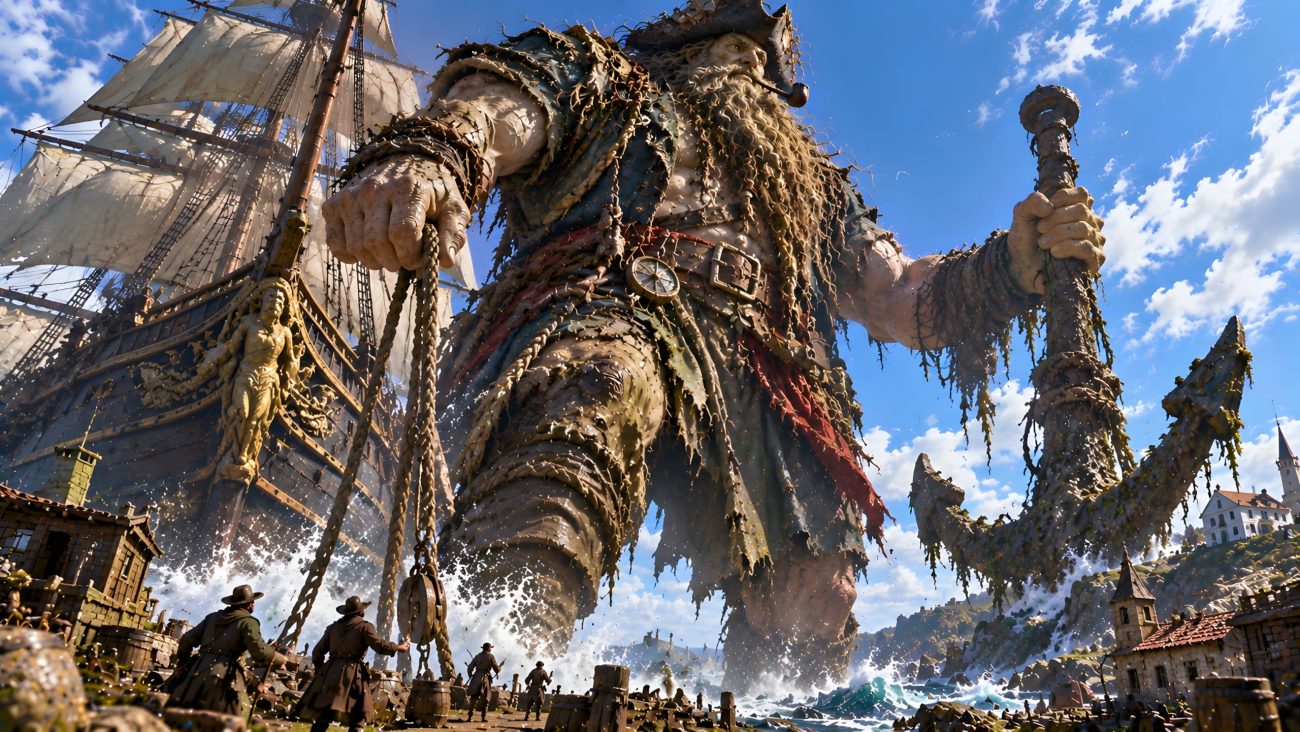
Alfred Bulltop Stormalong is a legendary American sailor and giant who features in the nautical tall tales of New England, particularly Massachusetts. Said to stand approximately thirty feet tall, he was a mighty seaman whose extraordinary size and strength inspired countless stories among sailors. He commanded an enormous clipper ship, known in different accounts as either the Courser or the Tuscarora. The vessel was so immense that its masts had to be hinged to prevent them from catching on the Moon. In some versions, the ship was so long that the crew needed a stable of Arabian horses to travel from one end to the other.

Stormalong’s legend grew from maritime work songs and sea shanties. Songs featuring names such as “Mister Stormalong,” “Way Stormalong John,” and “Yankee John, Stormalong” circulated among sailors, with early versions praising a deceased seaman and his benevolent son. These songs are traced to African-American folk music of the 1830s and 1840s. The elaborate tall tales about Stormalong appeared in print later, beginning in the early twentieth century, and transformed him into one of America’s best-known larger-than-life maritime heroes.

According to legend, Stormalong was already eighteen feet tall when he was washed ashore as a baby in New England. He eventually outgrew Cape Cod and moved to Boston, where he signed aboard a ship at the age of twelve. One story claims that he introduced the maritime expression “able-bodied” by writing “Stormalong, A.B.” on his first employment contract. His life at sea was filled with extraordinary exploits. His gigantic ship allegedly helped carve the route of the Panama Canal when it crashed into the Panamanian coast. On another voyage, it became stuck in the English Channel, and the crew had to grease its hull with soap. The combination of soap and the ship scraping against the cliffs of Dover supposedly made the cliffs brilliantly white.

One of Stormalong’s greatest adversaries was the Kraken, an enormous sea monster from Norse mythology. Their rivalry lasted throughout his life. During their first encounter, the Kraken escaped, leaving Stormalong so disappointed that he temporarily abandoned the sea and became a farmer in the American Midwest. Eventually, he returned to maritime adventures and faced the monster again. This time, he managed to lure the Kraken into a whirlpool from which it could never escape, securing his victory over the terrifying creature.

The stories disagree about Stormalong’s eventual fate. In one version, an incident involving a steamship led to a challenge from its captain, who demanded a transatlantic race. Stormalong had accidentally poured water down the ship’s funnel while attempting to extinguish what he believed was a dangerous fire. Despite his advanced age, he won the race by several miles, but the strain of steering his enormous vessel across the Atlantic proved fatal. He was buried at sea, and Davy Jones himself opened his legendary locker to receive the giant sailor’s body.

Another version recounts how Stormalong encountered a tremendous hurricane near Florida. As the storm battered the surrounding ships, he rescued sailors by bringing their vessels aboard his own enormous ship. Once the hurricane subsided, he returned the sailors to shore and began inspecting his sails. A final powerful gust caught the sails, lifting both Stormalong and his ship into the sky. A third account offers a more humorous ending: Stormalong’s legendary appetite finally killed him when he ate an enormous quantity of food, with one version claiming that he consumed six sharks for breakfast and subsequently died of indigestion.

Through his immense size, impossible maritime feats, and extravagant adventures, Stormalong embodies the humor, courage, and imaginative exaggeration of American sailor folklore. His stories transform the dangers of the sea and the hardships of maritime life into fantastic adventures in which even the greatest sea monsters and the largest oceans can be challenged by a sufficiently extraordinary sailor.


Sources

“Alfred Bulltop Stormalong.” Wikipedia: The Free Encyclopedia. Wikimedia Foundation. Accessed October 17, 2026. https://en.wikipedia.org/wiki/Alfred_Bulltop_Stormalong